gold trading psychology

Why Gold Prices Move: Key Factors for Traders in 2025

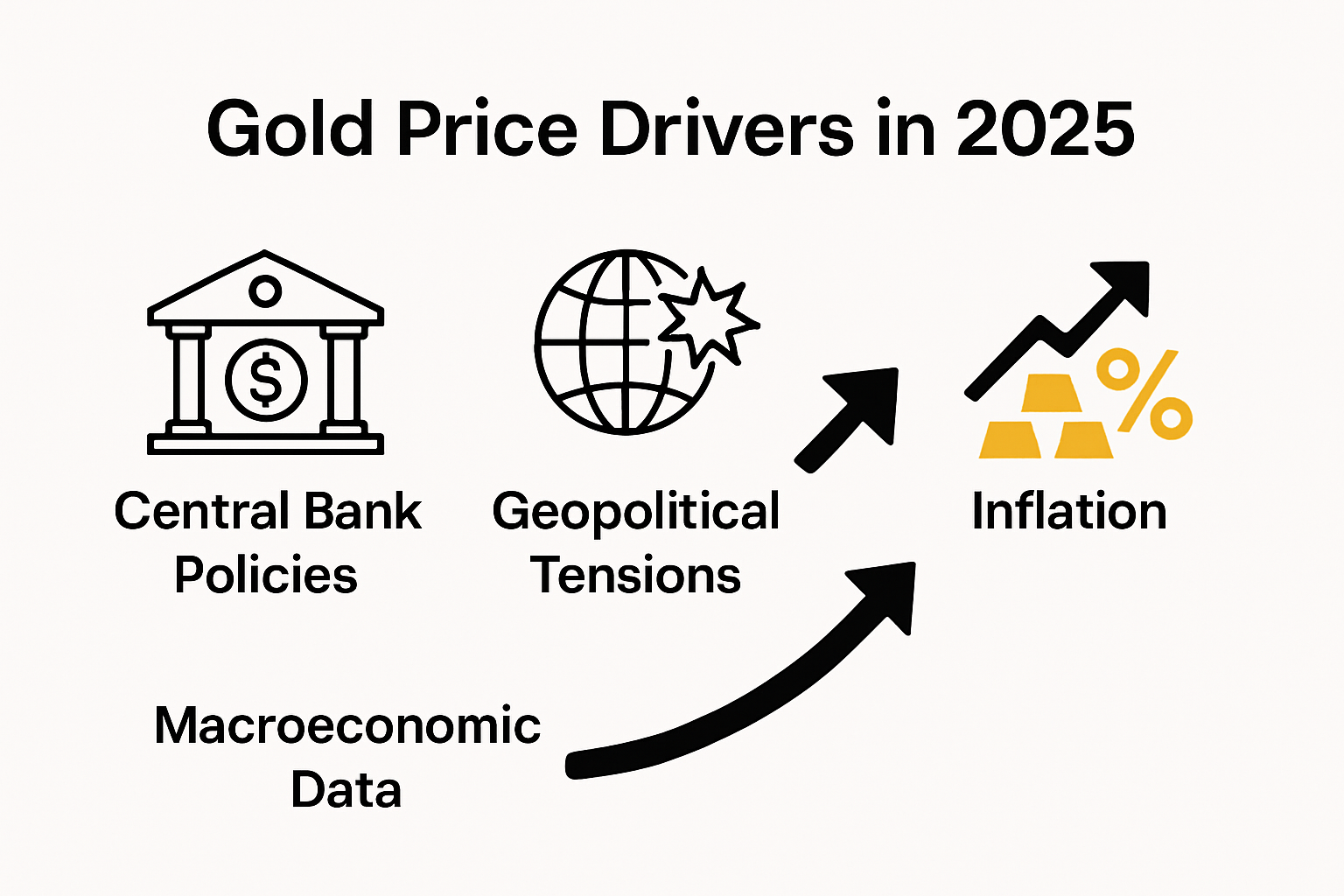
Gold has always held a special place in global finance, and 2025 is shaping up to be an especially volatile year for traders. Surprisingly, while many focus on political shocks or digital disruptions, the biggest moves often come from places nobody expects. India and China together account for over 50 percent of the world’s consumer gold demand, yet few traders outside these regions pay close attention to their festival calendars or wedding seasons. Missing the real triggers can make the difference between profit and loss in the months ahead.

Table of Contents

Quick Summary

Takeaway Explanation
Understand global demand trends Recognize key markets like India and China, where cultural events shape gold demand significantly.
Monitor geopolitical events closely Geopolitical tensions often lead to increased gold prices as investors seek safe-haven assets during uncertainty.
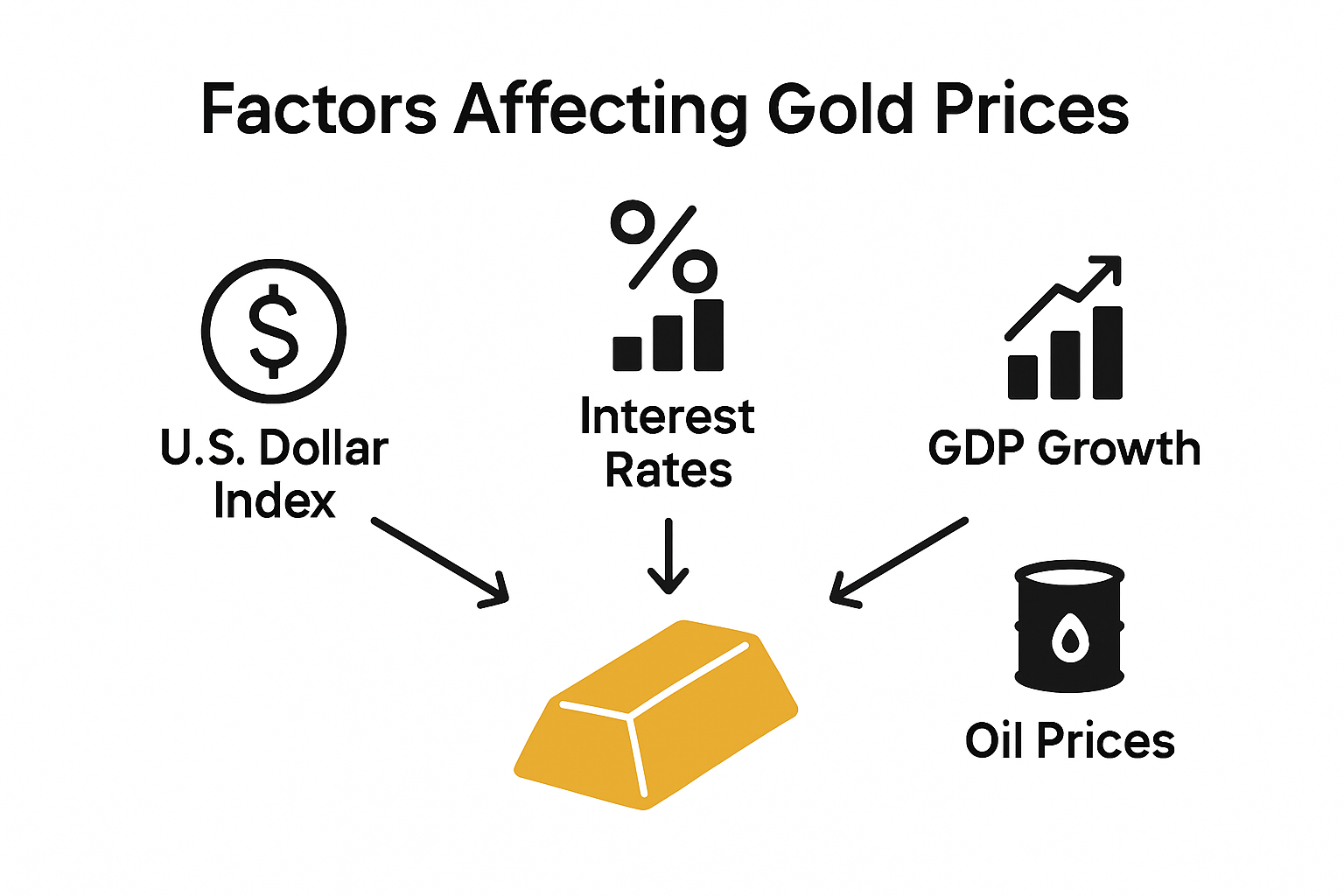
Watch dollar strength as an indicator The inverse relationship between the U.S. dollar and gold prices means that a stronger dollar can lead to lower gold prices.
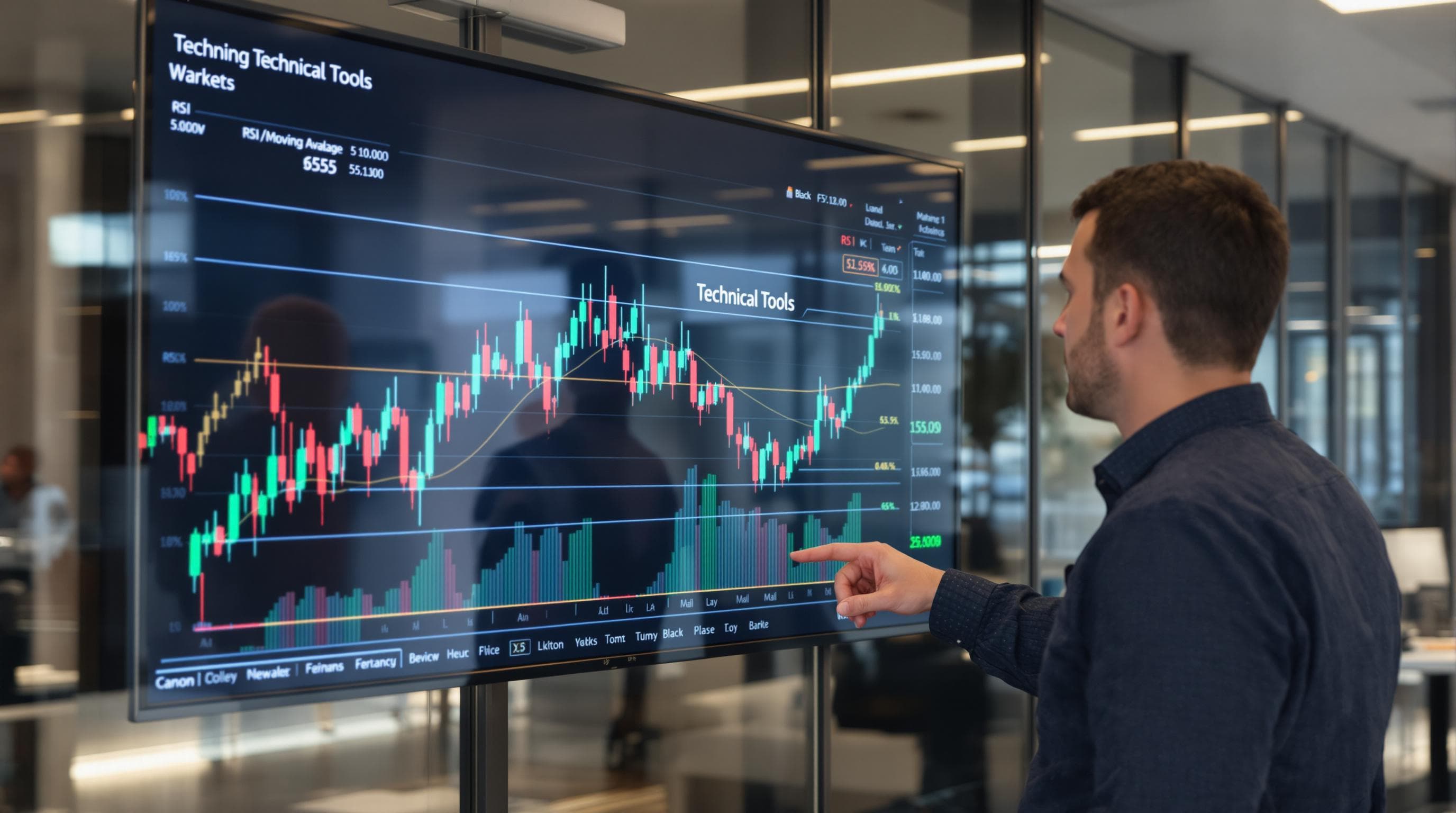
Use technical analysis tools effectively Employ indicators like RSI and Moving Averages to help predict potential price movements and trends in gold trading.
Implement strong risk management practices Establish clear stop-loss levels and maintain disciplined trading strategies to mitigate potential losses in volatile markets.

Understanding Supply and Demand in Gold

Gold markets are complex ecosystems driven by intricate interactions between supply and demand dynamics. Traders who grasp these fundamental principles gain a significant advantage in predicting price movements and making strategic investment decisions.

Global Demand Patterns

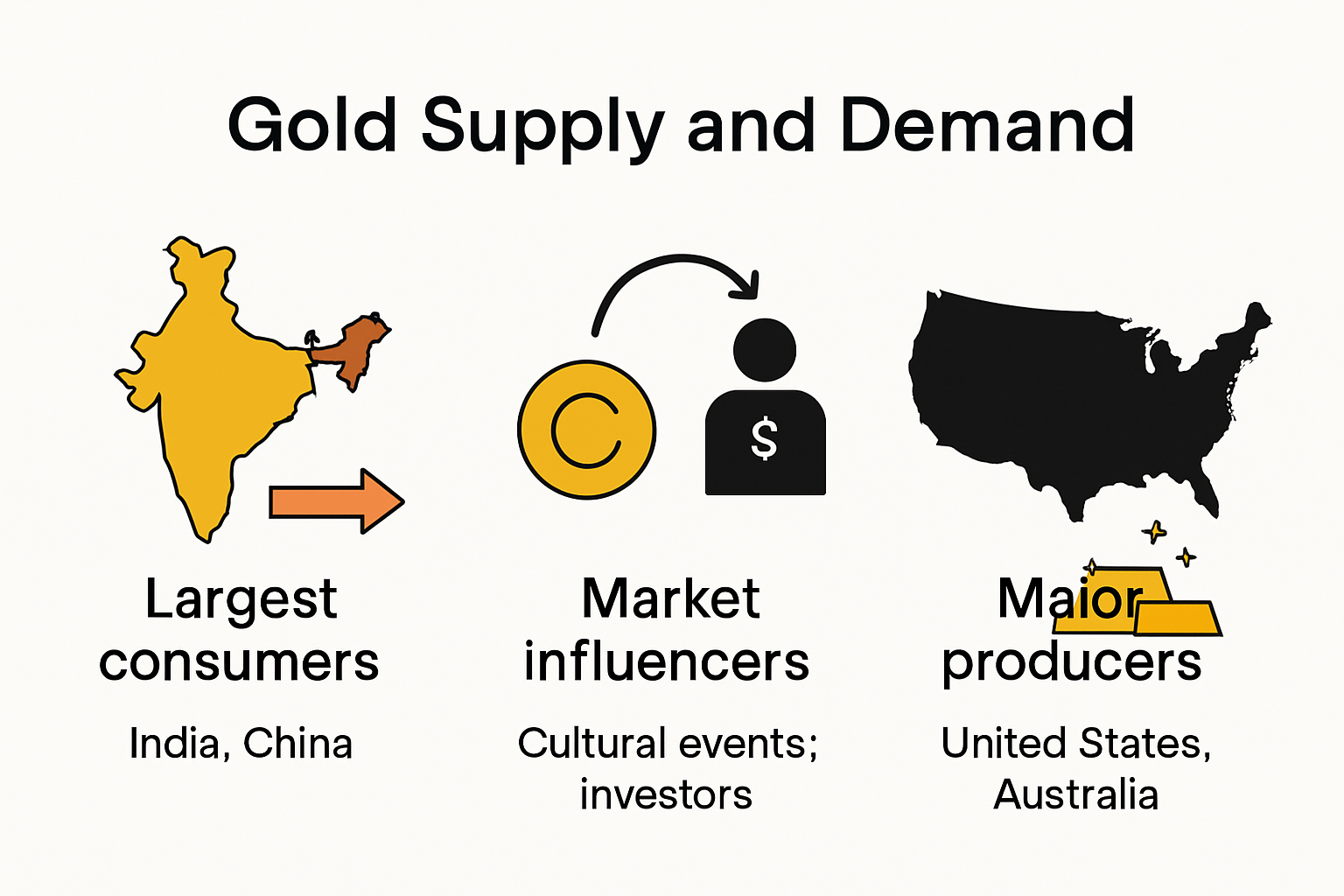
Consumer demand for gold varies dramatically across different regions and economic contexts. Research from the World Gold Council reveals that countries like India and China represent massive markets for gold consumption. In India, gold is not just an investment but a cultural cornerstone, with demand heavily influenced by wedding seasons and festival periods. These cultural nuances create predictable seasonal fluctuations in gold prices.

Economic conditions play a critical role in shaping gold demand. During periods of economic uncertainty, investors typically view gold as a safe-haven asset. According to economic research, rising disposable incomes in emerging markets can lead to significant increases in gold demand, particularly in luxury sectors like jewelry.

Supply Side Considerations

Gold supply is constrained by complex mining and production processes. Global gold production remains relatively stable, with major mining regions including South Africa, Russia, China, and Australia. The cost of extraction, geopolitical stability in mining regions, and technological advancements all impact the total global gold supply.

Mineral exploration, extraction costs, and environmental regulations directly influence gold production volumes. When mining becomes more expensive or challenging, the restricted supply can drive prices upward. Conversely, technological innovations in mining techniques can potentially increase production efficiency and moderate price increases.

Market Speculation and Investor Behavior

Traders and institutional investors significantly impact gold prices through speculation and strategic positioning. Large-scale investment movements can create rapid price fluctuations. Hedge funds, central banks, and institutional investors often use gold as a hedge against currency volatility and inflation.

Interestingly, gold demand is not solely driven by physical consumption. Financial instruments like ETFs, futures contracts, and gold-backed securities create additional layers of market complexity. Our guide on market strategies provides deeper insights into these sophisticated trading mechanisms.

Understanding these interconnected supply and demand factors requires continuous market analysis. Successful gold traders constantly monitor global economic indicators, cultural trends, and geopolitical events that might influence gold prices. By developing a nuanced comprehension of these dynamics, traders can make more informed decisions and potentially capitalize on market opportunities.

Below is a summary table of major gold-consuming and gold-producing countries referenced, highlighting their key roles:

Country Role in Gold Market Notes
India Major consumer High demand during festivals and weddings
China Major consumer/producer Large market; significant production and consumption
South Africa Major producer Historically large producer; geopolitical/economic impact
Russia Major producer Political stability influences production
Australia Major producer Stable production; technological innovation in mining

Gold supply and demand infographic with charts and global maps

Impact of Global Events on Gold Prices


Gold prices are profoundly influenced by global events, serving as a dynamic barometer of international economic and geopolitical tensions. Traders who understand these complex interactions can anticipate market movements and make more strategic investment decisions.

Geopolitical Tensions and Economic Uncertainty

Research from the Congressional Research Service reveals that international conflicts and macroeconomic disruptions create significant volatility in gold prices. When geopolitical tensions escalate, investors typically view gold as a safe-haven asset, driving up demand and prices. For instance, during periods of military conflicts, trade wars, or significant diplomatic disputes, gold becomes an attractive option for protecting wealth.

Historical data demonstrates gold’s remarkable resilience during global crises. The COVID-19 pandemic and subsequent economic shutdowns highlighted gold’s role as a critical hedge against market uncertainty. Investors rapidly shifted assets to gold, causing substantial price increases during periods of widespread economic instability.

Financial Market Disruptions

Financial market disruptions represent another critical factor influencing gold prices. A comprehensive research study indicates that events like stock market crashes, banking system challenges, and currency devaluations directly impact gold valuation. When traditional investment vehicles become unstable, investors seek alternative assets with inherent value.

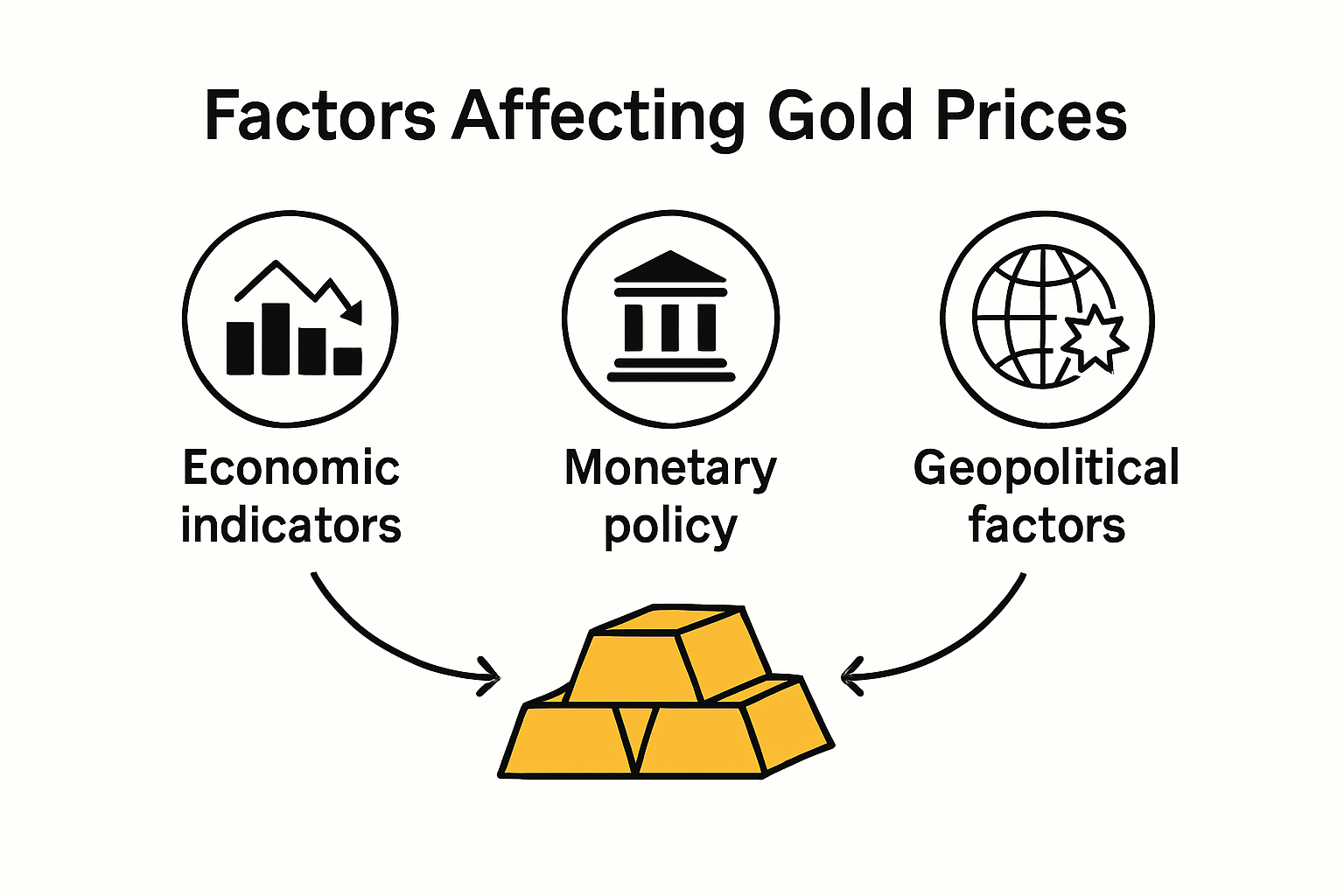
Central bank policies also play a significant role in gold price dynamics. Quantitative easing, interest rate adjustments, and monetary expansion strategies can create ripple effects in gold markets. Traders closely monitor these policy shifts, understanding that changes in monetary strategy can rapidly influence gold’s perceived value and investment attractiveness.

Technological and Systemic Transformations

Emerging global trends like digital transformation, renewable energy transitions, and technological disruptions create complex scenarios affecting gold prices. Technological advancements in mining, financial trading platforms, and investment instruments continuously reshape market dynamics.

Our comprehensive gold price forecast provides deeper insights into these evolving market conditions. Understanding these interconnected global events requires continuous learning and adaptive strategies.

Successful gold traders recognize that global events are not isolated incidents but interconnected phenomena with multifaceted implications. By maintaining a holistic perspective and staying informed about international developments, traders can better navigate the complex landscape of gold trading and potentially capitalize on emerging market opportunities.

Dollar Strength, Inflation, and Gold Movements

The intricate relationship between the U.S. dollar, inflation, and gold prices represents a critical area of analysis for traders seeking to understand market dynamics. These interconnected economic factors create a complex landscape that significantly influences gold trading strategies.

The Dollar-Gold Price Relationship

Investopedia research reveals a fundamental inverse relationship between the U.S. dollar and gold prices. When the dollar strengthens, gold prices typically decrease, as the metal becomes more expensive for international investors using other currencies. Conversely, a weakening dollar often drives gold prices upward, making the precious metal a more attractive investment option.

This dynamic stems from gold’s status as a global reserve asset. Traders closely monitor currency exchange rates and dollar performance, understanding that even slight fluctuations can create significant trading opportunities. The dollar’s purchasing power directly impacts gold’s international market value, making currency strength a crucial indicator for gold traders.

Inflation and Gold as a Hedge

Money.com analysis highlights gold’s historical role as a robust inflation hedge. During periods of high inflation, gold typically maintains or increases its value, protecting investors from currency devaluation. PIMCO’s financial research demonstrates that real yields play a critical role in gold pricing, with an inverse relationship between inflation-adjusted returns and gold prices.

Investors often turn to gold during economic uncertainty, viewing it as a safe-store of value. When traditional financial instruments lose value due to inflationary pressures, gold becomes an increasingly attractive investment. Central bank policies, monetary expansion, and global economic conditions all contribute to this complex pricing mechanism.

Strategic Implications for Traders

Successful gold trading requires a nuanced understanding of these economic interplays. Traders must continuously monitor multiple economic indicators, including dollar strength, inflation rates, and global economic trends. Our gold price forecast provides deeper insights into navigating these complex market dynamics.

The relationship between the dollar, inflation, and gold is not static. Global economic shifts, geopolitical events, and monetary policies can rapidly transform market conditions. Traders who develop a comprehensive understanding of these interconnected factors position themselves to make more informed investment decisions.

Ultimately, gold remains a unique asset class that reflects broader economic trends. By carefully analyzing dollar strength, inflation rates, and global economic indicators, traders can develop more sophisticated strategies for navigating the gold market’s inherent complexity.

Below is a comparison table summarizing key gold price influences and their typical effects on gold markets as discussed above:

Factor Typical Effect on Gold Price Example Scenario
Stronger U.S. Dollar Gold price decreases Dollar index rises sharply
Weaker U.S. Dollar Gold price increases Dollar index drops due to monetary easing
Rising Inflation Gold price increases or is stable Inflation outpaces interest rate hikes
Geopolitical Tensions Gold price increases Military conflict, trade war, major dispute
Market or Banking System Disruption Gold price increases Stock market crash, bank failures
Higher Gold Production Gold price may stabilize or decrease Adoption of new mining technologies

How Traders Use Gold Price Signals

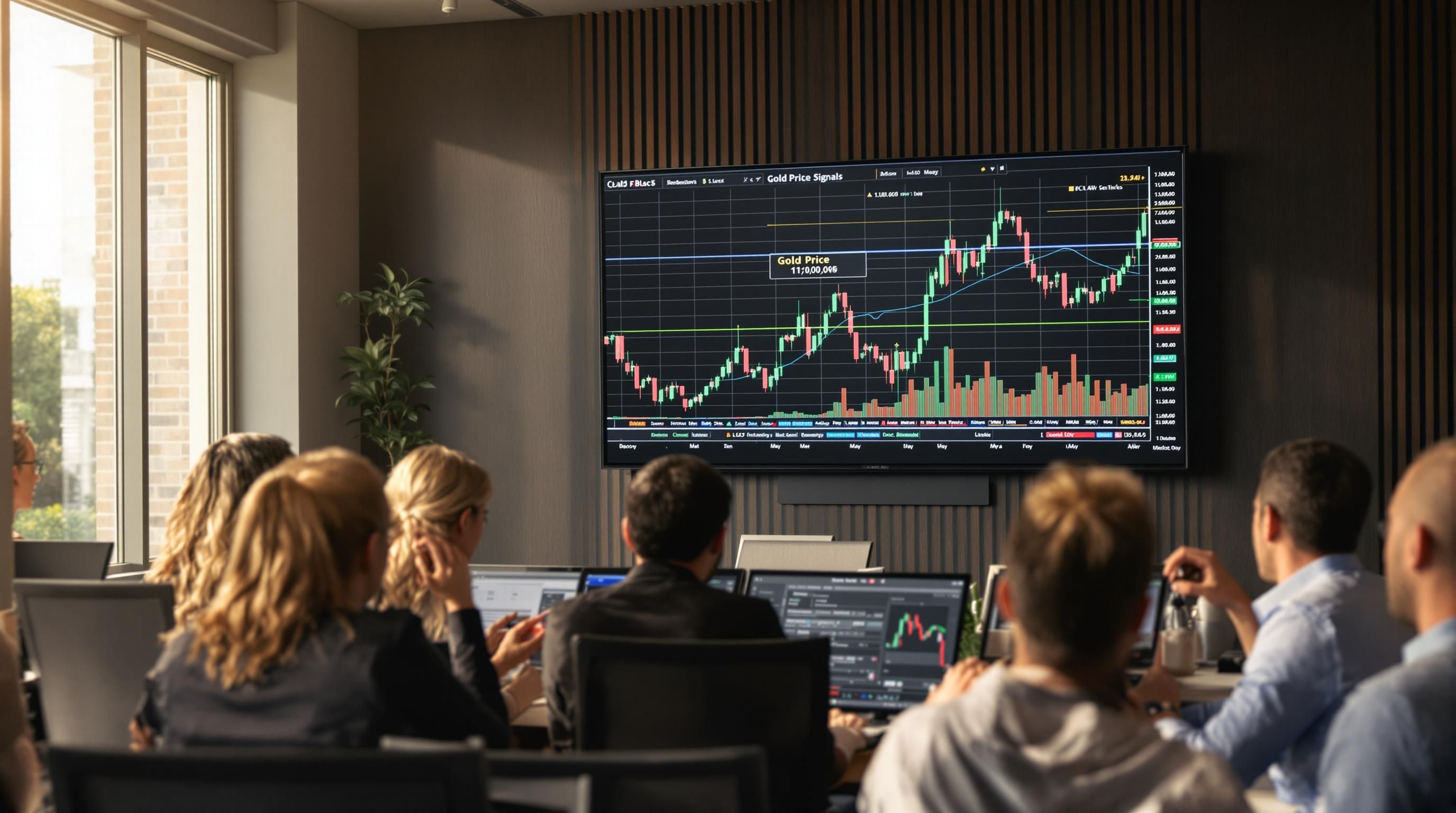
Trading gold requires sophisticated analytical approaches that blend technical indicators, market sentiment, and strategic interpretation of price signals. Professional traders develop nuanced strategies to navigate the complex gold market with precision and insight.

Technical Analysis and Momentum Indicators

Professional trading research reveals that successful gold traders utilize a comprehensive suite of technical analysis tools. The Relative Strength Index (RSI) emerges as a critical momentum indicator, helping traders assess whether gold is overbought or oversold. Trading experts from market analysis platforms explain that the RSI measures the speed and change of price movements, providing crucial insights into potential trend reversals.

Traders typically employ multiple indicators simultaneously, including Moving Averages, Bollinger Bands, and MACD (Moving Average Convergence Divergence). These tools help identify trend strength, potential breakout points, and market momentum. By combining these indicators, traders can develop more robust trading strategies that account for multiple market signals.

Signal Interpretation and Strategic Decision Making

Interpreting gold price signals goes beyond simple technical analysis. Successful traders integrate fundamental economic analysis, geopolitical insights, and market sentiment into their decision-making process. Our comprehensive guide to trading signals provides deeper insights into sophisticated signal interpretation techniques.

Traders look for confluence of signals across different timeframes. A signal that appears consistent on weekly, daily, and hourly charts typically carries more weight. They also consider volume, market volatility, and broader economic indicators to validate their trading decisions. This multi-layered approach helps mitigate risks and improve the probability of successful trades.

Risk Management and Signal Reliability

Professional gold traders understand that no signal is infallible. Effective risk management becomes crucial in translating price signals into profitable trades. This involves setting precise stop-loss levels, managing position sizes, and maintaining a disciplined approach to trade execution.

Traders often use probabilistic thinking, recognizing that each signal represents a potential opportunity rather than a guaranteed outcome. They develop sophisticated frameworks that account for signal reliability, historical performance, and current market conditions. Continuous learning and adaptation are key to maintaining a competitive edge in gold trading.

The gold market demands a dynamic approach. Traders must remain flexible, continuously refining their analytical methods and staying informed about global economic developments. By developing a comprehensive understanding of price signals and maintaining a disciplined trading approach, investors can navigate the complexities of gold trading with greater confidence and strategic insight.
gold price signals

Frequently Asked Questions

What are the main factors that influence gold prices in 2025?

Gold prices are influenced by several key factors including global demand patterns, geopolitical tensions, market speculation, dollar strength, and inflation.

How do cultural events in countries like India and China affect gold prices?

India and China account for over 50% of the world’s consumer gold demand, with cultural events such as weddings and festivals leading to predictable fluctuations in demand and prices.

Why is the relationship between the U.S. dollar and gold prices significant for traders?

There’s an inverse relationship between the U.S. dollar and gold prices; a stronger dollar typically leads to lower gold prices, while a weaker dollar can increase gold’s attractiveness and price.

How can traders use technical analysis to predict gold price movements?

Traders utilize technical analysis tools such as the Relative Strength Index (RSI) and Moving Averages to identify potential price trends, reversals, and market momentum to inform their trading strategies.

Tired of Missing Critical Gold Price Moves? Trade Smarter in 2025

Every gold trader knows how quickly the market reacts to shifts in demand, dollar strength, and unexpected global events. You have just read how factors like cultural trends in India and China, geopolitical tensions, and technical signals can turn the tide in moments. But recognizing these signals is only the first step. The real challenge is converting your knowledge into consistent profits before the next big move occurs.
https://xau-gold-signals.com

Take your gold trading to the next level with our high-accuracy XAU/USD signals, proven to spot these crucial market shifts as they happen. Start by exploring our News & Updates for real-time market insights, or learn actionable techniques from our How To Guides. Join us at xau-gold-signals.com today for daily gold trading alerts that help you maximize gains and protect against sudden losses. Don’t wait until the next price surge leaves you behind.

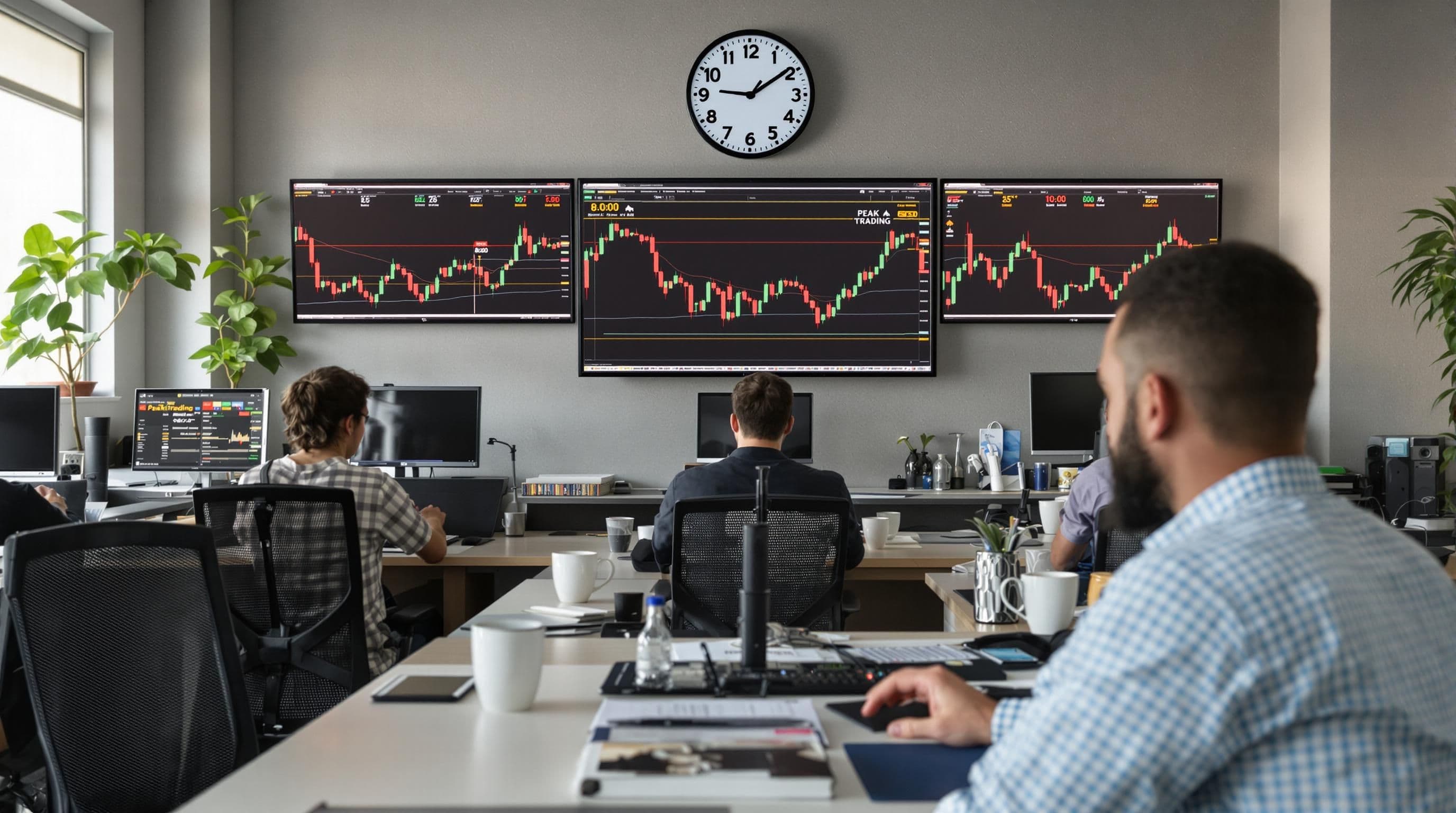
Trading office with analysts monitoring gold price signals on screens

Weekend Gold Market Analysis: Top Trading Signals 2025

Gold trading is grabbing headlines in 2025 and traders everywhere are watching its every move. Surprising as it sounds the so-called weekend effect actually gives gold lower returns on Mondays compared to other days which flips a lot of assumptions upside down. While most expect volatility to taper off after weekly trading wraps up the real story is how weekend signals and smart risk moves are fueling wild new opportunities for those who know where to look.

Table of Contents

Quick Summary

Takeaway Explanation
Understand economic factors impacting gold prices Monitor global economic shifts and central bank policies for insights into gold’s valuation.
Utilize advanced technical indicators Employ tools like Bollinger Bands and RSI to improve trading accuracy and predict market movements.
Be aware of weekend trading risks Recognize the ‘weekend effect’ where lower returns may complicate trading strategies on Mondays.
Implement robust risk management strategies Establish strict stop-loss measures and maintain conservative position sizing to minimize potential losses.
Engage in sentiment analysis Analyze news and social media trends to gain deeper insights into market psychology and trader behavior.

Gold markets continue to demonstrate remarkable complexity in 2025, driven by a sophisticated interplay of global economic factors. Investors and traders must understand the nuanced dynamics shaping gold’s price trajectory.

Global Economic Pressures and Gold Valuation

The gold market remains highly sensitive to macroeconomic shifts. According to research from the U.S. Geological Survey, central bank policies and international economic uncertainties significantly impact gold pricing. Recent analysis reveals that geopolitical tensions, inflation expectations, and monetary policy decisions create substantial volatility in gold markets.

Central banks worldwide have been strategically adjusting their gold reserves, reflecting growing economic uncertainties. These institutional moves send powerful signals to global investors about potential market directions. The trend indicates a preference for gold as a hedge against potential economic instability, reinforcing its status as a crucial safe haven asset.

Technical Analysis and Price Movement Indicators

Traders tracking gold markets must pay close attention to multiple technical indicators. Academic research from recent precious metals market studies suggests that price movements are increasingly influenced by complex algorithmic trading strategies and real-time global economic data.

Key technical factors driving gold price trends include moving averages, relative strength index (RSI), and support-resistance levels. Traders utilizing these analytical tools can gain insights into potential short-term and long-term price trajectories. The interaction between these technical indicators provides a comprehensive view of market sentiment and potential trading opportunities.

Emerging Market Dynamics and Gold Demand

Emergent economic patterns are reshaping gold market fundamentals. Traditional safe-haven demand continues to evolve, with institutional and retail investors reassessing gold’s role in diversified investment portfolios. Technological advancements and changing global economic structures are creating new dimensions of gold market analysis.

Investors should recognize that gold’s value extends beyond mere commodity trading. It represents a complex financial instrument reflecting broader economic narratives. Understanding these intricate relationships requires continuous monitoring of global economic indicators, monetary policies, and geopolitical developments.

For traders seeking deeper insights into gold market trends, our comprehensive trading signals guide offers advanced strategies and real-time analysis to help navigate these complex market conditions.

Infographic showing global factors impacting gold prices in 2025

Key Weekend Trading Signals for Gold

Weekend gold trading requires strategic analysis and precise signal interpretation. Traders must develop a robust approach to navigate the complex dynamics of gold markets during off-peak trading periods.

Advanced Technical Signal Strategies

Professional traders recognize that weekend trading signals demand sophisticated analytical techniques. Machine learning research from advanced financial modeling studies demonstrates that linear regression and technical indicators can provide critical insights into potential gold price movements.

Key technical signals include:

  • Bollinger Bands tracking price volatility
  • Darvas Box method for identifying potential breakout points
  • Moving average convergence for trend confirmation

These advanced techniques help traders anticipate potential price shifts before market reopening. By carefully analyzing historical data and current market conditions, traders can develop more nuanced weekend trading strategies.

Market Sentiment and Weekend Price Dynamics

Research on gold market behaviors reveals a fascinating phenomenon known as the ‘weekend effect’. Academic studies indicate that gold returns on Mondays tend to be lower compared to other trading days, presenting unique challenges and opportunities for strategic traders.

Traders must consider multiple factors during weekend analysis:

  • Geopolitical developments that might impact global markets
  • Potential economic announcements scheduled for the upcoming week
  • Global market sentiment across different financial regions

Understanding these complex interactions allows traders to develop more sophisticated weekend trading approaches that account for potential market volatility.

Trader analyzes gold signals at home with weekend news and notifications

Risk Management and Signal Interpretation

Successful weekend gold trading requires a disciplined approach to risk management. Research analyzing gold returns during different market conditions highlights that market sentiment can significantly influence weekend trading outcomes.

Essential risk management strategies include:

  • Implementing strict stop-loss parameters
  • Diversifying trading positions
  • Maintaining conservative position sizing

Traders looking to enhance their weekend gold trading skills can explore our comprehensive trading signals resource for advanced strategies and real-time market insights. By combining technical analysis, market sentiment evaluation, and robust risk management, traders can develop a more sophisticated approach to weekend gold trading.

To help clarify the main technical signals and risk management approaches discussed for weekend trading, the following table summarizes each strategy and its core focus.

Strategy Key Purpose
Bollinger Bands Monitor price volatility and identify overbought/oversold market zones
Darvas Box Method Detect potential breakout points for new trend opportunities
Moving Average Convergence Confirm existing market trends and signal possible reversals
Strict Stop-Loss Parameters Limit losses by marking predetermined exit points
Diversified Trading Positions Spread risk across multiple trades to reduce exposure
Conservative Position Sizing Maintain smaller trade sizes to manage and mitigate weekend volatility

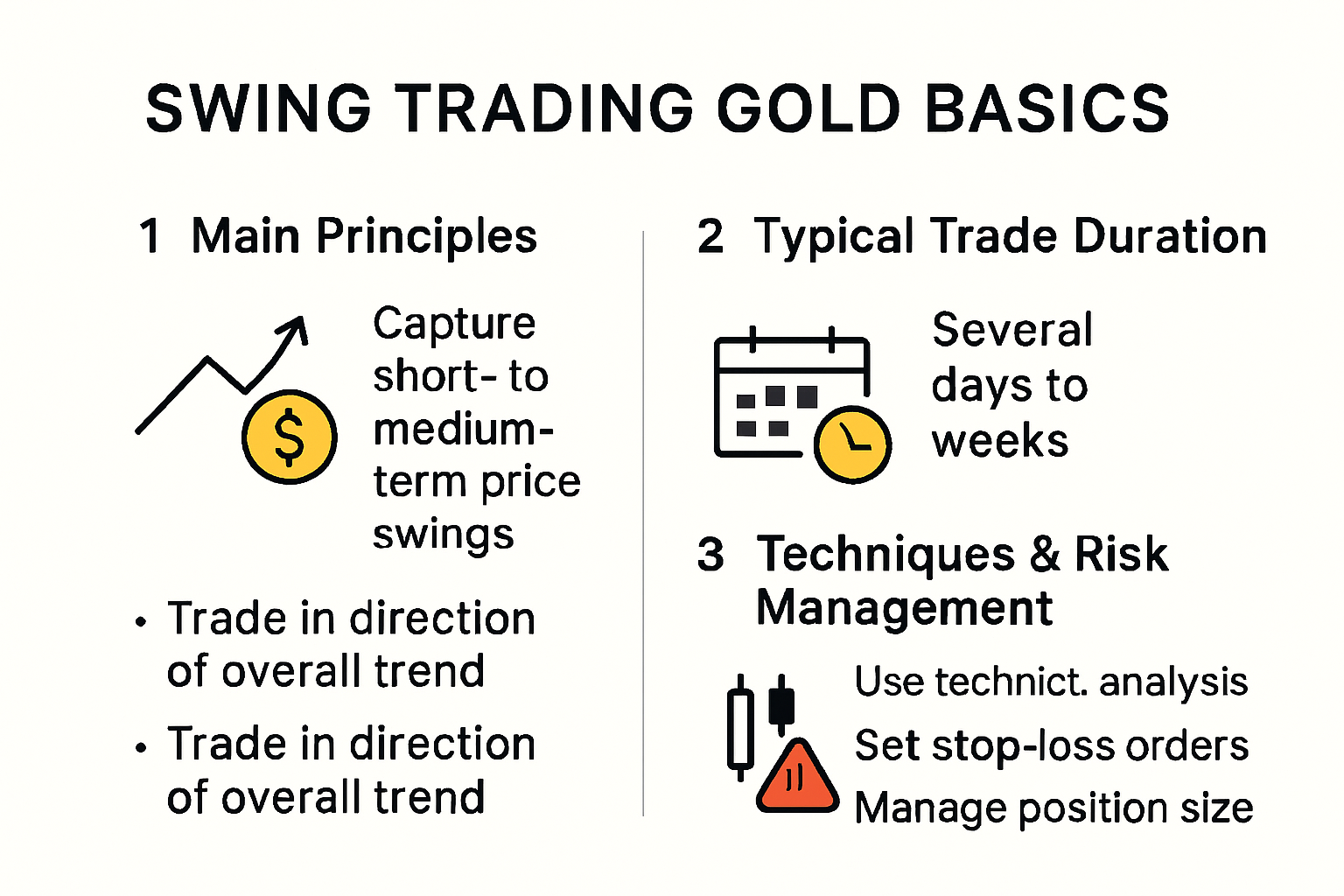
Swing Trading Strategies for the Gold Market

Swing trading in the gold market requires precision, strategic planning, and a deep understanding of market dynamics. Traders seeking to capitalize on medium-term price movements must develop robust approaches that balance technical analysis with comprehensive market insights.

Moving Average Crossover Techniques

Trading experts from financial analysis platforms highlight the moving average crossover as a fundamental strategy for gold market swing trading. This technique involves tracking the interaction between short-term and long-term moving averages to identify potential trend changes.

Key considerations for moving average crossover include:

  • Short-term moving average (typically 50-day period)
  • Long-term moving average (typically 200-day period)
  • Crossover points indicating potential trend reversals

Traders can optimize this strategy by combining multiple moving averages and considering additional technical indicators. The goal is to identify moments when short-term price momentum suggests a potential trend shift in the gold market.

Pivot Point Analysis and Market Sentiment

Market analysis research reveals the critical importance of pivot point calculations in swing trading. Pivot points provide traders with a mathematical framework for understanding potential market sentiment and price direction.

Calculating pivot points involves:

  • Averaging high, low, and closing prices
  • Identifying support and resistance levels
  • Interpreting price movements relative to pivot points

A price rising above the previous day’s pivot point suggests bullish market sentiment, while a drop below indicates potential bearish trends. Sophisticated traders use these pivot points as key decision-making tools in their swing trading strategies.

Risk Management and Strategic Positioning

Successful swing trading in the gold market demands exceptional risk management. Traders must develop strategies that protect capital while maximizing potential returns. This involves setting precise entry and exit points, implementing stop-loss mechanisms, and maintaining a disciplined approach to position sizing.

Critical risk management techniques include:

  • Calculating precise position sizes
  • Setting predetermined stop-loss levels
  • Maintaining portfolio diversification

Traders looking to enhance their swing trading skills can explore our comprehensive trading signals guide for advanced strategies and real-time market insights. By combining technical analysis, pivot point calculations, and robust risk management, traders can develop a more nuanced approach to gold market swing trading.

To provide a concise overview of the primary swing trading methods and where they fit into a trader’s overall strategy, the following table compares each approach and its main role.

Swing Trading Method Primary Focus Typical Application
Moving Average Crossover Identify trend reversals and confirmations Entry/exit point timing
Pivot Point Analysis Spot support and resistance levels Setting price targets and stops
Position Sizing & Stop-Loss Manage risk and capital exposure Portfolio and trade risk limitation
Portfolio Diversification Reduce exposure to single market moves Maintaining balanced trade distribution

Expert Tips for Forex and Gold Traders

Successful trading in gold and forex markets requires a sophisticated blend of technical skill, emotional intelligence, and strategic thinking. Professional traders must develop comprehensive approaches that transcend basic market analysis.

Advanced Market Sentiment Analysis

Research on trading signal generation reveals the critical importance of understanding market sentiment beyond traditional technical indicators. Modern traders are increasingly leveraging news and social media sentiment analysis to gain predictive insights into potential market movements.

Key sentiment analysis techniques include:

  • Real-time news monitoring
  • Social media trend tracking
  • Algorithmic sentiment scoring

By integrating these advanced analytical approaches, traders can develop more nuanced understanding of market psychology and potential price fluctuations. This approach goes beyond traditional technical analysis, providing a more holistic view of market dynamics.

Strategic Risk Management Techniques

Expert insights from trading platforms emphasize the paramount importance of disciplined risk management. Successful traders recognize that protecting capital is as crucial as generating profits.

Comprehensive risk management strategies include:

  • Implementing strict position sizing rules
  • Using advanced stop-loss mechanisms
  • Maintaining emotional discipline during trading

Traders must develop a consistent approach that balances potential gains with robust protective measures. This means understanding personal risk tolerance and creating trading strategies that align with individual financial goals.

Technical Tools and Analytical Frameworks

Trading experts recommend utilizing a comprehensive set of analytical tools to enhance trading performance. Modern traders need a sophisticated toolkit that goes beyond basic market indicators.

Essential technical analysis tools include:

  • Moving average convergence
  • Relative strength index (RSI)
  • MACD indicator analysis
  • Fibonacci retracement levels

Traders seeking to refine their scalping techniques can explore our advanced trading strategies guide for deeper insights into precision trading. By combining advanced sentiment analysis, strategic risk management, and comprehensive technical tools, traders can develop a more robust approach to gold and forex markets.

Frequently Asked Questions

What is the weekend effect in gold trading?

The weekend effect refers to the observed phenomenon where gold returns on Mondays tend to be lower compared to returns on other days of the week, impacting trading strategies for investors.

How can I use technical indicators for gold trading?

Utilizing technical indicators like Bollinger Bands, RSI, and moving averages can enhance your trading accuracy by helping to identify price trends and potential entry and exit points in the gold market.

What are essential risk management strategies for weekend gold trading?

Effective risk management strategies include implementing strict stop-loss orders, diversifying trading positions, and maintaining conservative position sizes to protect against potential losses during volatile market conditions.

How can market sentiment influence gold prices?

Market sentiment can greatly influence gold prices as it reflects investor behavior and expectations, which are affected by geopolitical events, economic announcements, and news trends. Monitoring sentiment can provide insights into potential price movements.

Turn Weekend Market Uncertainty Into Reliable Gold Profits

Are you struggling to predict gold price moves during weekends or worried about the notorious “weekend effect” highlighted in our latest News & Updates? Our expert team understands the frustration of navigating sudden volatility, confusing technical signals, and the fear of missing out on strong trading opportunities. We know that traders like you want dependable results, consistent market insights, and real-time strategies to conquer weekend market swings.

https://xau-gold-signals.com

With XAU Gold Signals, you never have to trade alone. Gain access to trusted gold trading signals with proven accuracy, crafted by professionals who specialize in both technical and sentiment analysis. Join our private Telegram group today and receive high-performance signals designed to minimize risk and maximize returns. Take control of your weekend trades now and experience the confidence that comes with expert-driven strategies. Start your journey by exploring our latest How To Guides and unlock a smarter way to trade gold this weekend.

Busy trading office with gold price charts and 'Price Fluctuates' text

Why Gold Price Fluctuates: Key Factors for Traders in 2025

Gold prices have a reputation for wild swings that keep traders constantly on edge. One moment gold is riding high as a safety net when uncertainty hits and the next its value tumbles as markets find their footing. But here is what flips the script. Advanced machine learning models now forecast gold price direction with over 80 percent accuracy, making guesswork a thing of the past and opening new doors for anyone looking to get ahead in 2025.

Table of Contents

Quick Summary

Takeaway Explanation
Economic uncertainty drives gold prices up. Investors seek gold for stability during economic instability, leading to price increases.
Interest rates inversely affect gold prices. Higher interest rates can lower gold’s attractiveness compared to interest-bearing assets, impacting demand.
Geopolitical tensions boost gold as a safe haven. Conflicts and political risks drive investors to gold, elevating its market value during crises.
Advanced analytics enhance trading strategies. Machine learning and predictive tools help traders anticipate market movements and make informed decisions.
Effective risk management is crucial in volatility. Traders should apply strict stop-loss orders and diversify portfolios to mitigate losses in unpredictable markets.

Economic Factors Driving Gold Price Fluctuations

Gold prices are intrinsically linked to complex economic dynamics that create a sophisticated dance of market forces. Understanding these economic factors is crucial for traders seeking to navigate the volatile gold market in 2025.

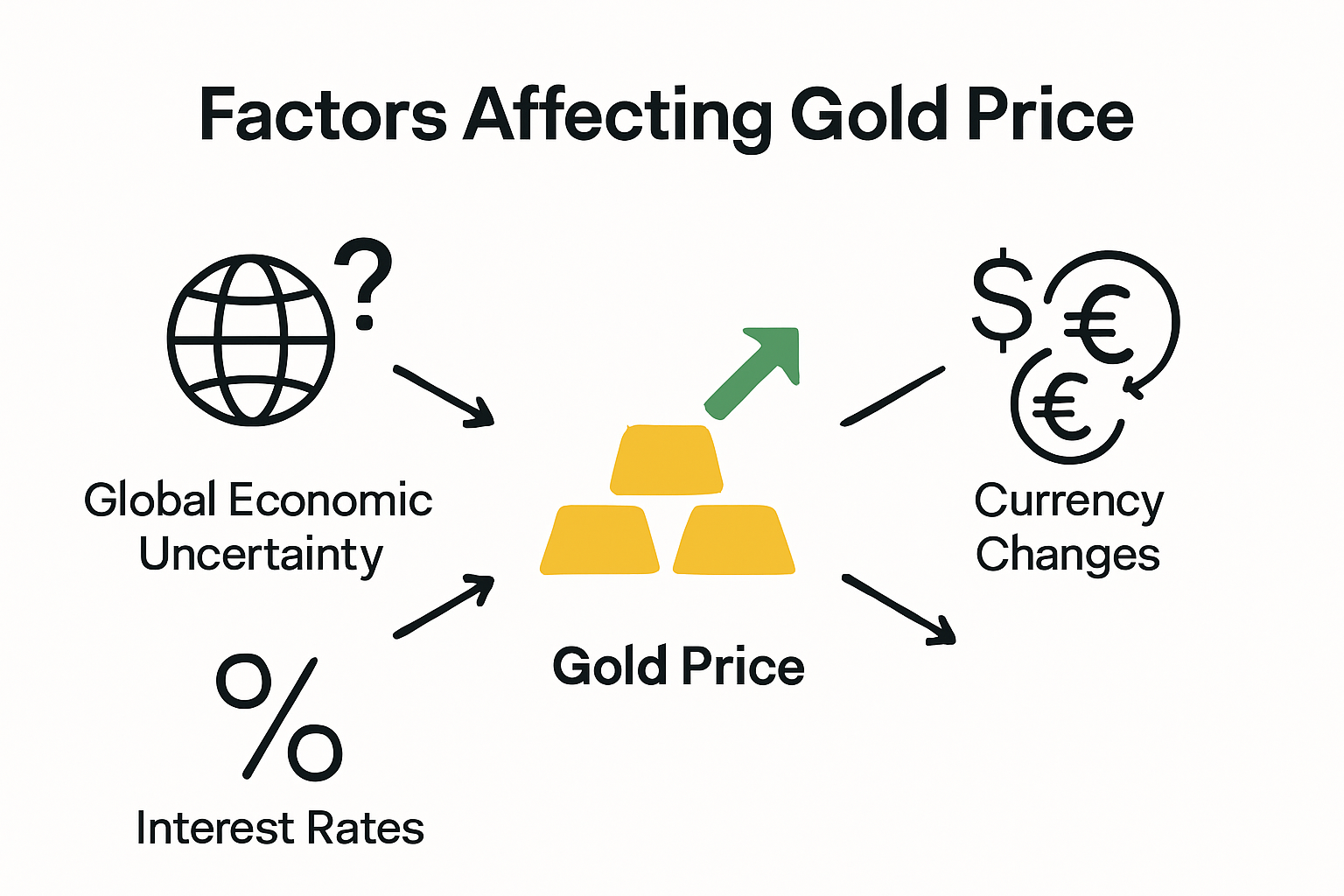
Infographic showing main factors influencing gold price

Global Economic Uncertainty and Safe Haven Demand

Economic instability serves as a powerful catalyst for gold price fluctuations. When global economic conditions become uncertain, investors traditionally turn to gold as a protective financial instrument. Research from CBS News highlights that economic turbulence often propels gold prices as investors seek to preserve wealth during market volatility.

The current geopolitical landscape demonstrates this phenomenon dramatically. Financial Times analysis reveals that foreign central banks, particularly from countries like China, are increasingly purchasing gold to diversify reserves away from the dollar-based payment system. This strategic shift reflects a broader loss of confidence in traditional monetary frameworks and directly impacts global gold pricing.

Monetary Policy and Interest Rate Dynamics

Monetary policy decisions significantly influence gold price movements. The relationship between interest rates and gold prices is inverse and nuanced. When central banks adjust interest rates, it creates ripple effects across investment landscapes. According to NASDAQ economic research, stronger U.S. economic indicators like low unemployment, robust jobs growth, and GDP expansion above 2% can potentially push gold prices lower.

This occurs because robust economic performance might signal potential monetary tightening, which reduces gold’s attractiveness compared to interest-bearing assets. Conversely, weaker economic data can create a dovish monetary policy environment, potentially increasing gold’s appeal as an investment vehicle.

International Trade and Currency Fluctuations

Global trade dynamics and currency value variations play critical roles in gold price determination. As nations recalibrate their economic strategies, gold emerges as a critical asset for maintaining financial stability. The ongoing shifts in international trade relationships, coupled with increasing geopolitical tensions, create an environment where gold’s value becomes more than just a commodity.

Traders must remain vigilant about international economic indicators, central bank policies, and global market sentiment. These factors collectively contribute to the complex ecosystem that drives gold price fluctuations. By understanding these intricate economic mechanisms, traders can develop more informed strategies for navigating gold market signals.

The gold market in 2025 promises to be a landscape of unprecedented complexity, where economic factors intertwine to create dynamic pricing environments. Successful traders will be those who can anticipate and interpret these multifaceted economic signals with precision and strategic insight.

To help clarify the main economic drivers affecting gold in 2025, here is a summary table organizing these factors, their mechanisms, and their impacts on gold price:

Economic Factor Mechanism Impact on Gold Price
Global Economic Uncertainty Turmoil in financial markets and economies boosts demand for stable assets Increases (Safe haven demand)
Central Bank Monetary Policy & Interest Rates Higher interest rates reduce gold’s appeal vs. yield-bearing assets, and vice-versa Higher rates = Decreases
Lower = Increases
International Trade & Currency Fluctuations Currency depreciation and changing trade relations can make gold more attractive as a store of value Increases when currencies weaken
Strong U.S. Economic Indicators (GDP, jobs) Indicates possible monetary tightening, making gold less attractive Decreases
Foreign Central Bank Gold Purchases Diversification away from dollar reserves leads to bulk gold buying Increases

Geopolitical Events And Currency Movements Impact

Financial analysts review global news with 'Safe Haven Demand' displayed

In the intricate world of gold trading, geopolitical events and currency movements represent powerful forces that can dramatically reshape market dynamics and influence gold prices with remarkable speed and complexity.

Global Tensions and Safe Haven Dynamics

Geopolitical risks consistently emerge as a critical driver of gold price fluctuations. Research from Resources Policy reveals that gold returns demonstrate significant positive responses to increases in economic policy uncertainty, geopolitical tensions, and market volatility across major global economies.

Specifically, international conflicts, trade disputes, and political instabilities trigger investor flight to safe haven assets. During periods of heightened geopolitical risk, gold transforms from a mere commodity to a strategic financial instrument. A study in Cogent Economics & Finance observed gold’s superior diversification capabilities during disruptive events like the COVID-19 pandemic and the Russia-Ukraine conflict, underscoring its resilience in turbulent market environments.

Currency Valuation and Gold Price Correlation

Currency movements play a pivotal role in determining gold’s global pricing mechanisms. When major currencies experience volatility or depreciation, investors often view gold as a stable store of value. The intricate relationship between currency fluctuations and gold prices creates a complex ecosystem where international monetary policies directly influence trading strategies.

Emerging market currencies, particularly those from developing economies, show pronounced sensitivity to gold price movements. Traders must carefully monitor exchange rate dynamics, central bank policies, and international monetary trends to anticipate potential gold price shifts.

Predictive Modeling and Risk Management

Research available on ResearchGate demonstrates the increasing sophistication of predictive models that analyze geopolitical risks and their potential impact on gold pricing. Advanced machine learning techniques now enable traders to develop more nuanced strategies for understanding and anticipating market movements.

Traders seeking to navigate these complex landscapes must develop multifaceted analytical approaches. This involves integrating geopolitical intelligence, currency market insights, and robust risk management techniques. Learn more about strategic gold trading signals to enhance your understanding of these dynamic market forces.

As we move through 2025, the intersection of geopolitical events and currency movements will continue to present both challenges and opportunities for gold traders. Success will belong to those who can interpret these complex signals with precision, adaptability, and strategic foresight.

Below is a table summarizing the major geopolitical and currency factors affecting gold price, their triggers, and typical gold market responses:

Driver Typical Trigger Gold Market Response
Geopolitical Risk Wars, international conflicts, political instability Gold price increases (safe haven inflow)
Policy Uncertainty Shifting regulations, elections, policy disagreements Gold price typically rises
Trade Disputes Tariffs, sanctions, major trade agreement tensions Uptick in gold demand
Major Currency Decline USD, yuan, euro, etc. fall in value Gold price increases
Emerging Market Volatility Rapid exchange rate drops in developing nations Gold price increases

How Gold Trading Signals Respond to Fluctuations

In the dynamic world of gold trading, understanding how trading signals respond to market fluctuations is crucial for investors seeking to maximize their strategic potential. Advanced technologies and analytical methodologies have transformed the way traders interpret and react to gold price movements.

Machine Learning and Predictive Analytics

Research published in the Journal of Risk and Financial Management demonstrates the power of advanced predictive technologies, with tree-based classifiers achieving over 80% accuracy in forecasting gold price directions for 10-day horizons. These sophisticated models capture complex market relationships, providing traders with unprecedented insights into potential price movements.

Machine learning algorithms now process vast amounts of data, including economic indicators, market sentiment, and global events, to generate more precise trading signals. A comprehensive study by the International Monetary Fund highlights how macroeconomic announcements significantly influence gold price volatility, with unexpected changes in indicators like inflation, GDP, and employment statistics creating immediate market responses.

News Sentiment and Real-Time Signal Adaptation

Cutting-edge research has revealed the profound impact of news sentiment on gold trading signals. An innovative study analyzing over 11,000 news headlines demonstrated that news flow can substantially affect future gold prices. Modern trading signal systems now incorporate real-time news sentiment analysis, allowing for rapid adaptation to emerging market conditions.

This approach enables traders to quickly interpret global events, geopolitical tensions, and economic shifts. By integrating natural language processing and machine learning, trading signals can now provide more nuanced and responsive recommendations that account for complex market dynamics.

Strategic Signal Interpretation

Successful gold trading in 2025 requires more than just receiving signals it demands a sophisticated understanding of how these signals are generated and interpreted. Traders must develop a holistic approach that combines technological insights with strategic thinking.

Explore our comprehensive guide to understanding gold trading signals to enhance your trading strategy. The most effective traders will be those who can synthesize machine-generated insights with personal market knowledge, creating a powerful approach to navigating gold market fluctuations.

As technological capabilities continue to evolve, the future of gold trading signals promises even more sophisticated, adaptive, and precise methodologies. Traders who embrace these advanced analytical tools will be best positioned to capitalize on the complex and dynamic gold market landscape of 2025.

Strategies for Forex and Gold Traders in Volatile Markets

Navigating volatile financial markets requires sophisticated strategies, exceptional risk management, and a deep understanding of complex market dynamics. Traders operating in forex and gold markets must develop adaptive approaches that can quickly respond to rapidly changing economic conditions.

Risk Management and Hedging Techniques

Research from the Federal Reserve Bank of New York emphasizes the critical importance of monitoring macroeconomic indicators and volatility indexes to develop effective trading strategies. Successful traders recognize that risk management is not about eliminating risk entirely, but strategically mitigating potential losses.

Key risk management techniques include implementing strict stop-loss orders, diversifying investment portfolios, and maintaining a disciplined approach to position sizing. Traders should allocate no more than 2-3% of their total capital to any single trade, ensuring that a single adverse market movement does not significantly impact overall portfolio performance.

Technical Analysis and Signal Interpretation

In volatile markets, technical analysis becomes an essential tool for forex and gold traders. Advanced charting techniques, such as moving averages, relative strength indicators, and Fibonacci retracements, provide critical insights into potential market movements. Traders must develop the ability to quickly interpret these signals and make rapid, informed decisions.

Learn advanced scalping strategies for rapid market gains to enhance your trading approach. Successful traders combine multiple analytical tools, creating a comprehensive view of market trends and potential price movements.

Psychological Resilience and Continuous Learning

Beyond technical skills, psychological resilience plays a crucial role in navigating volatile markets. Traders must cultivate emotional discipline, avoiding impulsive decisions driven by fear or greed. This requires developing a robust trading psychology that prioritizes rational analysis over emotional reactions.

Continuous learning is equally important. Markets evolve rapidly, and traders must stay informed about global economic trends, geopolitical developments, and emerging trading technologies. Participating in professional development programs, attending industry conferences, and maintaining a network of experienced traders can provide valuable insights and perspectives.

As we move through 2025, the most successful forex and gold traders will be those who combine technological sophistication, rigorous risk management, and psychological resilience. The ability to adapt quickly, interpret complex market signals, and maintain emotional discipline will separate exceptional traders from the average performers.

Traders must view volatility not as a threat, but as an opportunity for strategic positioning and potential profit generation. By developing a holistic approach that integrates advanced analytical tools, robust risk management techniques, and continuous learning, traders can transform market uncertainty into a competitive advantage.

Frequently Asked Questions

What are the main factors affecting gold price fluctuations in 2025?

Economic uncertainty, monetary policy, international trade dynamics, geopolitical events, and currency fluctuations are key factors influencing gold prices in 2025.

How does economic uncertainty drive gold prices?

During times of economic instability, investors flock to gold as a safe haven asset, increasing demand and thereby elevating its price.

What is the relationship between interest rates and gold prices?

Gold prices typically move inversely to interest rates; when interest rates rise, gold becomes less attractive compared to yield-bearing assets, leading to a decrease in demand and price.

How can traders use predictive analytics to anticipate gold price movements?

Traders can leverage advanced machine learning models to forecast gold prices with over 80% accuracy, allowing them to make informed trading decisions based on expected market fluctuations.

Ready to Trade Gold Smarter in 2025?

Wild gold price swings and unpredictable market events can leave traders feeling frustrated and exposed. If you are tired of guessing and want a clear advantage, you need gold trading signals that quickly adapt to economic uncertainty, central bank policy shifts, and currency volatility. Stay a step ahead by following the latest News & Updates that can help you turn complex factors into profitable opportunities.

https://xau-gold-signals.com

Success in 2025 will belong to those who act on data, not speculation. Join our Private Telegram Group now through https://xau-gold-signals.com and get exclusive access to real-time, high-win rate XAU/USD signals. Start trading with confidence and transform gold market ups and downs into consistent results today.

Forex traders in office watching gold market hours across world clocks

Gold Market Hours 2025: Key Times for Forex Traders

Gold trading never sleeps. Every day, more than $100 billion worth of gold changes hands across global markets. Most people think gold prices just follow the news or inflation. The surprise is that timing your trades during specific market hours can mean the difference between missing out and catching the biggest price moves. Get ready to uncover which hours fuel the best gold trades and why those windows matter more than any headline.

Table of Contents

Quick Summary

Takeaway Explanation
Understand global trading sessions Recognize the influence of the London, New York, and Asian sessions on gold trading.
Trade during market overlaps for liquidity Engage in trading when major markets overlap to maximize opportunities and minimize spreads.
Monitor economic events closely Pay attention to economic announcements that can lead to significant price movements in gold.
Implement risk management techniques Use stop-loss orders and size limits to protect profits during volatile market conditions.
Utilize advanced analysis methods Leverage tools like EFP spread tracking for more precise trading decisions.

Understanding Gold Market Hours

Gold market hours represent a complex global trading ecosystem that spans multiple international financial centers. Traders navigating the gold market must understand the intricate timing mechanisms that govern XAU/USD trading across different time zones and exchanges.

Global Trading Sessions and Market Dynamics

The gold market operates through interconnected trading sessions that reflect global economic activities. Unlike stock markets with fixed hours, gold trading occurs nearly 24 hours a day due to its decentralized nature. Research examining intraday trading behaviors reveals that trading volumes fluctuate significantly across different global financial centers.

Primary gold trading sessions include:

  • London Session: Considered the most significant global gold trading hub
  • New York Session: Representing major North American trading activity
  • Asian Session: Covering markets in Tokyo, Shanghai, and Hong Kong

Traders must recognize that each session presents unique liquidity and volatility characteristics. The overlap between these sessions creates windows of heightened trading opportunities, where price movements can be more pronounced and predictable.

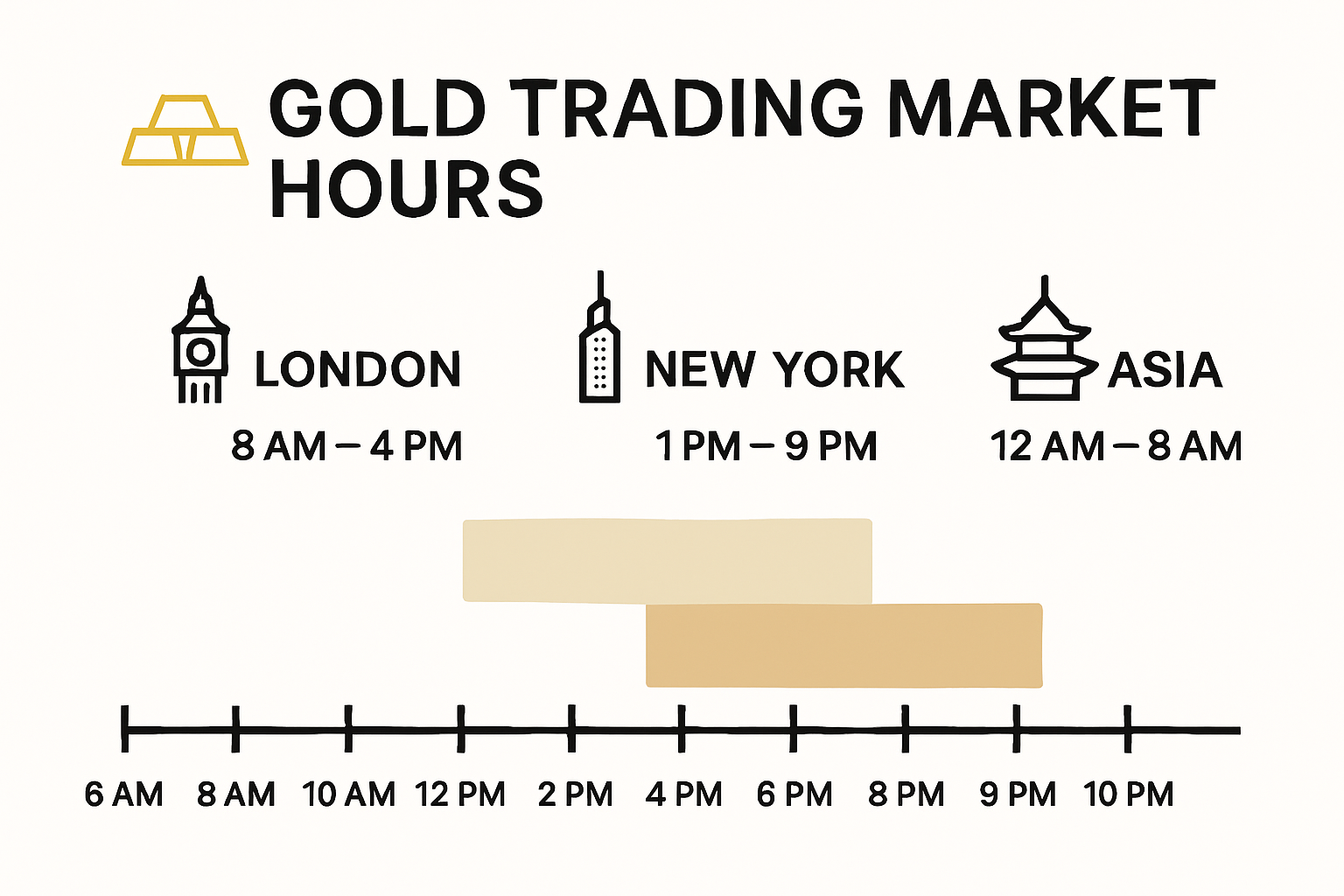
Infographic of global gold market trading hours and session overlaps.

Here’s a table summarizing the main global gold trading sessions and their characteristics to help traders quickly compare and plan their strategies:

Trading Session Major Markets Typical Hours (UTC) Key Characteristics
Asian Tokyo, Shanghai, Hong Kong 00:00 – 08:00 Moderate liquidity, early volatility
London London 08:00 – 16:00 Highest liquidity, global price setting
New York New York 13:00 – 21:00 High volatility, overlaps with London
London/New York Overlap London, New York 13:00 – 16:00 Peak liquidity and price action

Technical Synchronization and Market Mechanics

High-frequency trading research demonstrates how modern technological infrastructure synchronizes gold prices across international markets. This technological integration means that price movements in one session can instantaneously impact trading conditions in another.

Understanding these synchronization mechanisms is crucial for forex traders seeking to optimize their gold trading strategies. The temporal dynamics of gold markets are not just about time zones but also about complex algorithmic interactions that occur millisecond by millisecond.

For traders, this means developing a nuanced approach that considers not just when markets are open, but how different trading sessions interact and influence each other. Successful gold trading requires an appreciation of these intricate market dynamics, blending technical analysis with a deep understanding of global economic rhythms.

The gold market’s 24-hour nature presents both opportunities and challenges. Traders must remain vigilant, understanding that market conditions can change rapidly across different global sessions. Continuous learning and adaptive strategies are key to navigating this complex trading landscape.

Best Times to Trade Gold in Forex

Timing is everything in gold forex trading. Successful traders understand that specific market hours and global economic conditions can significantly impact gold price movements and trading opportunities.

Peak Trading Session Opportunities

Research analyzing market returns reveals interesting patterns in gold trading. While January historically offers the highest returns, traders must remain strategic about their trading windows. The most lucrative trading periods emerge during the overlap of major financial centers.

The London and New York trading sessions create a particularly dynamic trading environment. Forex market analysis indicates that the period between 8:00 AM and 11:00 AM Eastern Time presents optimal trading conditions. During these hours, market liquidity peaks, creating opportunities for precise entry and exit points.

Key trading session characteristics include:

  • High Liquidity: Maximum trading volume and tighter spreads
  • Increased Volatility: More significant price movements
  • Global Economic Intersection: Overlap of European and North American markets

The following table breaks down the advantages of trading gold during session overlaps, helping traders identify when to seek out the best opportunities:

Overlap Period Liquidity Level Volatility Level Trading Opportunity
Asian/London Overlap Moderate Moderate Early European moves
London/New York Overlap (8-11 ET) Highest Highest Best entries/exits
End of New York Session Lower Lower Cautious trading

Economic Uncertainty and Gold Trading

Market research consistently demonstrates that gold becomes particularly attractive during periods of economic instability. Investors frequently view gold as a safe-haven asset, driving increased trading activity during global economic uncertainties.

Traders should pay close attention to:

  • Geopolitical tensions
  • Major economic announcements
  • Central bank policy changes
  • Global financial market fluctuations

These factors can trigger substantial gold price movements, creating potential trading opportunities for well-prepared forex traders.

Successful gold trading requires more than understanding market hours. Traders must develop a comprehensive strategy that integrates technical analysis, global economic insights, and precise timing. Continuous learning and adaptability remain crucial in navigating the complex gold forex market.

Traders react to gold price spikes during peak session overlap

Impact of Market Hours on Gold Signals

Gold trading signals are profoundly influenced by global market hours, with each trading session presenting unique opportunities and challenges for forex traders. Understanding these nuanced dynamics can significantly enhance trading strategy and potential profitability.

Economic Announcements and Signal Sensitivity

Research from the International Monetary Fund reveals that gold prices are exceptionally sensitive to macroeconomic indicators. Unexpected changes in key U.S. economic data such as inflation rates, GDP, and employment statistics can trigger substantial price movements, making timing crucial for traders interpreting gold signals.

Traders must strategically monitor:

  • U.S. Federal Reserve announcements
  • Quarterly economic reports
  • Unexpected geopolitical developments
  • Major central bank policy changes

These events can create rapid signal transformations, requiring traders to remain agile and responsive during specific market hours.

Trading Volume and Signal Reliability

Intraday market research demonstrates a U-shaped pattern in trading volumes, with significant activity peaks during market opening and closing periods. This pattern suggests that gold trading signals are most reliable and potentially most profitable during these high-volume windows.

The convergence of global trading sessions creates unique signal generation opportunities. When Asian, European, and U.S. markets overlap, traders experience heightened market liquidity and increased signal generation potential. Understanding these temporal dynamics allows for more precise signal interpretation and trade execution.

Global Market Synchronization

Cryptocurrency market studies provide insights into global market synchronization, a principle equally applicable to gold trading. Significant economic reports and global trading sessions create recurring patterns of market activity that directly impact gold signals.

Successful traders recognize that gold signals are not static but dynamic representations of complex global economic interactions. They must develop strategies that account for:

  • Time zone differences
  • Economic calendar events
  • Market sentiment shifts
  • Technological trading infrastructure

By understanding how market hours influence signal generation, traders can transform potential volatility into strategic trading opportunities. Continuous learning, real-time adaptation, and a comprehensive approach to market analysis remain essential in navigating the intricate world of gold forex trading.

Tips for Maximizing Profits During Gold Market Hours

Successful gold trading requires strategic approaches that go beyond basic market understanding. Forex traders must develop sophisticated techniques to capitalize on the dynamic gold market environment and maximize their profit potential.

Risk Management and Volatility Strategies

Research on trading hour extensions reveals that increased market volatility presents both opportunities and significant risks. Traders must implement robust risk management techniques during high-volatility periods, particularly during market opening sessions.

Key risk management strategies include:

  • Setting precise stop-loss orders
  • Limiting position sizes
  • Using trailing stops
  • Diversifying trading positions
  • Maintaining consistent risk-to-reward ratios

Traders should treat volatility as a tool rather than a threat, using calculated approaches to transform market fluctuations into potential profit opportunities.

Advanced Market Analysis Techniques

Market making research in precious metals highlights the importance of understanding complex market mechanisms. Traders can optimize their strategies by closely monitoring the Exchange for Physical (EFP) spread, which represents the price difference between futures and spot markets.

Advanced analysis techniques involve:

  • Tracking EFP spread variations
  • Analyzing futures market trends
  • Identifying potential price discrepancies
  • Implementing multi-timeframe analysis
  • Utilizing both technical and fundamental analysis approaches

These sophisticated techniques allow traders to develop a more nuanced understanding of gold market dynamics, enabling more informed trading decisions.

Strategic Trading Approaches

While arbitrage concepts offer insights into market inefficiencies, gold traders must develop holistic strategies that adapt to rapidly changing market conditions. This requires a combination of technological tools, continuous learning, and psychological discipline.

Effective trading approaches include:

  • Developing a consistent trading plan
  • Using advanced charting and analysis tools
  • Practicing disciplined emotional management
  • Continuously updating market knowledge
  • Adapting strategies based on real-time market feedback

Successful gold trading is not about predicting market movements with absolute certainty, but about creating flexible strategies that can respond effectively to market changes. Traders who combine technical expertise, rigorous analysis, and psychological resilience are best positioned to navigate the complex gold market landscape.

Continuous learning, adaptability, and a systematic approach remain the cornerstone of profitable gold trading during critical market hours.

Frequently Asked Questions

What are the primary trading sessions for gold in 2025?

The primary trading sessions for gold include the Asian session (00:00 – 08:00 UTC), the London session (08:00 – 16:00 UTC), and the New York session (13:00 – 21:00 UTC). Each session has unique liquidity and volatility characteristics that affect gold trading.

When is the best time to trade gold in the Forex market?

The best time to trade gold is during the overlap of the London and New York sessions, particularly from 8:00 AM to 11:00 AM Eastern Time. During these hours, trading liquidity is at its highest, which can lead to better pricing and more profitable trading opportunities.

How do economic announcements affect gold trading?

Economic announcements can significantly impact gold prices, especially when they involve major indicators like inflation rates or employment statistics. Traders should closely monitor these events as they can lead to rapid price movements in the gold market, often creating trading opportunities.

What should traders know about risk management during gold market hours?

Traders should implement risk management strategies such as setting stop-loss orders, limiting position sizes, and maintaining a consistent risk-to-reward ratio, especially during high-volatility periods like market opening sessions. This will help protect against sudden price fluctuations while maximizing profit potential.

Capture the Most Profitable Gold Trades This Year

Timing your trades around global gold market hours can be overwhelming and unpredictable. The difference between catching a big move and facing losses often comes down to acting at the right moment during sessions like London-New York overlaps or key economic announcements. But you do not need to navigate this high-pressure environment alone. Our XAU/USD trading signals are built around the exact market sessions and trading windows discussed in this article, combining expert analysis with real-time alerts so you never miss the best opportunities.

https://xau-gold-signals.com

Ready to turn gold market volatility into consistent wins? Join our private Telegram group and start receiving daily, live gold signals trusted by traders worldwide. Secure your edge today at xau-gold-signals.com and trade each session with confidence.

Trader analyzing gold price signals on multiple screens in a modern home office setting

Interpreting Gold Signals: A 2025 Guide for Forex Traders

Gold price signals are driving drastic changes in forex trading, with advanced machine learning models now generating daily profit results like $1,623.52 over just 23 days. Most traders expect gold signals to be straightforward green lights or red flags for buy and sell. In reality, these signals are anything but simple routines—they are complex probabilistic tools packed with insights and blind spots, and understanding their true potential can completely shift how you trade gold.

Table of Contents

Quick Summary

Takeaway Explanation
Understand gold signals as probabilistic tools Gold signals provide probabilities of market movements, not certainties. Proper interpretation is essential for informed trading decisions.
Utilize advanced analytical tools for better insights Employ tools like machine learning and technical indicators to enhance gold signal accuracy and trading strategies.
Adhere to robust risk management practices Establish clear risk parameters, including stop-loss orders, to protect capital from unexpected market volatility.
Avoid common psychological trading errors Emotional decision-making can harm trading performance; develop discipline by following a structured trading plan.
Implement systematic trading strategies Create structured approaches for signal application, including clear entry and exit criteria, to enhance trading effectiveness.

What Are Gold Signals and How They Work

Trading gold requires precision and strategic insights. Gold signals represent sophisticated analytical tools that help forex traders make informed decisions about XAU/USD market movements. These signals are essentially expert-generated recommendations that provide traders with specific entry, exit, and risk management parameters for gold trading.

The Anatomy of Gold Trading Signals

Gold signals are complex mathematical and analytical outputs derived from multiple market analysis techniques. According to research from the International Finance Research Center, these signals incorporate sophisticated sentiment analysis and technical indicators to predict potential market movements. The primary components typically include:

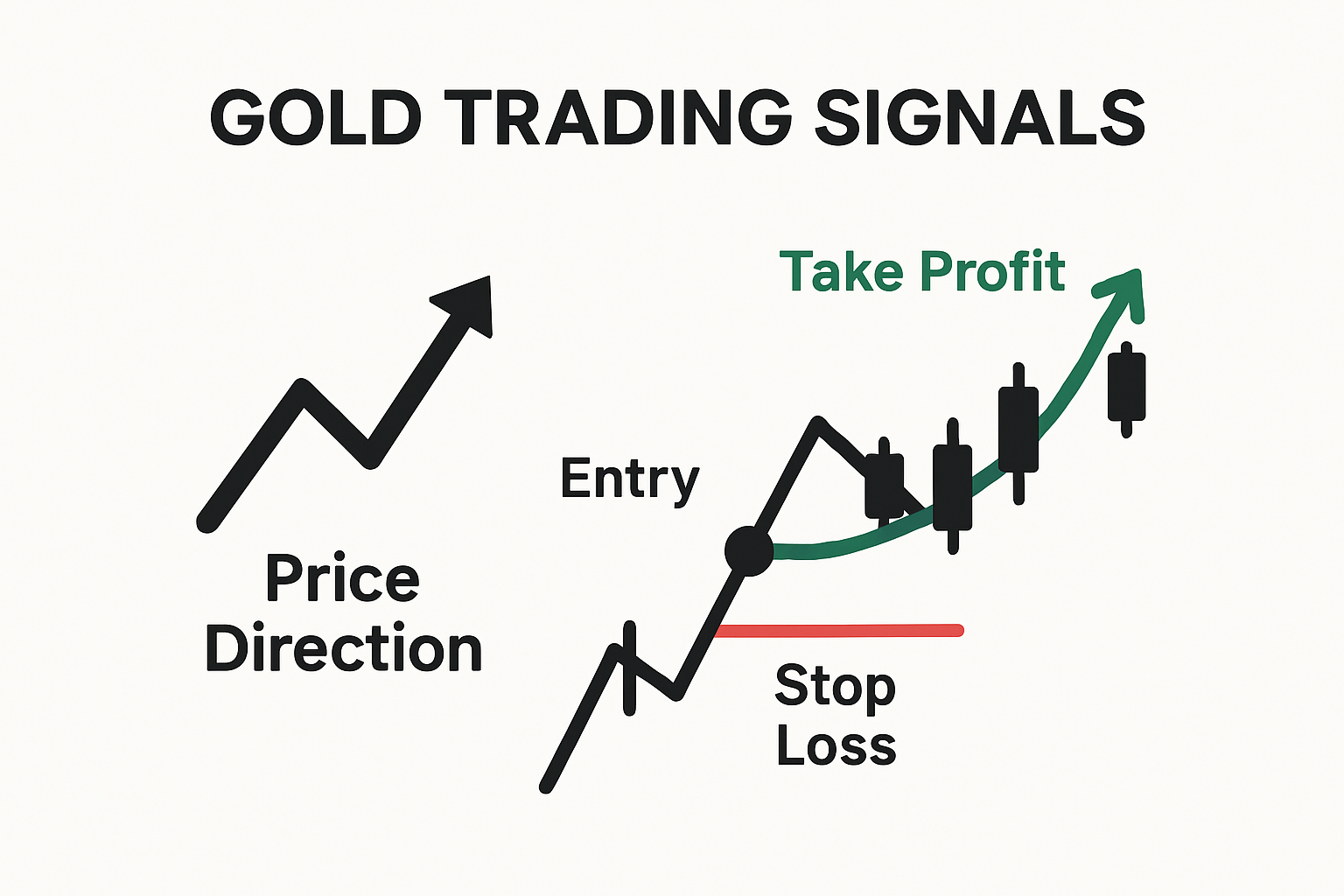
  • Price Direction: Indicates whether gold prices are likely to move up or down
  • Entry Points: Specific price levels recommended for opening a trade
  • Stop Loss: Predetermined price levels to limit potential losses
  • Take Profit: Target price points for closing the trade with desired profits

Professional traders rely on these signals because they synthesize massive amounts of market data into actionable insights. Advanced computational models now utilize machine learning algorithms and neural networks to generate increasingly accurate predictive signals, transforming how traders approach gold market strategies.

Components of a gold trading signal illustrated visually

Signal Generation Methodologies

The process of generating gold signals involves multiple sophisticated analytical approaches. Traders and algorithmic systems typically combine several key methodological frameworks:

  1. Technical Analysis: Examining historical price charts, identifying patterns, tracking moving averages, and using statistical indicators like Relative Strength Index (RSI) and Moving Average Convergence Divergence (MACD).

  2. Fundamental Analysis: Evaluating macroeconomic factors such as central bank policies, global economic indicators, geopolitical events, and currency fluctuations that might impact gold prices.

  3. Sentiment Analysis: Monitoring news sources, social media, and financial platforms to gauge market sentiment and potential investor behavior.

These methodologies work synergistically to produce gold signals that offer traders a comprehensive view of potential market movements. The integration of multiple analytical techniques helps minimize individual methodological biases and provides a more robust predictive framework.

Understanding gold signals requires recognizing they are probabilistic tools, not guaranteed predictions. Successful traders use these signals as part of a broader, disciplined trading strategy that includes risk management, continuous learning, and adaptive decision making. While signals provide valuable insights, they should always be combined with personal market analysis and a thorough understanding of individual trading goals.

For traders looking to enhance their gold trading strategies, continuous education and staying updated with the latest signal generation technologies remain critical. The gold market’s inherent complexity demands a nuanced, data-driven approach that balances technological insights with human judgment.

Essential Tools for Interpreting Gold Signals

Successful gold trading requires a strategic arsenal of analytical tools that transform raw market data into actionable insights. Professional traders leverage sophisticated technological platforms and advanced indicators to decode complex gold market signals with precision and confidence.

Technical Analysis Platforms and Indicators

Trading platforms serve as the primary infrastructure for interpreting gold signals. According to research from the International Finance Research Center, key technical indicators play a crucial role in signal interpretation. Traders typically rely on platforms that offer comprehensive analytical capabilities:

  • MetaTrader 4/5: Industry-standard platforms with robust charting tools
  • TradingView: Advanced visualization and social trading features
  • Bloomberg Terminal: Professional-grade market data and analysis system

Critical technical indicators for gold signal analysis include:

  1. Relative Strength Index (RSI)
  2. Moving Average Convergence Divergence (MACD)
  3. Bollinger Bands
  4. Fibonacci Retracement Levels

Advanced Computational Analysis Tools

Cutting-edge computational models are revolutionizing gold signal interpretation through machine learning and artificial intelligence technologies. These advanced tools utilize neural networks and deep learning algorithms to process massive datasets and generate predictive insights.

Key computational analysis approaches include:

  • Neural encoder-decoder frameworks
  • Deep reinforcement learning models
  • Conditional Generative Adversarial Networks (cGANs)
  • Time series prediction algorithms

These sophisticated tools enable traders to:

  • Identify complex market patterns
  • Predict potential price movements
  • Minimize human cognitive biases
  • Process information faster than traditional methods

Risk Management and Signal Validation Tools

Interpreting gold signals goes beyond mere technical analysis. Professional traders employ comprehensive risk management tools to validate and optimize trading decisions. These tools help assess signal reliability, potential market volatility, and overall trade performance.

Essential risk management technologies include:

  1. Monte Carlo simulation tools
  2. Portfolio risk calculators
  3. Automated stop-loss systems
  4. Real-time volatility tracking algorithms

Traders must understand that no single tool guarantees success. The most effective approach combines multiple analytical methods, continuous learning, and adaptive strategies. By integrating advanced technological tools with human expertise, traders can develop a nuanced understanding of gold market dynamics and improve their signal interpretation capabilities.

Continuous technological adaptation remains critical in the rapidly evolving forex trading landscape. Staying informed about emerging analytical technologies and refining signal interpretation skills will be key to maintaining a competitive edge in gold trading.

Traders collaboratively analyzing gold signals using technical platforms and indicators

Common Mistakes to Avoid in Gold Signal Analysis

Navigating the complex world of gold signal analysis requires more than just technical knowledge. Even experienced traders can fall into predictable traps that undermine their trading performance. Understanding and avoiding these common mistakes is crucial for maintaining a disciplined and profitable trading approach.

Misinterpreting Signal Reliability

One of the most critical errors traders make is overestimating the absolute reliability of gold signals. According to research from Finance World, blindly following signals without understanding their underlying rationale can lead to significant financial losses. Professional traders recognize that signals are probabilistic tools, not guaranteed predictions.

Key reliability misconceptions include:

  • Treating Signals as Absolute Guarantees: Signals represent potential market movements, not certainties
  • Ignoring Contextual Market Conditions: Failing to consider broader economic factors that influence gold prices
  • Signal Confirmation Bias: Selectively interpreting signals that confirm preexisting market expectations

Risk Management Failures

Forex Market Analyst research highlights that inadequate risk management is a fundamental error in signal-based trading. Successful traders implement robust risk mitigation strategies that protect their capital from unexpected market volatility.

Critical risk management mistakes include:

  1. Not setting appropriate stop-loss orders
  2. Risking excessive capital on a single trade
  3. Failing to diversify trading strategies
  4. Neglecting position sizing principles

Traders should establish clear risk parameters, typically limiting individual trade risks to 1-2% of their total trading capital. This approach ensures that a series of unsuccessful trades will not dramatically impact overall portfolio performance.

Emotional and Psychological Trading Errors

According to expert analysis from Forex Academy, psychological factors play a significant role in trading failures. Emotional decision-making can quickly erode carefully developed trading strategies.

Common psychological pitfalls include:

  • Chasing losses
  • Becoming overly attached to specific trade positions
  • Letting fear or greed drive trading decisions
  • Abandoning established trading plans during market volatility

Successful gold signal traders develop emotional discipline through structured approaches. This involves creating predefined trading rules, maintaining a trading journal, and regularly reviewing performance without emotional bias.

Mitigating these mistakes requires a holistic approach that combines technical knowledge, psychological awareness, and disciplined execution. Traders must continuously educate themselves, remain adaptable, and approach gold signal analysis with a balanced, analytical mindset.

Remember that mastering gold signal interpretation is an ongoing journey. Each mistake represents an opportunity to refine strategies, improve analytical skills, and develop a more nuanced understanding of complex market dynamics. Consistent learning, self-reflection, and a commitment to disciplined trading are the ultimate keys to long-term success in gold forex trading.

To help clarify the most common pitfalls in gold signal analysis, the following table summarizes key mistakes across three main categories:

Category Mistake/Description Potential Outcome
Signal Reliability Treating signals as absolute guarantees Financial losses
Signal Reliability Ignoring broader market/economic conditions Missed market shifts
Signal Reliability Signal confirmation bias (favoring signals that match your view) Skewed trading results
Risk Management Not using stop-loss orders Large, unmanaged losses
Risk Management Risking too much capital on one trade Rapid capital depletion
Risk Management Failing to diversify or ignoring position sizing Higher portfolio risk
Psychological/Emotional Error Making trades based on fear or greed Erosion of discipline
Psychological/Emotional Error Abandoning your plan during volatility or chasing losses Increased losses

Applying Gold Signals to Real Trading Strategies

Transforming gold signals into actionable trading strategies requires a systematic and disciplined approach. Traders must move beyond theoretical knowledge and develop practical methods for implementing signals effectively in real market conditions.

Strategic Signal Implementation Frameworks

Research from the journal Risks highlights the importance of integrating multiple data sources to enhance gold price forecasting. Successful implementation involves creating robust frameworks that combine technical analysis, fundamental insights, and adaptive strategies.

Key strategic implementation approaches include:

  • Multi-Timeframe Analysis: Examining signals across different time horizons
  • Signal Confirmation Techniques: Cross-referencing multiple indicators
  • Dynamic Risk Allocation: Adjusting position sizes based on signal strength
  • Contextual Market Assessment: Considering broader economic indicators

Traders can develop systematic approaches by establishing clear rules for:

  1. Signal entry criteria
  2. Position sizing
  3. Risk management parameters
  4. Exit strategy protocols

Advanced Predictive Modeling Techniques

Cutting-edge research on event-driven price prediction demonstrates the potential of sophisticated machine learning models in developing trading strategies. Neural network approaches, particularly Long Short-Term Memory (LSTM) models, offer sophisticated methods for interpreting complex market signals.

Advanced predictive modeling strategies include:

  • Neural network-based trend prediction
  • Machine learning signal validation
  • Automated trading bot integration
  • Real-time market sentiment analysis

One remarkable study showcased a neural network model that generated a profit of $1,623.52 over a 23-day testing period, illustrating the potential of sophisticated algorithmic approaches.

Practical Signal Application Methodology

Effective gold signal application requires a structured methodology that balances technological insights with human judgment. Traders must develop a comprehensive approach that combines:

  • Rigorous backtesting of signal strategies
  • Continuous performance monitoring
  • Adaptive strategy refinement
  • Psychological discipline

Successful implementation involves creating a systematic trading plan that:

  1. Defines clear entry and exit criteria
  2. Establishes strict risk management protocols
  3. Incorporates ongoing learning and strategy adjustment
  4. Maintains emotional neutrality

The following table outlines a step-by-step process for applying gold signals to real trading, helping traders visualize an effective methodology:

Step Action Purpose
1. Strategy Backtesting Test signals with historical data Validate signal effectiveness and consistency
2. Define Entry/Exit Rules Set clear criteria for trade entry and exit Establish discipline and reduce ambiguity
3. Risk Management Setup Apply stop-loss, position sizing, max risk per trade Limit potential losses
4. Live Signal Monitoring Continuously monitor signals in real-time Ensure strategy adapts to changing markets
5. Performance Review Review trades, journal outcomes, refine strategies Continuous improvement and learning
6. Emotional Discipline Follow plan, avoid impulsive trades Maintain consistency across market cycles

Traders should view gold signals as probabilistic tools rather than absolute predictors. The most effective strategies combine technological insights with human expertise, allowing for nuanced interpretation and adaptive decision-making.

Ultimately, applying gold signals to real trading strategies is an ongoing process of learning, refinement, and disciplined execution. Successful traders continuously evolve their approaches, integrating new technologies and insights while maintaining a core focus on risk management and strategic consistency.

Frequently Asked Questions

What are gold signals in forex trading?

Gold signals are analytical tools that provide traders with insights into potential market movements for gold. They offer recommendations on entry and exit points, as well as risk management parameters based on complex market analysis.

How can I interpret gold trading signals effectively?

To interpret gold signals effectively, combine technical analysis, fundamental insights, and sentiment analysis. Utilize advanced analytical tools and remember that signals represent probabilities rather than certainties.

What tools can enhance the accuracy of gold signals?

Tools such as technical analysis platforms (MetaTrader 4/5, TradingView), advanced computational models using machine learning, and risk management tools like stop-loss systems can significantly enhance the accuracy of gold signals.

What common mistakes should I avoid when analyzing gold signals?

Common mistakes to avoid include treating signals as absolute guarantees, neglecting proper risk management, and allowing emotional factors to influence trading decisions. Cultivate a disciplined approach to minimize these errors.

Transform Gold Signal Insights Into Real Profits

Are you struggling to make sense of complex gold trading signals and feeling frustrated by inconsistent results? If you want to move beyond confusing numbers and complicated analysis, you need more than just theory. You deserve proven, actionable guidance. Discover how the right trading partner can help you turn those probabilistic signals into steady profit and real confidence in your trading journey by visiting XAU Gold Signals.

https://xau-gold-signals.com

Now is the time to bridge the gap between market analysis and results. Our high-accuracy gold signals deliver simple, real-time strategies for gold traders at every skill level. Get instant access to our private Telegram group, daily trading signals, and expert-driven analyses that remove guesswork. Take the step toward profitable, stress-free gold trading by joining us at XAU Gold Signals today.

Traders analyzing gold and forex price chart with 'Price Action' text overlay

Price Action in Trading: Powerful Strategies for Gold & Forex 2025

Gold and forex traders keep searching for reliable ways to predict market moves. Some still chase the newest indicator or complex system, hoping for an edge. Yet statistics reveal that over 70 percent of successful traders rely mainly on raw price action instead of complicated tools. That single shift alone changes the game and clears out much of the noise.

Table of Contents

Quick Summary

Takeaway Explanation
Focus on Price Movement Alone Price action trading emphasizes raw price changes, minimizing reliance on complex indicators for market analysis.
Utilize Candlestick Patterns Recognizing specific candlestick patterns can indicate potential market reversals or continuations, aiding in trading decisions.
Implement Multi-Timeframe Analysis Analyzing price movements across different timeframes helps discern overall trends versus short-term fluctuations for better trading insights.
Establish Clear Risk Management Effective trading requires implementing stop-loss and take-profit levels to secure gains and limit losses based on market signals.
Avoid Emotional Trading Maintaining discipline and sticking to a trading plan can greatly enhance one’s success and mitigate poor decision-making under pressure.

What Price Action in Trading Means

Price action trading represents a dynamic approach to understanding financial markets through the lens of price movement. Unlike complex trading strategies that rely heavily on multiple technical indicators, price action focuses exclusively on the raw price changes of a financial instrument over time. Our comprehensive guide on price action trading provides deeper insights into this powerful trading methodology.

Infographic explaining price action in trading basics

Understanding Price Movement Fundamentals

At its core, price action trading is about interpreting market psychology through price charts. According to Investopedia, price action is defined as the movement of a security’s price plotted over time, forming the basis for all technical analyses. Traders who practice price action trading observe how prices move, identifying patterns, trends, and potential future market directions without relying on complex technical indicators.

In gold and forex markets, price action becomes particularly crucial. Traders analyze historical price movements, looking for repetitive patterns that might indicate potential market behavior. These patterns could include specific candlestick formations, support and resistance levels, trend reversals, and consolidation zones. By understanding these nuanced price movements, traders can make more informed decisions about entry and exit points.

Key Principles of Price Action Analysis

Successful price action trading requires a deep understanding of market dynamics. According to Britannica’s financial resources, traders focus on several critical principles. First, they recognize that price reflects all available market information. This means that every historical and current price movement encapsulates trader sentiments, economic conditions, and market expectations.

Traders analyze multiple timeframes to get a comprehensive view of price movements. Short-term charts might reveal immediate market sentiment, while longer-term charts provide context about broader market trends. This multi-timeframe analysis helps traders distinguish between temporary price fluctuations and more significant market movements.

Another essential principle is understanding market context. Price action traders don’t just look at raw price movements but consider the broader economic environment, geopolitical events, and market psychology. They use price charts as a window into collective market behavior, interpreting how different market participants react to various economic stimuli.

Price action trading demands discipline, patience, and continuous learning. Traders must develop a keen eye for recognizing patterns, understanding market psychology, and making calculated decisions based on price movements. While it might seem straightforward, mastering price action requires extensive practice, emotional control, and a systematic approach to market analysis.

Core Price Action Strategies for Gold and Forex

Price action strategies in gold and forex trading represent sophisticated techniques for interpreting market movements without relying extensively on complex technical indicators. Learn advanced trading signals on our expert blog for deeper insights into these powerful strategies.

Candlestick Pattern Recognition

Candlestick patterns form the cornerstone of price action trading for gold and forex markets. According to a comprehensive study from Universitas Atma Jaya Yogyakarta, technical analysis strategies focusing on candlestick formations can yield profitable trading outcomes. Traders identify specific patterns like hammer, shooting star, doji, and engulfing patterns that signal potential market reversals or continuations.

In gold trading, these candlestick patterns become particularly significant. A hammer pattern near a support level might indicate a potential bullish reversal, while a shooting star at resistance could signal an upcoming bearish trend. Traders must combine pattern recognition with broader market context to improve their decision making.

Trader at desk studying candlestick chart with 'Pattern Signals' overlay

Multi-Timeframe Analysis Strategy

Multi-timeframe analysis is crucial for developing robust price action strategies. According to research published in Mathematics journal, integrating advanced mathematical models with price action analysis can significantly enhance forecasting accuracy. Traders examine price movements across different timeframes weekly, daily, and hourly charts to develop a comprehensive market perspective.

This approach allows traders to distinguish between short-term fluctuations and long-term trends. For instance, a trader might identify a bullish trend on a weekly chart while simultaneously recognizing potential short-term pullback opportunities on a daily or hourly chart. By understanding these interconnected price movements, traders can make more informed entry and exit decisions.

Support and Resistance Tracking

Support and resistance levels represent critical elements in price action strategies for gold and forex markets. According to research from Columbia University, commodities like gold exhibit predictable behavioral patterns around these key price levels. Traders track historical price points where assets have consistently reversed or consolidated, using these zones as strategic trading regions.

In gold trading, support levels represent price points where buying pressure historically prevents further decline, while resistance levels indicate zones where selling pressure typically emerges. Traders watch for price action signals near these levels such as bullish or bearish engulfing candles, pin bars, or inside bars to make trading decisions. These signals provide insights into potential trend continuations or reversals.

Successful price action trading requires continuous learning, disciplined practice, and a deep understanding of market psychology. Traders must remain adaptable, recognizing that no single strategy guarantees success in the dynamic gold and forex markets.

Here is a summary table of the primary price action strategies and their key features for gold and forex trading:

Strategy Description Example Patterns/Methods
Candlestick Pattern Recognition Identifies specific candlestick formations that signal reversals or continuations Hammer, Shooting Star, Doji, Engulfing
Multi-Timeframe Analysis Analyzes price movement across weekly, daily, and hourly charts for broad and short-term trends Weekly trend vs. Daily pullbacks
Support & Resistance Tracking Tracks key price levels where reversals or consolidations are likely to occur Trading at Support/Resistance Zones

Using Price Action for Reliable Trading Signals

Price action trading provides traders with a sophisticated approach to generating reliable trading signals by interpreting market movements through precise price behavior analysis. Explore our comprehensive trading signal strategies to enhance your understanding of these advanced techniques.

Identifying High-Probability Entry Signals

Generating reliable trading signals using price action requires a nuanced understanding of market psychology and price movement patterns. According to research from the University of St. Thomas, systematic price-based strategies can provide statistically significant trading signals, particularly when focused on key psychological price levels.

In gold and forex markets, traders look for specific price action signals that indicate potential market entry points. These signals include pin bars, engulfing patterns, and inside bars that demonstrate clear market sentiment shifts. A bullish pin bar at a support level, for instance, might signal a potential upward price movement, while a bearish engulfing pattern near a resistance zone could indicate an impending downward trend.

Confirmation and Risk Management Techniques

Successful price action signal generation goes beyond simple pattern recognition. Traders must implement robust confirmation and risk management strategies to validate potential trading opportunities. This involves analyzing multiple timeframes, considering market context, and establishing clear entry, stop-loss, and take-profit levels.

For gold trading, confirmation might involve comparing price action signals across different timeframes. A bullish signal on an hourly chart should ideally align with broader trends visible on daily or weekly charts. Traders also examine volume, market sentiment, and external economic factors to increase the reliability of their trading signals.

Advanced Signal Filtering Strategies

Advanced price action traders develop sophisticated signal filtering techniques to minimize false positives and improve trade accuracy. This approach involves creating a comprehensive trading framework that combines multiple confirmation criteria. Traders might look for confluence between price action patterns, support and resistance levels, and broader market trends.

In forex and gold markets, signal filtering can include examining the quality of candlestick formations, the strength of trend momentum, and the overall market structure. Traders might reject signals that do not meet strict criteria, such as those lacking clear market context or showing weak price momentum.

Trading success with price action signals requires continuous learning, disciplined practice, and an adaptive approach. No single strategy guarantees consistent profits, and traders must remain flexible, continuously refining their approach based on market conditions and personal trading experience. Developing a deep understanding of market psychology and price movement dynamics is crucial for transforming price action signals into profitable trading opportunities.

Common Mistakes to Avoid with Price Action

Mastering price action trading requires not just understanding successful strategies, but also recognizing and avoiding critical errors that can undermine trading performance. Learn more about advanced trading techniques to refine your approach and minimize potential pitfalls.

Below is a table summarizing the most common mistakes traders make with price action, along with a brief description and solution for each:

Mistake Description Solution/Best Practice
Overcomplicating Technical Analysis Adding too many indicators, creating unnecessary complexity and signal noise Keep charts clean; focus on price, core patterns, and market structure
Emotional Trading & Lack of Discipline Making decisions based on fear, impulse, or deviating from the trading plan Stick to a plan; apply strict risk management and entry/exit rules
Ignoring Multiple Timeframe Contexts Trading without considering longer- and shorter-term market trends and context Analyze signals on several timeframes for a holistic market perspective

Overcomplicating Technical Analysis

One of the most prevalent mistakes in price action trading is overcomplicating technical analysis. According to Charles Schwab’s trading guidelines, traders often fall into the trap of adding unnecessary complexity to their trading strategies. Price action trading fundamentally relies on simplicity and clear market interpretation.

Traders frequently make the error of incorporating too many technical indicators, which can create signal noise and confusion. The core principle of price action trading is to understand market movements through pure price behavior, not by drowning in a sea of complex indicators. Successful traders learn to read price charts cleanly, focusing on key patterns, support and resistance levels, and market structure.

Emotional Trading and Lack of Discipline

Emotional trading represents a critical mistake that can devastate trading performance. Investing.com highlights that selling out of fear or trading against overall market trends are significant errors that undermine trading success. Price action traders must develop emotional discipline and stick to their predefined trading plans.

This discipline involves several key practices: maintaining consistent risk management, avoiding impulsive trades based on temporary market fluctuations, and maintaining a systematic approach to market analysis. Traders should establish clear entry and exit rules before entering any trade and have the mental fortitude to follow these rules regardless of short-term market movements.

Ignoring Multiple Timeframe Contexts

Another common mistake in price action trading is failing to analyze price movements across multiple timeframes. Yahoo Finance reports that traders often make the critical error of ignoring longer time frames and trading based on limited perspectives.

Effective price action trading requires a holistic view of market movements. A signal that appears promising on a short-term chart might look entirely different when viewed in the context of daily or weekly trends. Traders must develop the skill of analyzing price action across different time horizons to understand true market dynamics.

Successful price action trading demands continuous learning, self-awareness, and the ability to adapt. Traders must recognize that mistakes are part of the learning process and approach each trade with a growth mindset. By understanding and avoiding these common pitfalls, traders can develop more robust and consistent trading strategies in gold and forex markets.

Frequently Asked Questions

What is price action trading?

Price action trading focuses on analyzing the raw movements of price over time, using price charts to identify patterns and market trends without relying on complex indicators.

How can candlestick patterns improve trading decisions?

Candlestick patterns can signal potential market reversals or continuations, helping traders identify entry and exit points based on clear price behavior.

What is multi-timeframe analysis in price action trading?

Multi-timeframe analysis involves examining price movements across different timeframes to gain a comprehensive understanding of market trends and to distinguish between short-term fluctuations and long-term trends.

How can I avoid common mistakes in price action trading?

To avoid mistakes, focus on simplicity in your analysis, maintain emotional discipline, and consider multiple timeframes to gain a complete view of the market.

Turn Price Action Insights Into Consistent Trading Profits

If you have ever felt stuck using complex indicators or missing winning trades because of overloaded charts, you are not alone. The path to mastering gold and forex often comes down to reading pure price movement and taking action with confidence. Our How To Guides will show you how to put price action strategies to work right away, so you never have to second guess your entry or exit again.

https://xau-gold-signals.com

It is the perfect time to stop feeling uncertain and start getting reliable trade setups from proven experts. Join our Private Telegram group for daily, real-time XAU/USD gold signals and see how our actionable strategies help you avoid emotional trading and achieve steady growth. Take control of your trades today and experience the accuracy and risk management that make winning with gold signals possible.

Analyst reviews gold trading charts with 'Gold Trading Terms' on monitor

Essential Gold Trading Terminology Guide for Forex Traders 2025

Gold trading sounds simple at first glance but the reality is loaded with complex words that can trip up even experienced forex traders. Picture this—the spot price of gold can change dozens of times in a single minute as global markets react. Most people assume learning these terms is just for financial pros. Knowing the right terminology could be the edge that separates consistent winners from everyone else.

Table of Contents

Quick Summary

Takeaway Explanation
Understand key gold trading terms. Familiarity with terms like Spot Price and Gold Fixing enhances trading decisions in the gold market.
Utilize technical indicators for signals. Indicators such as RSI and MACD aid in identifying trading opportunities through price movement analysis.
Combine technical and fundamental analysis. Successful traders analyze both price trends and economic indicators to better predict gold market movements.
Implement risk management strategies. Using Stop Loss and understanding Volatility helps traders minimize potential losses while maximizing gains.
Learn advanced trading concepts. Concepts like arbitrage and hedging deepen understanding, allowing more strategic investment in gold markets.

Key Gold Trading Terminology Explained

Understanding gold trading terminology is crucial for forex traders looking to navigate the complex world of precious metal investments. This comprehensive guide breaks down essential terms that will empower traders to make more informed decisions in the gold market.

Infographic of key gold trading terms and definitions

Fundamental Market Terminology

Traders must first grasp the core terminology that defines gold trading mechanics. Spot Price represents the current market value of gold for immediate delivery, which serves as the baseline for most trading activities. The Commodity Futures Trading Commission highlights that spot prices fluctuate continuously based on global market conditions, economic indicators, and trading volume.

A critical concept is Gold Fixing, which refers to the process of determining the official gold price at specific times. This mechanism, traditionally conducted by major London bullion banks, provides a benchmark for global gold transactions. Traders use this reference point to evaluate potential entry and exit points in their trading strategies.

Advanced Trading Concepts

Beyond basic pricing, traders encounter more sophisticated terminology that impacts trading decisions. Spread represents the price difference between buying and selling gold, which directly influences potential profitability. According to the University of Missouri Extension, understanding spreads is essential for managing transaction costs and potential returns.

The COMEX (Commodity Exchange) plays a pivotal role in gold trading. Investopedia explains that COMEX is the primary futures and options market for metals, where traders can execute complex trading strategies involving gold contracts. Professionals use COMEX to hedge positions, speculate on price movements, and manage risk.

Technical Analysis Terminology

Technical traders rely on specific terminology to analyze gold price movements. Support and Resistance levels are crucial concepts that help predict potential price reversals. Learn more about advanced trading strategies to understand how these levels can guide trading decisions.

Additional key terms include Long Position (betting on price increases) and Short Position (anticipating price declines). Traders must also understand Margin requirements, which determine the amount of capital needed to open and maintain trading positions.

Mastering these gold trading terminologies transforms complex market dynamics into actionable insights. Whether you are a beginner or an experienced trader, comprehending these terms provides a solid foundation for navigating the intricate world of gold trading with confidence and precision.

Understanding Trading Signals in Gold Markets

Trading signals are critical tools that help forex traders make informed decisions in the volatile gold markets. These signals provide strategic insights into potential trading opportunities by analyzing complex market dynamics and price movements.

Technical Analysis Signals

Technical analysis plays a crucial role in generating gold trading signals. Research from ResearchGate reveals that indicators like Relative Strength Index (RSI) and Moving Average Convergence Divergence (MACD) are powerful tools for predicting gold price movements. These technical indicators help traders identify potential buy and sell points by examining historical price patterns, trading volume, and momentum.

Traders typically use multiple technical indicators simultaneously to increase signal reliability. Moving Averages can reveal trend directions, while Bollinger Bands help assess market volatility. Stochastic Oscillators provide insights into potential trend reversals, giving traders a comprehensive view of market conditions.

Two traders discuss gold charts with 'Trading Signals' shown on monitor

Fundamental Analysis Signals

Beyond technical indicators, fundamental analysis offers critical context for gold trading signals. The Economic Times emphasizes the importance of combining technical and fundamental analysis to understand comprehensive market movements.

Fundamental signals include economic indicators such as inflation rates, currency strength, geopolitical events, and central bank policies. These factors significantly impact gold prices. For instance, during economic uncertainties, investors often view gold as a safe-haven asset, driving up its value. Traders must monitor global economic news, interest rate changes, and geopolitical tensions to generate accurate trading signals.

Signal Generation and Interpretation

Investopedia defines a trade signal as a trigger for action, generated through complex analysis involving mathematical algorithms and market factors. In gold trading, signals can be human-generated or produced by advanced trading software.

Understanding signal quality is crucial. Traders should explore different signal strategies to develop a robust trading approach. Not all signals are equal, and experienced traders learn to distinguish between high-probability and low-probability signals.

Successful gold trading requires continuous learning, risk management, and a nuanced understanding of how different signals interact. Traders must remain adaptable, using signals as guidance while maintaining their own critical analysis and risk assessment strategies.

Gold Market Analysis Terms for Forex Traders

Forex traders navigating the gold market must develop a comprehensive understanding of specialized analysis terminology. These critical terms enable precise market interpretation, risk management, and strategic decision-making in the complex world of gold trading.

Fundamental Analysis Terminology

Fundamental analysis provides traders with crucial insights into gold market dynamics. The Commodity Futures Trading Commission emphasizes understanding key economic indicators that influence gold prices. Economic Indicators such as inflation rates, currency strength, and global economic stability play pivotal roles in determining gold’s market value.

Key fundamental analysis terms include Purchasing Power Parity (PPP), which compares currency values across different economies, and Gross Domestic Product (GDP) trends. Traders must also comprehend Interest Rate Differentials, which significantly impact gold pricing by influencing investor sentiment and currency movements.

To help clarify the distinctions, the following table summarizes key fundamental analysis terminology and their impact on the gold market:

Term Definition Impact on Gold Trading
Economic Indicators Statistics reflecting the health of an economy Strong indicators may depress gold, weak ones can raise prices
Purchasing Power Parity Measurement comparing currency values across economies Affects gold pricing through currency strength
Gross Domestic Product The total value of goods/services produced by a country Economic growth or decline influences investor demand for gold
Interest Rate Differentials Difference in interest rates between countries Changes can alter gold’s appeal relative to other assets

Technical Analysis Terminology

Technical analysis offers traders sophisticated tools for interpreting gold market movements. Trend Lines help identify potential price directions, while Fibonacci Retracements provide insights into potential support and resistance levels. Explore advanced trading strategies to enhance your market analysis skills.

Critical technical terms include Candlestick Patterns, which reveal market sentiment and potential price reversals. Volume Analysis helps traders understand the strength behind price movements, while Momentum Indicators provide insights into the speed and force of price changes.

Risk Management Terminology

Investopedia highlights the importance of understanding risk management terminology in forex trading. Volatility measures the rate and magnitude of price fluctuations, while Beta indicates a gold asset’s sensitivity to market movements.

Traders must be familiar with terms like Stop Loss, which limits potential losses, and Take Profit, which secures gains at predetermined levels. Correlation helps traders understand how gold interacts with other financial instruments, providing a more comprehensive market perspective.

The CFTC advises traders to thoroughly understand these terms and associated market risks before engaging in gold trading. Mastering this terminology transforms complex market data into actionable trading strategies, empowering traders to make more informed decisions in the dynamic gold market.

Successful gold trading requires continuous learning, adaptability, and a nuanced understanding of these critical analysis terms. Traders who invest time in comprehending these concepts position themselves for more strategic and potentially profitable trading experiences.

Advanced Terminology for Gold Investment Strategies

Advanced gold investment strategies require a sophisticated understanding of complex trading terminology. Professional traders leverage nuanced techniques that go beyond basic market interactions, employing strategic approaches to maximize potential returns and minimize risks in the volatile gold market.

Strategic Trading Techniques

Convergence trading represents a sophisticated investment approach. Wikipedia defines convergence trade as a strategy involving simultaneous buying and selling of related assets, expecting their prices to align over time. This technique allows traders to exploit minute price differentials between similar gold-related financial instruments.

Hedging Strategies play a critical role in advanced gold investment. Traders utilize complex options contracts to protect against potential market downturns while maintaining exposure to potential price appreciation. Put Options and Call Options provide strategic flexibility, allowing investors to design intricate risk management frameworks.

The following table summarizes advanced gold trading techniques and the benefits they offer:

Technique Description Primary Benefit
Convergence Trading Simultaneous buy and sell of related gold assets expecting price alignment Profit from price discrepancies
Hedging Strategies Use of options like puts and calls to offset potential losses Risk reduction during market volatility
Arbitrage Trading Simultaneous purchase and sale in different markets to exploit price variation Opportunity to profit from price inefficiencies

Risk Management Terminology

Advanced risk management goes beyond traditional stop-loss mechanisms. Technical analysis reveals that sophisticated traders employ dynamic hedging techniques to continuously adjust their market positions. Position Sizing becomes crucial, with traders allocating specific capital percentages to manage overall portfolio exposure.

Key risk management terms include Volatility Index, which measures market uncertainty, and Beta Coefficient, indicating an asset’s sensitivity to broader market movements. Traders use these metrics to develop probabilistic models that anticipate potential market fluctuations and design corresponding investment strategies.

Advanced Investment Concepts

The most sophisticated gold investors understand complex investment terminology that extends beyond traditional trading approaches. Research on advanced hedging techniques highlights the importance of understanding nuanced investment concepts.

Arbitrage Trading represents a high-level strategy where traders simultaneously purchase and sell gold across different markets to capitalize on price discrepancies. Derivative Instruments like futures and forward contracts allow traders to speculate on future gold prices without physically owning the asset.

Understanding these advanced terminologies transforms gold trading from a simple transactional activity to a sophisticated financial discipline. Successful traders continuously educate themselves, adapting their strategies to evolving market conditions and developing a comprehensive understanding of these complex investment mechanisms.

Mastering these advanced gold investment terms requires dedication, continuous learning, and a willingness to embrace complex financial strategies. Traders who invest time in understanding these nuanced concepts position themselves to make more informed, strategic decisions in the dynamic world of gold trading.

Frequently Asked Questions

What is the spot price of gold in trading?

The spot price of gold is the current market value at which gold can be bought or sold for immediate delivery. It fluctuates continuously based on global market conditions and economic indicators.

What does ‘gold fixing’ mean in the gold market?

Gold fixing refers to the process of determining the official price of gold at specific times, traditionally conducted by major banks. This price serves as a benchmark for gold transactions around the world.

How do technical analysis signals help in gold trading?

Technical analysis signals, such as RSI and MACD, help traders predict potential price movements by examining historical data and market conditions. These indicators assist in making informed buy and sell decisions.

What are risk management strategies for gold trading?

Risk management strategies in gold trading include using Stop Loss orders to limit potential losses, understanding volatility to assess market risks, and employing position sizing to allocate appropriate capital to trades.

Level Up Your Gold Trading Confidence With Pro Signals

Understanding gold trading terminology is a powerful first step, but real results come when you apply that knowledge directly in the market. If you have ever struggled to translate terms like spot price, support and resistance, or margin into consistent profits, you are not alone. Many traders know the theory, but still face setbacks managing complex signals and pinpointing the best trade entries. That is where a proven edge makes all the difference.

Discover practical, high-win rate strategies in our How To Guides designed for both new and experienced gold traders. You can easily bridge the gap between learning the key terminology from this guide and turning expert concepts into reliable trade outcomes with our daily XAU/USD signals.

https://xau-gold-signals.com

Ready to transform your market insight into action? Join our Private Telegram Group for real-time gold trading signals supported by technical, fundamental, and price action analysis. Experience steady profits with our 90 percent plus accuracy rate. Do not leave your gains up to chance. Visit XAU Gold Signals now and access industry-leading support for your next gold trade.

Traders in a modern room analyzing gold price forecasts on digital screens

Top Gold Price Forecasting Methods for Traders in 2025

Gold prices are getting harder to predict with traditional tools. In 2023, machine learning models like XGBoost delivered some of the most accurate gold forecasts ever, leaving many traders surprised. Most people assume forecasting gold is only about watching interest rates, but new strategies using deep data analysis and AI are actually rewriting the rules—and might give everyday traders an unexpected edge this year.

Table of Contents

Quick Summary

Takeaway Explanation
Economic Indicators are Crucial Real interest rates and inflation expectations significantly influence gold prices, making it essential for traders to monitor these factors closely.
Utilize Advanced Forecasting Techniques Incorporating machine learning and statistical models can enhance prediction accuracy by analyzing complex market dynamics and integrating multiple variables.
Develop a Systematic Trading Strategy Establishing clear entry and exit rules, alongside rigorous risk management, is vital for maintaining discipline and optimizing trading performance.
Continuous Learning is Key Traders should remain adaptable and continuously update their forecasting models based on new data and technological advancements to navigate the evolving market effectively.
Match Methods to Trading Profiles Selecting forecasting techniques that align with individual trading goals, skill levels, and resources is essential for successful gold trading.

Key Factors Affecting Gold Price Movements

Gold price movements represent a complex interplay of global economic, geopolitical, and market dynamics that traders must carefully analyze. Understanding these intricate factors is crucial for developing accurate gold price forecasting methods in 2025 and beyond.

Economic Indicators and Monetary Policy Influences

Economic indicators play a pivotal role in determining gold price trajectories. According to the International Monetary Fund, real interest rates stand out as a critical driver of gold prices. When interest rates decline, gold becomes more attractive as an investment, typically causing prices to rise. Inflation expectations also significantly impact gold valuations, with investors frequently turning to gold as a hedge against currency devaluation.

Monetary policies implemented by central banks create substantial ripple effects in gold markets. Quantitative easing programs, interest rate adjustments, and overall economic stimulus strategies directly influence investor sentiment and gold demand. The National Bureau of Economic Research highlights how macroeconomic indicators like employment data and broader economic stability metrics contribute to gold price volatility.

Global Geopolitical and Market Uncertainty Factors

Geopolitical tensions and market uncertainties emerge as powerful catalysts for gold price movements. Traders recognize gold as a traditional safe-haven asset during periods of economic instability. Political conflicts, international trade disputes, and unexpected global events can trigger rapid shifts in gold valuations. Investors often view gold as a protective financial instrument when traditional markets experience heightened volatility.

Currency exchange rates, particularly the US dollar’s performance, represent another crucial determinant of gold prices. A weakening dollar typically correlates with rising gold prices, as gold becomes more affordable for international investors. Conversely, a strong dollar can exert downward pressure on gold valuations.

Market Sentiment and Investment Flows

Investor psychology and sentiment play an increasingly important role in gold price forecasting. Institutional and retail investor behaviors, commodity market trends, and alternative investment landscapes significantly influence gold demand. Emerging investment vehicles like cryptocurrency and digital assets create additional competitive dynamics in the broader investment ecosystem.

Traders focused on gold price forecasting methods must develop sophisticated analytical approaches that integrate these multifaceted factors. By understanding the nuanced interactions between economic indicators, geopolitical events, and market sentiment, traders can construct more robust predictive models. Explore our advanced gold trading signals to gain deeper insights into navigating these complex market dynamics.

Successful gold trading requires continuous monitoring of these interconnected factors, adaptable strategies, and a comprehensive understanding of global economic trends.

Infographic showing main gold price drivers and influences


Gold price forecasting demands sophisticated analytical techniques that combine multiple methodologies to enhance predictive accuracy. Traders seeking to navigate the complex gold market must understand and leverage advanced forecasting approaches that integrate statistical, technological, and market-driven strategies.

Machine Learning and Statistical Forecasting Models

Advanced computational techniques have revolutionized gold price prediction. Research published in 2023 demonstrated the effectiveness of machine learning algorithms in forecasting gold price movements. Techniques like random forests, gradient boosting regression trees (GBRT), and XGBoost have shown remarkable performance in analyzing complex market dynamics.

These machine learning models process vast amounts of historical data, identifying intricate patterns that traditional statistical methods might overlook. By integrating multiple variables such as economic indicators, market sentiment, and historical price trends, these algorithms can generate more nuanced and precise predictions. Explore our advanced gold trading signals to understand how cutting-edge techniques transform trading strategies.

Office team analyzing gold price with machine learning models on screens

Technical Analysis and Trading Algorithms

Research from 2022 highlighted several effective algorithmic trading systems for precious metal futures, including gold. Techniques like linear regression, Darvas boxes, and Bollinger bands offer traders structured approaches to understanding potential price movements. Linear regression, in particular, demonstrated superior effectiveness in forecasting gold price trends.

Technical analysis involves studying price charts, identifying historical patterns, and using statistical indicators to predict future movements. Traders utilize tools like moving averages, relative strength index (RSI), and support and resistance levels to make informed trading decisions. Price action trading strategies provide additional insights into market sentiment and potential price trajectories.

Comprehensive Predictive Frameworks

Modern gold price forecasting increasingly relies on holistic approaches that combine multiple data sources and modeling techniques. A 2023 study proposed an integrated framework that merges classical statistical techniques, machine learning algorithms, and deep learning architectures.

This comprehensive approach captures complex market dynamics by incorporating financial indicators, macroeconomic data, and sentiment analysis. By leveraging diverse data sources, traders can develop more robust predictive models that account for linear and nonlinear market patterns, seasonal variations, and long-range dependencies.

Successful gold trading requires continuous learning and adaptation. Traders must remain flexible, understanding that no single forecasting method guarantees absolute accuracy. The most effective approach combines multiple techniques, maintains rigorous risk management, and stays attuned to global economic shifts.

As technology advances, gold price forecasting methods will continue evolving, offering traders increasingly sophisticated tools to navigate market complexities and make informed investment decisions.

To help clarify the strengths and uses of each forecasting approach discussed above, the following table presents a side-by-side comparison of popular gold price forecasting methods, their main techniques, strengths, and the typical profiles of traders best suited to use them:

Method Main Techniques Key Strengths Best For
Machine Learning & Statistical Models XGBoost, Random Forest, Regression Trees Handles complex patterns, high accuracy Advanced traders, data-savvy
Technical Analysis & Trading Algorithms Moving Averages, RSI, Bollinger Bands, Darvas Box, Linear Regression Easy to implement, visual, actionable signals All experience levels
Comprehensive Predictive Frameworks Combines classical, ML, deep learning Holistic, integrates many data sources Professionals, institutions
Simple Statistical Methods Exponential Smoothing, Linear Regression Interpretable, low technical barrier Beginners, intermediate

How to Apply Forecasting Techniques in Trading

Successful application of gold price forecasting techniques requires a strategic and disciplined approach that combines advanced analytical methods with robust risk management principles. Traders must develop a comprehensive framework that transforms sophisticated forecasting models into actionable trading strategies.

Developing a Systematic Trading Strategy

Creating a systematic trading strategy begins with understanding the strengths and limitations of different forecasting techniques. Research from the National Bureau of Economic Research emphasizes the importance of integrating macroeconomic indicators into quantitative trading models. Traders should develop a multi-layered approach that combines machine learning algorithms, technical analysis, and fundamental economic insights.

Key components of a systematic strategy include establishing clear entry and exit rules, defining risk tolerance levels, and implementing consistent position sizing methodologies. This approach helps traders minimize emotional decision-making and maintain discipline during volatile market conditions. Learn more about our advanced trading signal strategies to understand how professional traders develop robust trading frameworks.

Risk Management and Performance Optimization

Effective risk management is crucial when applying forecasting techniques in gold trading. Traders must implement sophisticated risk mitigation strategies that protect capital while maximizing potential returns. This involves setting precise stop-loss levels, diversifying trading approaches, and continuously monitoring the performance of forecasting models.

Quantitative backtesting plays a critical role in validating forecasting techniques. Traders should rigorously test their models using historical data, assessing key performance metrics such as win rate, average return, maximum drawdown, and risk-adjusted returns. This analytical approach helps identify the most reliable forecasting methods and refine trading strategies over time.

Continuous Learning and Adaptive Strategies

The gold market’s dynamic nature demands continuous learning and strategy adaptation. Successful traders remain flexible, regularly updating their forecasting models and incorporating new data sources and technological innovations. Machine learning techniques enable traders to develop adaptive models that can quickly respond to changing market conditions.

Implementing a continuous improvement cycle involves several key practices. Traders should maintain detailed trading journals, analyze performance metrics, and be willing to modify their approaches based on empirical evidence. Regular review of trading strategies helps identify patterns, eliminate ineffective techniques, and refine predictive models.

Technology plays a pivotal role in modern gold price forecasting. Advanced trading platforms and analytical tools provide traders with real-time data, sophisticated visualization techniques, and powerful computational capabilities. By leveraging these technologies, traders can develop more nuanced and responsive forecasting strategies.

Ultimately, successful gold trading requires a holistic approach that combines technical expertise, disciplined risk management, and a commitment to continuous learning. Traders must remain adaptable, leveraging the latest forecasting techniques while maintaining a clear understanding of their individual risk tolerance and investment objectives.

Choosing the Best Gold Forecasting Approach for You

Selecting the most appropriate gold price forecasting method requires careful consideration of individual trading goals, skill levels, and available resources. Traders must conduct a comprehensive self-assessment to determine the most suitable approach that aligns with their unique investment objectives and market understanding.

Matching Forecasting Methods to Trading Profile

Research from the Journal of Applied Data Sciences highlights the importance of selecting forecasting techniques that match a trader’s analytical capabilities. Single exponential smoothing, for instance, demonstrated high accuracy with a Mean Absolute Percentage Error of 7.12%, making it an excellent option for traders seeking straightforward predictive models.

Beginners might prefer simpler statistical methods that provide clear, interpretable results. Advanced traders can leverage more complex machine learning algorithms that capture intricate market dynamics. Explore our trading signal strategies to understand which approach best suits your trading profile and experience level.

Evaluating Technical Complexity and Investment Horizon

A 2021 study revealed that different neural network models perform optimally at varying investment timeframes. Long Short-Term Memory (LSTM) models showed superior accuracy for predictions spanning three years or more, while Gated Recurrent Unit (GRU) models performed better for shorter periods. This underscores the critical importance of aligning forecasting techniques with your specific investment horizon.

Traders must consider their technical proficiency, computational resources, and willingness to invest time in learning complex modeling techniques. Some approaches require advanced programming skills and sophisticated software, while others can be implemented using standard trading platforms and basic statistical tools.

To help you evaluate which forecasting methods align with your technical skills, resources, and investment timeline, here is a summary of model suitability based on complexity and horizon:

Model/Approach Technical Complexity Best Investment Horizon Suitable For
Exponential Smoothing Low Short- to Medium-term Beginners
Simple Regression Low Short-term Beginners/Intermediate
Technical Indicators Low-Medium Short- to Medium-term All Levels
Machine Learning (XGBoost, RF, GBRT) High Short- to Long-term Advanced/Data-Savvy
Deep Learning (LSTM, GRU) High LSTM: Long-term, GRU: Short-term Advanced/Algo Traders
Comprehensive Frameworks High Any, depending on design Institutions, Professionals

Comprehensive Approach Selection Framework

Research published in 2023 proposed a holistic framework for gold price forecasting that integrates multiple analytical approaches. This comprehensive method combines classical statistical techniques, machine learning algorithms, and deep learning architectures to capture the multifaceted nature of gold price movements.

Key considerations in selecting a forecasting approach include:

  • Data Availability: Assess the quality and quantity of historical data you can access
  • Computational Resources: Evaluate your technical capabilities and available technology
  • Risk Tolerance: Align forecasting complexity with your comfort level and investment strategy
  • Time Commitment: Consider the time required to develop and maintain different forecasting models

Successful gold trading demands continuous learning and adaptation. No single forecasting method guarantees absolute accuracy, so traders should remain flexible and willing to refine their approaches. Experimenting with multiple techniques, conducting rigorous backtesting, and maintaining a disciplined approach are essential for long-term success.

Ultimately, the best gold forecasting approach is one that you understand thoroughly, can implement consistently, and aligns with your unique trading objectives. Continuous education, practice, and a willingness to adapt will be your most valuable tools in navigating the complex gold trading landscape.

Frequently Asked Questions

What are the key factors affecting gold prices?

Economic indicators such as real interest rates and inflation expectations, geopolitical tensions, and market sentiment are the primary factors influencing gold price movements.

How can machine learning improve gold price forecasting?

Machine learning models, such as XGBoost, analyze complex market dynamics and identify patterns in large datasets, resulting in more accurate predictions compared to traditional methods.

What is the best method for beginners to forecast gold prices?

Beginners may find simple statistical methods, such as exponential smoothing and linear regression, to be effective as they are easy to understand and implement.

How important is risk management in gold trading?

Risk management is crucial in gold trading. It helps protect capital, optimizes trading performance, and ensures disciplined decision-making during volatile market conditions.

Tired of Missing Profitable Gold Trades? Make Your Forecasting Methods Work for You

Are you struggling to keep up with rapidly changing gold markets and feeling overwhelmed by complex forecasting tools? Many traders, as mentioned in our article on top gold price forecasting methods for 2025, face challenges predicting gold price movements—even with advanced strategies like machine learning or technical analysis. If you want to turn insights into consistent results, you need more than just theory—you need actionable trading signals grounded in real market analysis.

Explore hands-on strategies and guidance in our How To Guides

https://xau-gold-signals.com

Stop relying only on guesswork or lagging indicators. Join our Private Telegram Group at XAU/USDT Gold Trading Signals and get exclusive access to high-accuracy gold trade setups every day. Our expert team uses cutting-edge analysis—combining technical, fundamental, and AI-driven insights—to deliver powerful signals and help you manage risk effectively. Take control of your gold trading now and never miss a high-probability move again.

Modern financial office with traders analyzing gold swing charts, 'Swing Trading Gold' visible on screen

Swing Trading Gold Basics: Essential Guide for Traders 2025

Modern financial office with traders analyzing gold swing charts, 'Swing Trading Gold' visible on screen

Swing trading gold is catching more attention than ever, and for good reason. With gold’s price sometimes swinging several percent in a single week, this strategy allows traders to capitalize on short bursts of momentum. Surprising as it sounds, most professional gold traders risk only 1 to 2 percent of their capital on each trade, even when gains can be so tempting. The real secret? It’s the discipline in risk management that separates winners from the crowd, not just predicting where the metal will glitter next.

Table of Contents

Quick Summary

Takeaway Explanation
Swing Trading Strategy Swing trading in gold focuses on capturing short to medium-term price fluctuations, utilizing technical analysis and market indicators to identify entry and exit points.
Key Technical Indicators Effective trading includes the use of essential technical analysis tools like Fibonacci Retracement, Moving Averages, and RSI, primarily on a 4-hour chart for robust signal confirmation.
Risk Management Practices Successful swing traders limit their risk to 1-2% of trading capital per trade and apply strategic position sizing to manage potential losses while maximizing profit potential.
Technological Tools Utilizing advanced technological tools for signal generation and sentiment analysis can provide traders with a competitive edge by enhancing prediction accuracy and market insight.
Psychological Discipline Maintaining emotional control and adhering to a predefined trading plan is crucial; viewing losses objectively as learning opportunities can support consistent long-term trading success.

Understanding Swing Trading in Gold Markets


Swing trading gold represents a strategic approach to capitalizing on short to medium-term price fluctuations in the precious metal market. Unlike day trading, which involves multiple trades within a single day, swing trading gold provides traders with a more measured perspective on market movements.

Infographic summarizing swing trading gold basics and risk tips.

Gold Market Price Dynamics

Swing trading gold fundamentally revolves around capturing price movements that typically occur over several days to weeks. Traders leverage technical analysis and market indicators to identify potential entry and exit points. The goal is not to predict every microscopic price change but to ride significant market trends that offer meaningful profit potential.

The core principle involves understanding gold’s unique market behavior. Gold prices are influenced by multiple factors including global economic conditions, currency valuations, geopolitical tensions, and investor sentiment. Swing traders must develop a nuanced understanding of these interconnected dynamics to make informed trading decisions.

Technical Analysis in Gold Swing Trading

Successful gold swing trading requires mastering technical analysis tools. According to market research from VT Markets, traders typically utilize multiple indicators to confirm potential trading opportunities. Key strategies include:

  • Fibonacci Retracement: Identifying potential support and resistance levels using key mathematical ratios
  • Moving Averages: Tracking price trend directions and momentum
  • Relative Strength Index (RSI): Measuring momentum and potential trend reversals

Traders often use the 4-hour chart as their primary timeframe, combining indicators like RSI and MACD for robust signal confirmation. Position sizing becomes critical, with traders carefully managing risk through predetermined stop-loss and take-profit levels.

Risk Management Strategies

Risk management distinguishes successful swing traders from amateur investors. Gold markets can be volatile, demanding disciplined approaches to capital preservation. This means never risking more than a small percentage of your trading capital on a single trade, typically between 1-2%.

Effective swing trading in gold markets requires continuous learning, adaptability, and a deep understanding of both technical and fundamental market analysis. Traders must remain vigilant, continuously monitoring global economic indicators, central bank policies, and geopolitical events that could impact gold prices.

Learn more about advanced gold trading strategies to refine your approach and potentially enhance your trading performance in this dynamic market.

To better understand the most influential technical indicators for swing trading gold as mentioned above, the table below provides an at-a-glance overview of each indicator’s role and focus:

Technical Indicator Purpose/Function Key Focus
Fibonacci Retracement Identify potential support/resistance using ratios Entry/exit levels
Moving Averages Track trend direction & momentum Trend analysis
Relative Strength Index (RSI) Measure momentum and potential trend reversals Overbought/oversold
MACD Confirm momentum/trend strength with moving averages Signal confirmation

Key Strategies for Swing Trading Gold

Successful gold swing trading demands a sophisticated approach that combines multiple strategic techniques and deep market understanding. Traders must develop a comprehensive toolkit to navigate the complex and often unpredictable gold market landscape.

Trend Following and Momentum Strategies

Trend following remains a fundamental strategy in gold swing trading. According to research from the International Review of Financial Analysis, gold markets exhibit distinct bubble-like price behaviors that create unique trading opportunities. Traders identify primary market trends using multiple timeframe analysis, typically focusing on daily and weekly charts to confirm directional movements.

Key momentum indicators like the Moving Average Convergence Divergence (MACD) and Relative Strength Index (RSI) help traders validate potential entry and exit points. The strategy involves entering trades in the direction of the prevailing trend, using pullbacks as strategic entry opportunities. Traders look for confluence of multiple technical indicators to increase trade probability and reduce false signal risks.

Home trader analyzing gold price trends with trend and momentum charts visible on monitors

Advanced Technical Analysis Techniques

Quantitative investment strategies have revolutionized gold trading by introducing sophisticated analytical approaches. Traders now utilize complex models that combine multiple technical indicators and machine learning algorithms to predict potential price movements.

Critical techniques include:

  • Support and Resistance Mapping: Identifying key price levels where gold typically experiences trend reversals
  • Fibonacci Retracement: Using mathematical ratios to predict potential pullback levels
  • Volume Analysis: Understanding market participation and momentum through trading volume indicators

Successful implementation requires combining these techniques with fundamental analysis, monitoring global economic indicators, geopolitical events, and currency market dynamics that influence gold prices.

Risk Management and Position Sizing

Risk management separates professional traders from amateur speculators. Implementing robust risk control mechanisms is crucial in gold swing trading. Traders typically risk no more than 1-2% of their total trading capital on a single trade, using stop-loss orders to limit potential downside.

Position sizing strategies involve calculating precise entry points, potential profit targets, and maximum acceptable loss levels. Advanced traders use techniques like the Average True Range (ATR) to dynamically adjust position sizes based on market volatility. This approach ensures consistent risk management across different market conditions.

Explore advanced gold trading signal strategies to enhance your trading approach and develop a more nuanced understanding of market dynamics. Continuous learning and adaptation remain the hallmarks of successful gold swing trading.

Essential Tools and Signals for XAU/USD

Trading XAU/USD effectively requires a sophisticated arsenal of technological tools, analytical techniques, and real-time signal generation capabilities. Modern gold traders must leverage advanced technologies to gain a competitive edge in the dynamic precious metals market.

Advanced Technological Signal Generation

Research from recent neural network studies demonstrates remarkable potential in predicting gold versus USD commodity movements. Cutting-edge technologies like Long Short-Term Memory (LSTM) neural networks enable traders to generate minute-per-minute predictions with increasing accuracy. These machine learning models analyze complex market data patterns that human traders might overlook, providing nuanced insights into potential price movements.

According to news sentiment analysis research, traders can now integrate sophisticated information extraction frameworks that assess market sentiments from news headlines and social media. By training machine learning models on historical data, traders can develop predictive models that capture subtle market dynamics and potential price influencers.

Signal Generation and Market Sentiment Tools

Effective XAU/USD trading demands a multi-dimensional approach to signal generation. Key technological tools include:

  • Sentiment Analysis Platforms: Utilizing lexicon-based and machine learning algorithms to gauge market emotions
  • Real-Time News Aggregators: Tracking global economic indicators and geopolitical events
  • Advanced Charting Software: Providing complex technical analysis capabilities
  • Automated Trading Bots: Executing trades based on predefined algorithmic strategies

The integration of sentiment analysis represents a groundbreaking approach to trading. Research indicates that analyzing sentiments expressed in news and social media can provide critical insights into market movements, helping traders anticipate potential price shifts before they occur.

Risk Management and Signal Verification

Successful signal utilization goes beyond mere generation. Traders must develop robust verification mechanisms to validate potential trading opportunities. This involves cross-referencing multiple signal sources, understanding their individual reliability metrics, and creating comprehensive risk management protocols.

Key verification strategies include:

  • Comparing signals across different technological platforms
  • Analyzing signal accuracy rates historically
  • Implementing strict risk-reward ratio assessments
  • Using probabilistic modeling to evaluate signal reliability

Discover our comprehensive XAU/USD signal strategies to enhance your trading approach and leverage cutting-edge technological tools. The future of gold trading lies in intelligent, data-driven decision-making processes that combine human insight with technological precision.

Here’s a summary table comparing the essential technological tools used for XAU/USD trading, their primary function, and key benefits for swing traders:

Tool Main Function Key Benefit
Sentiment Analysis Platform Assesses market emotions/news impact Early signal, captures market mood
News Aggregator Tracks global news/events Instant awareness, news interpretation
Charting Software Technical analysis/visualization Robust analysis, multiple indicators
Automated Trading Bot Algorithmic trade execution Speed, eliminates emotional bias

Managing Risk and Maximizing Profit

Successful gold swing trading hinges on a trader’s ability to implement robust risk management strategies while simultaneously creating opportunities for consistent profitability. Understanding the delicate balance between risk mitigation and profit generation is crucial for long-term trading success.

Strategic Position Sizing and Capital Allocation

Advanced risk management techniques emphasize the critical importance of intelligent capital allocation. Professional traders typically risk no more than 1-2% of their total trading capital on any single trade. This approach ensures that a series of unsuccessful trades will not decimate the trading account, providing a critical buffer against market volatility.

Position sizing involves calculating precise trade entries, potential profit targets, and maximum acceptable loss levels. Traders use sophisticated methods like the Average True Range (ATR) to dynamically adjust position sizes based on current market volatility. This adaptive approach allows traders to maintain consistent risk exposure across different market conditions.

Risk Mitigation Techniques

According to risk management research, successful gold traders employ multiple layers of risk protection. Key strategies include:

  • Stop-Loss Orders: Automatically limiting potential losses by setting predetermined exit points
  • Diversification: Spreading risk across multiple trading instruments and strategies
  • Hedging: Using complementary trading positions to offset potential losses
  • Risk-Reward Ratio Analysis: Ensuring potential profits significantly outweigh potential losses

The 1:3 risk-reward ratio represents a standard benchmark, meaning traders aim to gain three dollars for every dollar potentially risked. This approach requires precise entry point selection and a deep understanding of market dynamics.

Psychological Aspects of Risk Management

Beyond technical strategies, successful risk management demands exceptional psychological discipline. Swing trading research highlights the importance of emotional control and consistent decision-making processes. Traders must develop a structured approach that removes emotional bias from trading decisions.

Key psychological strategies include:

  • Maintaining a detailed trading journal
  • Developing and strictly following a predefined trading plan
  • Practicing mindfulness and emotional regulation techniques
  • Accepting losses as a natural part of the trading process

Traders who view losses as learning opportunities rather than personal failures are more likely to maintain long-term trading success. The ability to analyze losing trades objectively and adapt strategies accordingly separates professional traders from amateurs.

Explore our comprehensive risk management guide to develop a more nuanced approach to protecting and growing your trading capital. Remember, in gold swing trading, preservation of capital is ultimately more important than any single trade’s potential profit.

Frequently Asked Questions

What is swing trading in gold?

Swing trading in gold involves capturing short to medium-term price fluctuations in the gold market, utilizing technical analysis and market indicators to identify optimal entry and exit points.

How much capital should I risk when swing trading gold?

Professional gold traders typically risk only 1-2% of their total capital on each trade to manage risk effectively while aiming for significant returns.

What technical indicators are best for swing trading gold?

Effective swing traders commonly use indicators such as Fibonacci Retracement, Moving Averages, and the Relative Strength Index (RSI) primarily on a 4-hour chart for robust signal confirmation.

What strategies can improve my success in swing trading gold?

Key strategies for success in swing trading gold include trend following, momentum trading, advanced technical analysis, and implementing strong risk management practices.

Take Your Gold Swing Trading to the Next Level With Expert Signals

Are you ready to apply what you have learned about swing trading gold to real money trades but still feel uncertain about market timing and risk management? Many traders face struggles turning strong technical analysis into consistent profits and managing risk exposure on fast-moving XAU/USD swings. If you want actionable strategies and accurate signals that take the guesswork out of your gold trades, you are not alone. For hands-on guidance and tailored support, visit our How To Guides for step-by-step instructions and practical resources designed to help you master every swing trade setup.

https://xau-gold-signals.com

Ready for precise signals and strategies that keep your swing trades profitable and your risk under control? Join our private Telegram group at https://xau-gold-signals.com and unlock access to our high-accuracy XAU/USD signals. Start maximizing your gold trading results today with proven strategies trusted by successful traders. Opportunity in the gold market does not wait. Act now to see the difference expert-driven signals can make for your next trade.

Analyst reviews gold price charts and news, 'Gold Trends' on sticky note

How to Analyze Gold Trends for Smart Trading in 2025

Analyst reviews gold price charts and news, 'Gold Trends' on sticky note

Gold prices are anything but steady and the factors influencing them are surprisingly complex. Most people think gold simply tracks inflation or reacts to global crises and that is part of the story. Yet, according to researchers, the U.S. dollar index, interest rates, and even oil prices all act as primary predictors for gold’s next move. This means the smartest gold traders in 2025 will blend economic indicators, technical tricks, and even machine learning to spot profit-winning trends before everyone else.

Table of Contents

Quick Summary

Takeaway Explanation
Monitor Global Economic Indicators Key indicators like the U.S. dollar index, interest rates, and GDP growth significantly influence gold prices, so stay updated on these metrics to anticipate market movements.
Utilize Technical Analysis Tools Employ essential tools such as the Relative Strength Index (RSI) and Moving Averages, and combine them with trend analysis techniques for more informed trading decisions.
Assess Geopolitical Risks Understanding global tensions and economic policies can help predict gold price fluctuations, thus maintaining awareness of international news is crucial for traders.
Incorporate Advanced Forecasting Techniques Utilize machine learning models and advanced algorithms to enhance trend predictions and identify potential price shifts with higher accuracy.
Implement Strong Risk Management Develop comprehensive risk management strategies, including stop-loss mechanisms and position sizing, to ensure disciplined trading and validate trend signals effectively.

Understanding Key Factors in Gold Price Movements

Gold trading requires a comprehensive understanding of the complex dynamics that influence price movements. Successful traders recognize that gold is not just a commodity but a sophisticated financial instrument affected by multiple interconnected factors. By dissecting these key influences, traders can develop more nuanced strategies for analyzing and predicting gold trends.

Global Economic Indicators and Macroeconomic Forces

Economic indicators play a critical role in determining gold price trajectories. According to a 2024 study by Xiong and Zhang, several macroeconomic factors significantly impact gold prices. The research reveals that the U.S. dollar index, interest rates, GDP growth, and oil prices are primary predictors of gold market movements.

The inverse relationship between the U.S. dollar and gold is particularly noteworthy. When the dollar weakens, gold typically becomes more attractive as an alternative investment, driving prices upward. Conversely, a strong dollar can suppress gold prices. Traders must continuously monitor currency fluctuations and central bank policies to understand potential gold price shifts.

Interest rates also exert substantial influence. Lower interest rates reduce the opportunity cost of holding gold, making it more appealing to investors. When traditional savings and bond yields decrease, investors often pivot towards gold as a store of value.

Infographic showing main drivers of gold price movements

Market Sentiment and Geopolitical Dynamics

Geopolitical tensions and global uncertainties dramatically impact gold prices. Investors frequently view gold as a safe-haven asset during periods of economic instability, political conflict, or financial market volatility. This perception drives demand and subsequently influences pricing.

According to a research analysis by Coronado and Rojas, there exists a complex, nonlinear causal relationship between crude oil markets, gold markets, and stock markets. This interconnectedness means that disruptions in one sector can create ripple effects across others, presenting both challenges and opportunities for gold traders.

For instance, global events such as trade disputes, regional conflicts, or significant economic policy changes can trigger rapid shifts in gold prices. Traders must develop a keen awareness of international news and maintain a global perspective when analyzing potential gold trend movements.

Technical Analysis and Market Psychology

Beyond macroeconomic factors, technical analysis provides crucial insights into gold price trends. Traders use historical price data, trading volume, and statistical indicators to predict future market behavior. Learn more about advanced price action techniques to enhance your trading strategy.

Market psychology plays an equally important role. Collective investor sentiment, speculative trading activities, and crowd behavior can create momentum that drives gold prices. Understanding these psychological dynamics requires continuous learning and adaptability.

Successful gold trading in 2025 demands a multifaceted approach. By integrating economic indicators, geopolitical awareness, technical analysis, and psychological insights, traders can develop more robust strategies for navigating the complex gold market landscape.

To help you quickly review the macroeconomic and geopolitical factors influencing gold prices, here is a summary table:

Factor Gold Price Relationship Key Considerations
U.S. Dollar Index Inverse Weakening dollar increases gold attractiveness; strong dollar suppresses prices
Interest Rates Inverse Lower rates increase gold appeal as opportunity cost drops
GDP Growth Mixed Strong growth can dampen gold demand; recession often boosts gold demand
Oil Prices Correlated Rising oil often leads to higher gold due to inflationary pressures
Geopolitical Tensions Direct Conflicts/instability tend to push gold prices higher as a safe-haven
Central Bank Policies Direct/Indirect Policy shifts (especially Fed) impact rates & currency, influencing gold

Technical analysis provides gold traders with sophisticated tools to interpret market behavior and predict potential price movements. By leveraging advanced indicators and analytical techniques, traders can develop more strategic and informed trading approaches in the complex gold market.

Essential Technical Indicators for Gold Trading

Technical indicators serve as critical instruments for understanding gold price dynamics. According to research examining technical analysis indicators, several key oscillators and momentum tools can significantly enhance trading decisions.

The Relative Strength Index (RSI) helps traders identify potential overbought or oversold conditions. When the RSI moves above 70, it suggests the gold market might be overbought and due for a potential price correction. Conversely, an RSI below 30 indicates possible oversold conditions, signaling a potential buying opportunity.

The Commodity Channel Index (CCI) offers another powerful analytical tool. According to technical analysis research, the CCI measures a security’s variation from its statistical mean, helping traders spot cyclical trends and potential price reversals in gold markets.

Below is a table summarizing essential technical analysis tools and how they are used in gold trading:

Indicator What It Measures Common Trading Use
RSI (Relative Strength Index) Overbought/oversold levels Identifies potential entry/exit points
CCI (Commodity Channel Index) Deviation from mean price Detects cyclical trends and reversals
Moving Averages (50/200-day) Trend direction Bullish/bearish crossovers and trend confirmation
MACD Momentum shifts Spots trend reversals and momentum changes
Chart Patterns Price formation Anticipates reversals/continuations (e.g., head & shoulders)

Advanced Trend Confirmation Strategies

Successful gold trading requires more than single-indicator analysis. Unlock advanced trading insights by understanding support and resistance levels to enhance your technical analysis approach.

Technical market analysis from Investopedia suggests an innovative approach to trend confirmation by analyzing gold mining stocks alongside gold prices. Traders can use ratios comparing miners’ indices to gold prices to validate potential uptrends or downtrends.

Moving averages provide another critical trend confirmation mechanism. The 50-day and 200-day moving averages help traders identify long-term market trends. When the shorter-term moving average crosses above the longer-term average, it often signals a bullish trend, while the opposite suggests a bearish market sentiment.

Combining Multiple Analysis Techniques

No single technical indicator provides a complete market picture. Experienced traders combine multiple tools to develop robust trading strategies. The Moving Average Convergence Divergence (MACD) indicator, for instance, helps identify momentum shifts by comparing short-term and long-term moving averages.

Chart patterns like head and shoulders, double tops, and triangles offer additional insights into potential price movements. These visual representations help traders anticipate potential trend reversals or continuations.

Traders collaborate at interactive screen with gold chart, 'Technical Tools' on display

The most effective gold trading strategies integrate multiple technical analysis tools, fundamental economic insights, and risk management techniques. Continuous learning, practice, and adaptability remain key to navigating the dynamic gold market landscape in 2025 and beyond.

Fundamental Analysis Strategies for Gold Traders

Fundamental analysis represents a critical approach for gold traders seeking to understand the deeper economic forces driving market movements. By examining macroeconomic indicators, global economic trends, and geopolitical dynamics, traders can develop more comprehensive and strategic trading perspectives.

Global Economic Indicators and Monetary Policy

According to the International Monetary Fund research, gold serves as a sophisticated economic indicator with complex relationships to global financial systems. The IMF study highlights gold’s unique position as an inflation hedge, emphasizing its sensitivity to macroeconomic variables such as inflation rates, exchange rates, and real interest rates.

Central bank policies play a pivotal role in gold price dynamics. Traders must closely monitor decisions by major central banks, particularly the Federal Reserve, as interest rate adjustments directly impact gold’s attractiveness as an investment. When interest rates decline, gold becomes more appealing, as the opportunity cost of holding non-yielding assets decreases.

Inflation represents another critical fundamental factor. During periods of high inflation or economic uncertainty, investors often pivot towards gold as a store of value. This flight to safety can drive significant price movements, making inflation tracking essential for sophisticated gold traders.

Geopolitical Risk Assessment

Geopolitical tensions and global economic uncertainties dramatically influence gold prices. International conflicts, trade disputes, and systemic economic challenges can trigger rapid shifts in gold market sentiment. Traders must develop a nuanced understanding of global political landscapes to anticipate potential market reactions.

Currency market dynamics, especially U.S. dollar strength, represent another crucial fundamental analysis component. Gold prices typically exhibit an inverse relationship with the dollar, meaning a weakening dollar often corresponds with rising gold prices. Stay updated with the latest market developments to refine your trading strategy.

Emerging market economic conditions also provide valuable insights. Changes in economic policies, industrial demand, and purchasing power in countries like China and India can significantly impact global gold markets, given their substantial gold consumption and investment patterns.

Comprehensive Economic Ecosystem Analysis

Successful fundamental analysis extends beyond isolated indicators. Traders must consider the interconnected nature of global economic systems. This involves examining relationships between gold prices and other asset classes, including commodities, equities, and fixed-income investments.

Sector-specific research adds another layer of sophistication. Analyzing gold mining company performance, exploration investments, production costs, and global supply chain dynamics can provide additional context for understanding potential price movements.

Risk management remains paramount. While fundamental analysis offers profound insights, traders must combine these strategies with robust technical analysis and disciplined risk assessment. Continuous learning, adaptability, and a holistic view of global economic trends will be crucial for navigating the complex gold trading landscape in 2025 and beyond.

The following table summarizes the fundamental factors and their typical impact on gold prices:

Fundamental Factor Typical Gold Price Impact Notes
Inflation Rates Positive Higher inflation encourages gold buying as hedge
Central Bank Policy Positive/Negative Rate cuts increase gold appeal; rate hikes reduce it
USD Strength Negative Weak dollar boosts gold; strong dollar pressures gold
Global Economic Crisis Positive Instability drives investors to safe-haven assets
Emerging Market Demand Positive More buying from China/India lifts prices
Oil Prices Positive Higher oil can boost gold via inflationary pressures

Applying Trend Analysis to Gold Trading Signals

Trend analysis represents a sophisticated approach to interpreting gold market movements, enabling traders to develop more strategic and predictive trading methodologies. By leveraging advanced analytical techniques and innovative technological tools, traders can transform raw market data into actionable trading insights.

Machine Learning and Advanced Trend Forecasting

Research published in mathematical modeling journals demonstrates the power of machine learning algorithms in predicting gold price trends. The study reveals that linear regression techniques can effectively forecast gold price movements by analyzing extensive historical price data.

Modern trend analysis goes beyond traditional charting methods. Comprehensive scientific research explores dynamic relationships between gold price returns and critical economic indicators like crude oil prices, the US dollar index, and market volatility indices. By employing advanced forecasting models such as neural networks and Bayesian structural time series, traders can develop more nuanced trend prediction strategies.

Quantitative approaches enable traders to move beyond subjective interpretations. Sophisticated algorithms can process vast amounts of historical data, identifying complex patterns that human analysts might overlook. These computational techniques help traders recognize potential trend reversals and momentum shifts with greater precision.

Innovative Trend Interpretation Techniques

Beyond computational methods, unique research utilizing fuzzy techniques offers intriguing insights into trend analysis. By applying higher-degree fuzzy transforms and fuzzy natural logic, researchers can generate linguistic descriptions of gold price trend-cycles, providing traders with more contextual market understanding.

Traders can enhance their trend analysis by integrating multiple indicators and cross-referencing different analytical approaches. Bollinger bands, moving averages, and momentum oscillators offer complementary perspectives on market trends. Explore advanced trading signal strategies to refine your analytical toolkit.

Volatility analysis plays a crucial role in trend interpretation. By measuring price fluctuations and understanding their potential causes, traders can develop more robust trading strategies. This involves monitoring not just price movements, but also the speed and intensity of those changes.

Risk Management and Trend Validation

Successful trend analysis requires more than identifying potential market directions. Traders must implement rigorous risk management protocols to validate and act upon trend signals. This means developing comprehensive strategies that include stop-loss mechanisms, position sizing, and continuous trend confirmation.

Cross-referencing trend signals across multiple timeframes provides additional confirmation. A trend identified on daily charts might look different when examined through weekly or monthly perspectives. Experienced traders synthesize information from various timeframes to develop a more holistic market view.

Technology continues to revolutionize trend analysis. Advanced trading platforms now offer real-time data processing, machine learning integrations, and predictive modeling tools that were unimaginable just a few years ago. Traders who embrace these technological advances can gain significant competitive advantages in the rapidly evolving gold trading landscape.

ultimately, successful trend analysis is both an art and a science. It requires technical proficiency, continuous learning, and the ability to adapt to changing market conditions. By combining sophisticated analytical techniques with disciplined risk management, traders can transform trend analysis into a powerful strategic tool for gold trading in 2025 and beyond.

Frequently Asked Questions

What are the key factors influencing gold prices in 2025?

Gold prices are influenced by several factors, including the U.S. dollar index, interest rates, inflation, geopolitical tensions, and global economic indicators. Monitoring these factors is crucial for effective gold trading strategies.

How can technical analysis tools help in gold trading?

Technical analysis tools, like the Relative Strength Index (RSI) and Moving Averages, assist traders in identifying market trends, potential entry and exit points, and overbought or oversold conditions, leading to more informed trading decisions.

What is the importance of fundamental analysis in gold trend analysis?

Fundamental analysis is essential because it allows traders to understand the economic and geopolitical factors that drive gold prices. Key aspects include monitoring inflation rates, central bank policies, and global demand, which can help predict price movements effectively.

How can machine learning be utilized for gold trend forecasting?

Machine learning algorithms analyze vast amounts of historical price data and economic indicators to detect patterns and forecast future gold price trends. This technology enables more precise and data-driven trading strategies.

Ready to Turn Gold Market Insights Into Real Profits?

You just explored the complexities of analyzing gold trends for smarter trading in 2025. The article covered tough challenges: making sense of ever-shifting factors like the U.S. dollar index, interest rates, and technical chart patterns. If you are tired of struggling to time entries or worry about missing crucial moves, our expert strategies offer an edge. Get practical steps and daily best practices in our How To Guides section and elevate your gold trading game.

https://xau-gold-signals.com

Stop second-guessing your trades. With our industry-leading XAU/USD signals, you receive real-time, high-accuracy alerts tailored to shifting economic trends and price action. Join now to move beyond uncertainty and act on proven opportunities. Visit xau-gold-signals.com to claim your spot and start making informed trades today.