


Swing trading gold is catching more attention than ever, and for good reason. With gold’s price sometimes swinging several percent in a single week, this strategy allows traders to capitalize on short bursts of momentum. Surprising as it sounds, most professional gold traders risk only 1 to 2 percent of their capital on each trade, even when gains can be so tempting. The real secret? It’s the discipline in risk management that separates winners from the crowd, not just predicting where the metal will glitter next.
Table of Contents
- Understanding Swing Trading In Gold Markets
- Key Strategies For Swing Trading Gold
- Essential Tools And Signals For XAU/USD
- Managing Risk And Maximizing Profit
Quick Summary
| Takeaway | Explanation |
|---|---|
| Swing Trading Strategy | Swing trading in gold focuses on capturing short to medium-term price fluctuations, utilizing technical analysis and market indicators to identify entry and exit points. |
| Key Technical Indicators | Effective trading includes the use of essential technical analysis tools like Fibonacci Retracement, Moving Averages, and RSI, primarily on a 4-hour chart for robust signal confirmation. |
| Risk Management Practices | Successful swing traders limit their risk to 1-2% of trading capital per trade and apply strategic position sizing to manage potential losses while maximizing profit potential. |
| Technological Tools | Utilizing advanced technological tools for signal generation and sentiment analysis can provide traders with a competitive edge by enhancing prediction accuracy and market insight. |
| Psychological Discipline | Maintaining emotional control and adhering to a predefined trading plan is crucial; viewing losses objectively as learning opportunities can support consistent long-term trading success. |
Understanding Swing Trading in Gold Markets
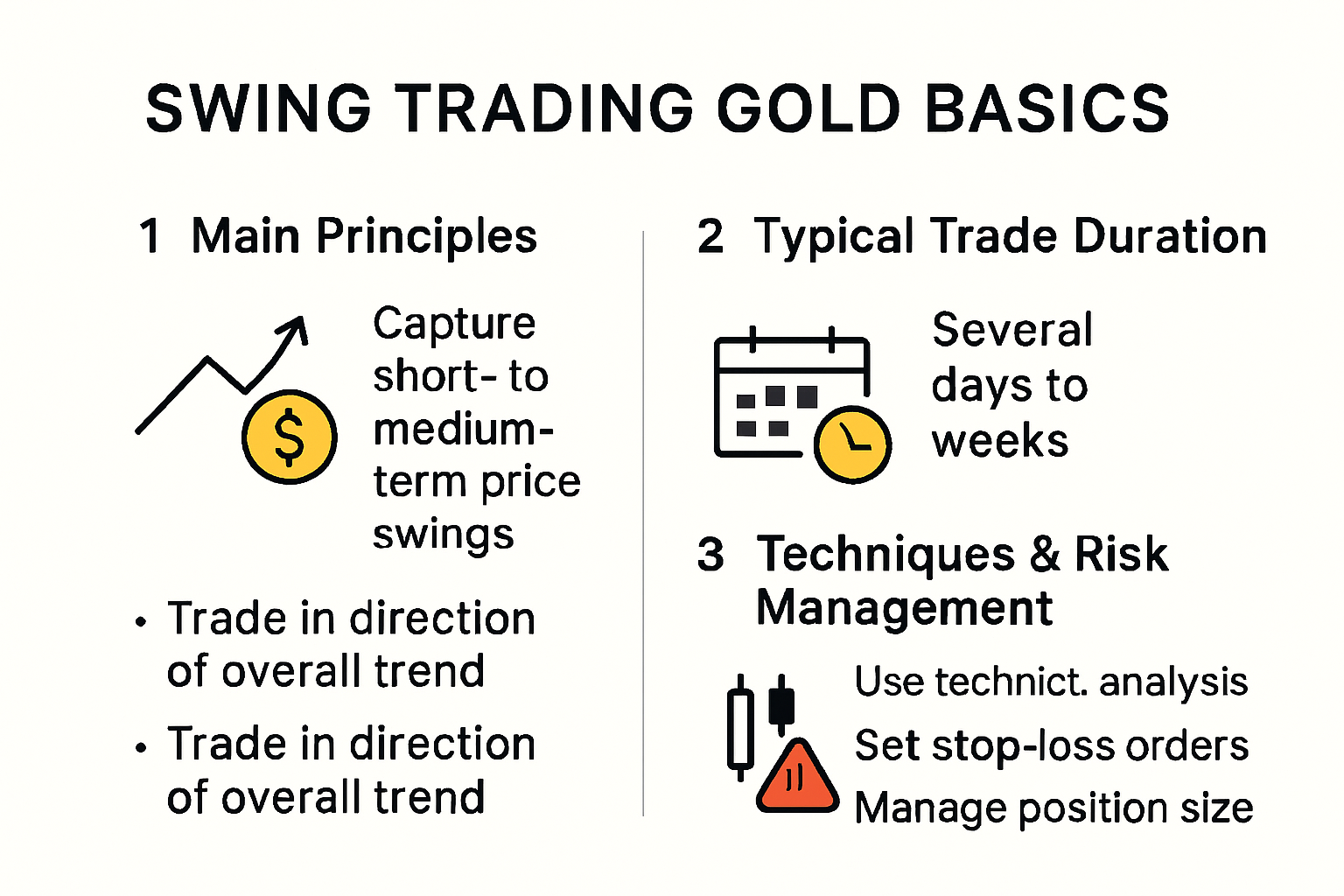
Swing trading gold represents a strategic approach to capitalizing on short to medium-term price fluctuations in the precious metal market. Unlike day trading, which involves multiple trades within a single day, swing trading gold provides traders with a more measured perspective on market movements.
Gold Market Price Dynamics
Swing trading gold fundamentally revolves around capturing price movements that typically occur over several days to weeks. Traders leverage technical analysis and market indicators to identify potential entry and exit points. The goal is not to predict every microscopic price change but to ride significant market trends that offer meaningful profit potential.
The core principle involves understanding gold’s unique market behavior. Gold prices are influenced by multiple factors including global economic conditions, currency valuations, geopolitical tensions, and investor sentiment. Swing traders must develop a nuanced understanding of these interconnected dynamics to make informed trading decisions.
Technical Analysis in Gold Swing Trading
Successful gold swing trading requires mastering technical analysis tools. According to market research from VT Markets, traders typically utilize multiple indicators to confirm potential trading opportunities. Key strategies include:
- Fibonacci Retracement: Identifying potential support and resistance levels using key mathematical ratios
- Moving Averages: Tracking price trend directions and momentum
- Relative Strength Index (RSI): Measuring momentum and potential trend reversals
Traders often use the 4-hour chart as their primary timeframe, combining indicators like RSI and MACD for robust signal confirmation. Position sizing becomes critical, with traders carefully managing risk through predetermined stop-loss and take-profit levels.
Risk Management Strategies
Risk management distinguishes successful swing traders from amateur investors. Gold markets can be volatile, demanding disciplined approaches to capital preservation. This means never risking more than a small percentage of your trading capital on a single trade, typically between 1-2%.
Effective swing trading in gold markets requires continuous learning, adaptability, and a deep understanding of both technical and fundamental market analysis. Traders must remain vigilant, continuously monitoring global economic indicators, central bank policies, and geopolitical events that could impact gold prices.
Learn more about advanced gold trading strategies to refine your approach and potentially enhance your trading performance in this dynamic market.
To better understand the most influential technical indicators for swing trading gold as mentioned above, the table below provides an at-a-glance overview of each indicator’s role and focus:
| Technical Indicator | Purpose/Function | Key Focus |
|---|---|---|
| Fibonacci Retracement | Identify potential support/resistance using ratios | Entry/exit levels |
| Moving Averages | Track trend direction & momentum | Trend analysis |
| Relative Strength Index (RSI) | Measure momentum and potential trend reversals | Overbought/oversold |
| MACD | Confirm momentum/trend strength with moving averages | Signal confirmation |
Key Strategies for Swing Trading Gold
Successful gold swing trading demands a sophisticated approach that combines multiple strategic techniques and deep market understanding. Traders must develop a comprehensive toolkit to navigate the complex and often unpredictable gold market landscape.
Trend Following and Momentum Strategies
Trend following remains a fundamental strategy in gold swing trading. According to research from the International Review of Financial Analysis, gold markets exhibit distinct bubble-like price behaviors that create unique trading opportunities. Traders identify primary market trends using multiple timeframe analysis, typically focusing on daily and weekly charts to confirm directional movements.
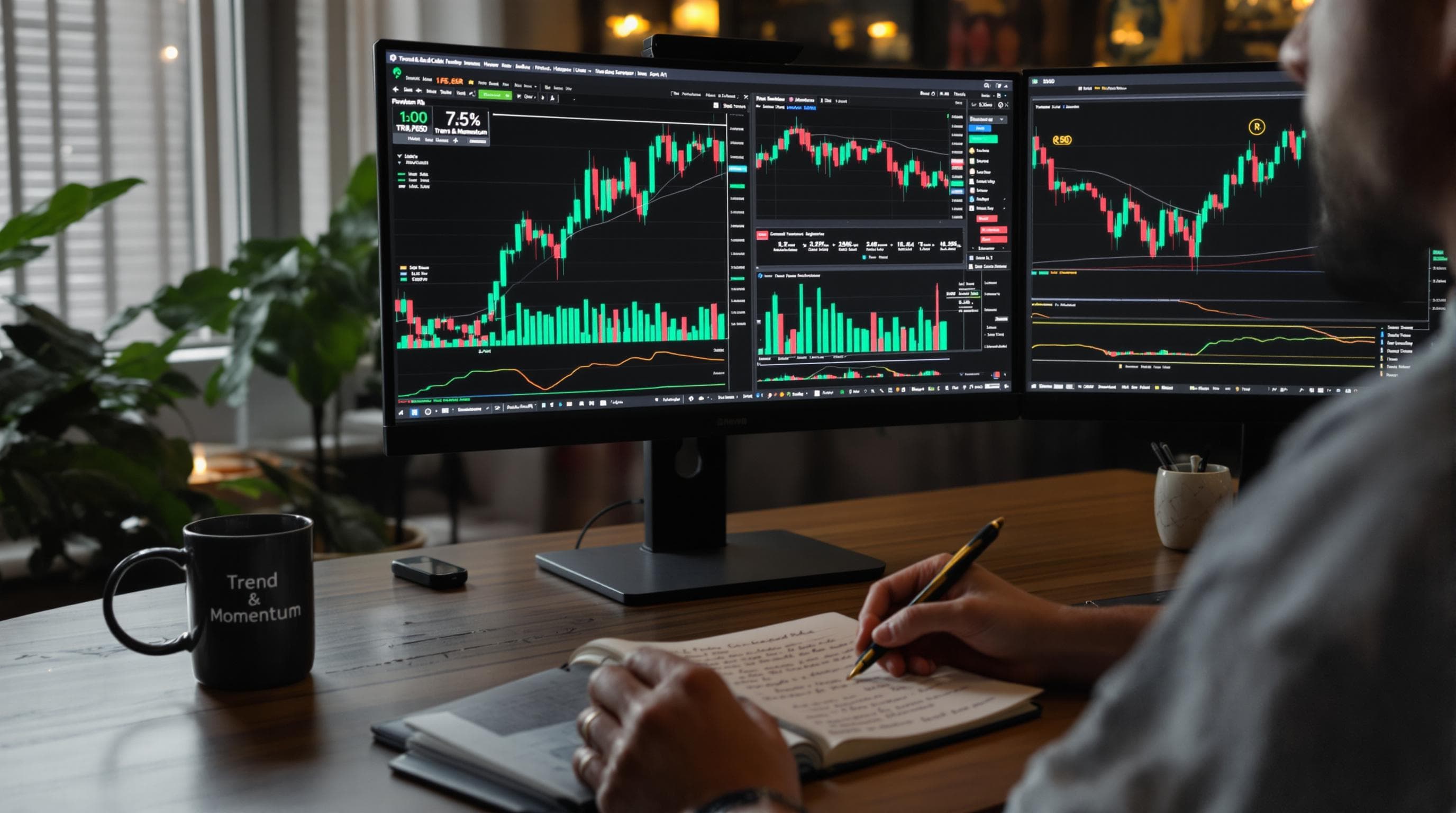
Key momentum indicators like the Moving Average Convergence Divergence (MACD) and Relative Strength Index (RSI) help traders validate potential entry and exit points. The strategy involves entering trades in the direction of the prevailing trend, using pullbacks as strategic entry opportunities. Traders look for confluence of multiple technical indicators to increase trade probability and reduce false signal risks.
Advanced Technical Analysis Techniques
Quantitative investment strategies have revolutionized gold trading by introducing sophisticated analytical approaches. Traders now utilize complex models that combine multiple technical indicators and machine learning algorithms to predict potential price movements.
Critical techniques include:
- Support and Resistance Mapping: Identifying key price levels where gold typically experiences trend reversals
- Fibonacci Retracement: Using mathematical ratios to predict potential pullback levels
- Volume Analysis: Understanding market participation and momentum through trading volume indicators
Successful implementation requires combining these techniques with fundamental analysis, monitoring global economic indicators, geopolitical events, and currency market dynamics that influence gold prices.
Risk Management and Position Sizing
Risk management separates professional traders from amateur speculators. Implementing robust risk control mechanisms is crucial in gold swing trading. Traders typically risk no more than 1-2% of their total trading capital on a single trade, using stop-loss orders to limit potential downside.
Position sizing strategies involve calculating precise entry points, potential profit targets, and maximum acceptable loss levels. Advanced traders use techniques like the Average True Range (ATR) to dynamically adjust position sizes based on market volatility. This approach ensures consistent risk management across different market conditions.
Explore advanced gold trading signal strategies to enhance your trading approach and develop a more nuanced understanding of market dynamics. Continuous learning and adaptation remain the hallmarks of successful gold swing trading.
Essential Tools and Signals for XAU/USD
Trading XAU/USD effectively requires a sophisticated arsenal of technological tools, analytical techniques, and real-time signal generation capabilities. Modern gold traders must leverage advanced technologies to gain a competitive edge in the dynamic precious metals market.
Advanced Technological Signal Generation
Research from recent neural network studies demonstrates remarkable potential in predicting gold versus USD commodity movements. Cutting-edge technologies like Long Short-Term Memory (LSTM) neural networks enable traders to generate minute-per-minute predictions with increasing accuracy. These machine learning models analyze complex market data patterns that human traders might overlook, providing nuanced insights into potential price movements.
According to news sentiment analysis research, traders can now integrate sophisticated information extraction frameworks that assess market sentiments from news headlines and social media. By training machine learning models on historical data, traders can develop predictive models that capture subtle market dynamics and potential price influencers.
Signal Generation and Market Sentiment Tools
Effective XAU/USD trading demands a multi-dimensional approach to signal generation. Key technological tools include:
- Sentiment Analysis Platforms: Utilizing lexicon-based and machine learning algorithms to gauge market emotions
- Real-Time News Aggregators: Tracking global economic indicators and geopolitical events
- Advanced Charting Software: Providing complex technical analysis capabilities
- Automated Trading Bots: Executing trades based on predefined algorithmic strategies
The integration of sentiment analysis represents a groundbreaking approach to trading. Research indicates that analyzing sentiments expressed in news and social media can provide critical insights into market movements, helping traders anticipate potential price shifts before they occur.
Risk Management and Signal Verification
Successful signal utilization goes beyond mere generation. Traders must develop robust verification mechanisms to validate potential trading opportunities. This involves cross-referencing multiple signal sources, understanding their individual reliability metrics, and creating comprehensive risk management protocols.
Key verification strategies include:
- Comparing signals across different technological platforms
- Analyzing signal accuracy rates historically
- Implementing strict risk-reward ratio assessments
- Using probabilistic modeling to evaluate signal reliability
Discover our comprehensive XAU/USD signal strategies to enhance your trading approach and leverage cutting-edge technological tools. The future of gold trading lies in intelligent, data-driven decision-making processes that combine human insight with technological precision.
Here’s a summary table comparing the essential technological tools used for XAU/USD trading, their primary function, and key benefits for swing traders:
| Tool | Main Function | Key Benefit |
|---|---|---|
| Sentiment Analysis Platform | Assesses market emotions/news impact | Early signal, captures market mood |
| News Aggregator | Tracks global news/events | Instant awareness, news interpretation |
| Charting Software | Technical analysis/visualization | Robust analysis, multiple indicators |
| Automated Trading Bot | Algorithmic trade execution | Speed, eliminates emotional bias |
Managing Risk and Maximizing Profit
Successful gold swing trading hinges on a trader’s ability to implement robust risk management strategies while simultaneously creating opportunities for consistent profitability. Understanding the delicate balance between risk mitigation and profit generation is crucial for long-term trading success.
Strategic Position Sizing and Capital Allocation
Advanced risk management techniques emphasize the critical importance of intelligent capital allocation. Professional traders typically risk no more than 1-2% of their total trading capital on any single trade. This approach ensures that a series of unsuccessful trades will not decimate the trading account, providing a critical buffer against market volatility.
Position sizing involves calculating precise trade entries, potential profit targets, and maximum acceptable loss levels. Traders use sophisticated methods like the Average True Range (ATR) to dynamically adjust position sizes based on current market volatility. This adaptive approach allows traders to maintain consistent risk exposure across different market conditions.
Risk Mitigation Techniques
According to risk management research, successful gold traders employ multiple layers of risk protection. Key strategies include:
- Stop-Loss Orders: Automatically limiting potential losses by setting predetermined exit points
- Diversification: Spreading risk across multiple trading instruments and strategies
- Hedging: Using complementary trading positions to offset potential losses
- Risk-Reward Ratio Analysis: Ensuring potential profits significantly outweigh potential losses
The 1:3 risk-reward ratio represents a standard benchmark, meaning traders aim to gain three dollars for every dollar potentially risked. This approach requires precise entry point selection and a deep understanding of market dynamics.
Psychological Aspects of Risk Management
Beyond technical strategies, successful risk management demands exceptional psychological discipline. Swing trading research highlights the importance of emotional control and consistent decision-making processes. Traders must develop a structured approach that removes emotional bias from trading decisions.
Key psychological strategies include:
- Maintaining a detailed trading journal
- Developing and strictly following a predefined trading plan
- Practicing mindfulness and emotional regulation techniques
- Accepting losses as a natural part of the trading process
Traders who view losses as learning opportunities rather than personal failures are more likely to maintain long-term trading success. The ability to analyze losing trades objectively and adapt strategies accordingly separates professional traders from amateurs.
Explore our comprehensive risk management guide to develop a more nuanced approach to protecting and growing your trading capital. Remember, in gold swing trading, preservation of capital is ultimately more important than any single trade’s potential profit.
Frequently Asked Questions
What is swing trading in gold?
Swing trading in gold involves capturing short to medium-term price fluctuations in the gold market, utilizing technical analysis and market indicators to identify optimal entry and exit points.
How much capital should I risk when swing trading gold?
Professional gold traders typically risk only 1-2% of their total capital on each trade to manage risk effectively while aiming for significant returns.
What technical indicators are best for swing trading gold?
Effective swing traders commonly use indicators such as Fibonacci Retracement, Moving Averages, and the Relative Strength Index (RSI) primarily on a 4-hour chart for robust signal confirmation.
What strategies can improve my success in swing trading gold?
Key strategies for success in swing trading gold include trend following, momentum trading, advanced technical analysis, and implementing strong risk management practices.
Take Your Gold Swing Trading to the Next Level With Expert Signals
Are you ready to apply what you have learned about swing trading gold to real money trades but still feel uncertain about market timing and risk management? Many traders face struggles turning strong technical analysis into consistent profits and managing risk exposure on fast-moving XAU/USD swings. If you want actionable strategies and accurate signals that take the guesswork out of your gold trades, you are not alone. For hands-on guidance and tailored support, visit our How To Guides for step-by-step instructions and practical resources designed to help you master every swing trade setup.
Ready for precise signals and strategies that keep your swing trades profitable and your risk under control? Join our private Telegram group at https://xau-gold-signals.com and unlock access to our high-accuracy XAU/USD signals. Start maximizing your gold trading results today with proven strategies trusted by successful traders. Opportunity in the gold market does not wait. Act now to see the difference expert-driven signals can make for your next trade.
