
Gold and the US dollar have a reputation for moving in opposite directions, shaping the decisions of traders across the globe. Here is something that might surprise you. During the COVID-19 pandemic, both gold and the US dollar rose at the same time, flipping old assumptions on their heads. If you think gold always jumps when the dollar drops, get ready to rethink your strategy for 2025.
Table of Contents
- How USD Movements Influence Gold Prices
- Key Factors Affecting USD And Gold Relationship
- Strategies For Trading Gold With USD Trends
- Recent USD Fluctuations And Gold Market Outlook 2025
Quick Summary
| Takeaway | Explanation |
|---|---|
| Inverse Relationship | The U.S. dollar and gold prices traditionally show a strong inverse correlation; as the dollar strengthens, gold prices typically decline, and vice versa. |
| Complex Market Dynamics | During extreme market conditions, the usual correlation can break down, requiring traders to consider broader economic indicators and geopolitical events. |
| Risk Management Strategies | Successful trading of gold involves advanced risk management techniques, incorporating predictive modeling and flexibility to adjust strategies based on changing market conditions. |
| State-Dependent Correlation | The inverse relationship between gold and the USD varies depending on economic conditions, indicating that traders should adapt their strategies according to interest rate environments. |
| Holistic Approach | A well-rounded strategy that integrates technical analysis, economic understanding, and nimble decision-making is crucial for navigating the complexities of the gold market in relation to USD fluctuations. |
Understanding the intricate relationship between the U.S. dollar and gold prices is crucial for traders seeking to navigate the complex world of international markets. The connection between these two financial instruments represents a fundamental dynamic that can significantly impact investment strategies and trading decisions.
How USD Movements Influence Gold Prices
Understanding the intricate relationship between the U.S. dollar and gold prices is crucial for traders seeking to navigate the complex world of international markets. The connection between these two financial instruments represents a fundamental dynamic that can significantly impact investment strategies and trading decisions.
The Inverse Correlation Mechanism
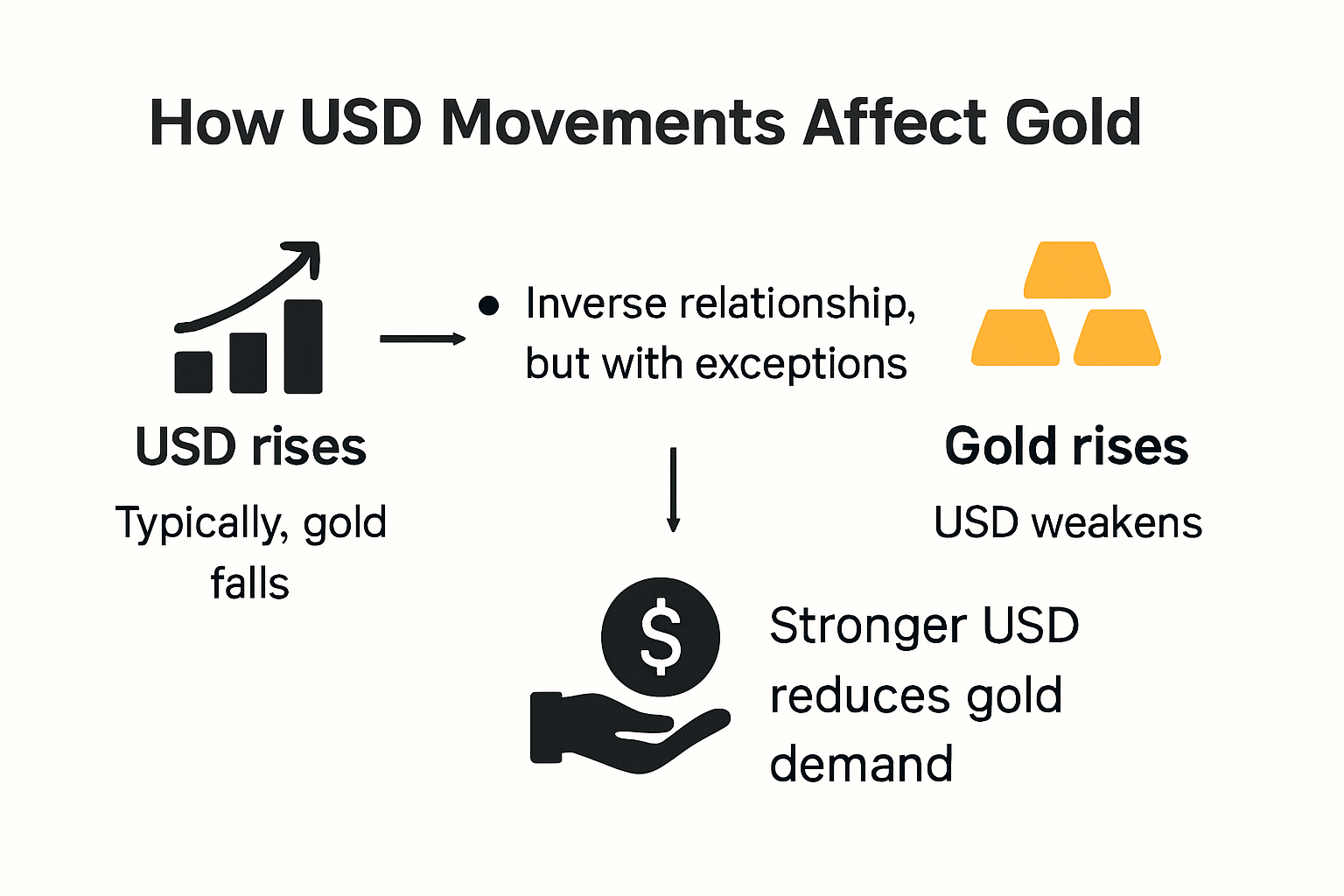
The U.S. dollar and gold prices traditionally exhibit a strong inverse relationship. When the dollar strengthens, gold prices typically decline, and when the dollar weakens, gold prices tend to rise. This mechanism stems from the fundamental economic principles of global trade and currency valuation. Investopedia explains that a stronger dollar makes gold more expensive for international buyers, effectively reducing global demand and putting downward pressure on prices.
Traders must recognize that this relationship is not simply a coincidence but a result of complex market dynamics. When the U.S. dollar gains strength, it becomes more expensive for investors holding other currencies to purchase gold. Conversely, a weaker dollar makes gold more affordable and attractive to international investors, potentially driving up demand and price.
Contextual Variations in Currency Gold Dynamics
Interestingly, the relationship between the U.S. dollar and gold is not always straightforward. Scientific research suggests that during extreme market conditions, such as financial crises, the typical inverse correlation can be disrupted. In some instances, both the dollar and gold might move in the same direction, challenging traditional market assumptions.
This nuanced relationship underscores the importance of comprehensive market analysis. Traders cannot rely solely on the dollar-gold correlation but must consider broader economic indicators, geopolitical events, and market sentiment. Factors such as inflation rates, central bank policies, and global economic uncertainty can all influence this delicate balance.
Strategic Implications for Traders
Successful trading requires a deep understanding of these complex interactions. Monitoring the U.S. dollar’s performance becomes crucial for gold traders. Small fluctuations in currency strength can translate into significant price movements in the gold market. Learn more about advanced gold trading strategies.
Professional traders develop sophisticated models that incorporate multiple variables to predict potential gold price movements. They track not just currency movements but also analyze broader economic trends, interest rates, and global economic indicators. This multifaceted approach allows for more accurate predictions and more informed trading decisions.
Understanding the USD-gold relationship is not just about recognizing an inverse correlation. It is about comprehending the underlying economic mechanisms that drive these market dynamics. By developing a nuanced understanding of how currency movements influence gold prices, traders can position themselves to make more strategic and potentially profitable trading decisions in an ever-changing global market.
Key Factors Affecting USD and Gold Relationship

The relationship between the U.S. dollar and gold is complex and influenced by multiple interconnected economic factors. Understanding these key drivers helps traders develop more sophisticated strategies for navigating market dynamics.
Economic Indicators and Market Sentiment
Economic indicators play a critical role in shaping the USD-gold relationship. Research published in the Business Administration and Economics Review revealed that inflation and dollar strength are primary determinants of gold price movements. When inflation rises, investors often turn to gold as a hedge against currency devaluation, creating a nuanced interaction between economic indicators and precious metal valuation.
Market sentiment emerges as another crucial factor. During periods of economic uncertainty, traditional market correlations can shift dramatically. Scientific research demonstrates that extreme market conditions can disrupt the typical inverse relationship between gold and the U.S. dollar, highlighting the importance of adaptive trading strategies.
To clarify, here’s a table summarizing the main factors that influence the USD-gold relationship as discussed in this section:
| Factor | Role/Impact on USD-Gold Relationship | Example/Context |
|---|---|---|
| Inflation | Drives investors to gold as hedge against currency devaluation | High inflation increases gold demand |
| USD Strength | Inverse correlation with gold; strong USD makes gold costlier globally | Stronger USD tends to lower gold price |
| Market Sentiment | Can override traditional correlations in uncertainty or crisis | Crisis may send both USD and gold upward |
| Central Bank Policy | Influences both USD and gold via interest rates and monetary policy | Fed rates shifts affect both markets |
| Geopolitical Tensions | Boost safe-haven demand, potentially raising both assets simultaneously | COVID-19, international conflicts |
Geopolitical Dynamics and Economic Stress
Geopolitical tensions and global economic stress significantly impact the USD-gold relationship. The National reported instances during the COVID-19 pandemic where both gold and the U.S. dollar appreciated simultaneously, challenging conventional market assumptions.
Traders must consider multiple variables beyond simple currency movements. Central bank policies, international trade tensions, and global economic stability all contribute to the complex interplay between the U.S. dollar and gold prices. These factors create a multidimensional landscape that requires continuous monitoring and sophisticated analytical approaches.
Risk Management and Strategic Analysis
Effective trading requires a comprehensive approach to understanding the USD-gold relationship. Professionals develop advanced models that incorporate economic indicators, geopolitical events, and market sentiment. Explore advanced gold trading strategies to enhance your market analysis techniques.
Risk management becomes paramount in this dynamic environment. Traders must remain flexible, recognizing that historical correlations can break down during periods of significant economic disruption. Developing a nuanced understanding of the factors influencing the USD-gold relationship allows for more informed and adaptive trading decisions.
Ultimately, success in trading gold requires a holistic approach. By understanding the intricate interactions between economic indicators, market sentiment, and global dynamics, traders can position themselves to make more strategic and potentially profitable decisions in an increasingly complex global market.
Strategies for Trading Gold with USD Trends
Trading gold effectively requires a sophisticated understanding of USD trends and their complex interactions with precious metal markets. Professional traders develop multifaceted approaches that go beyond simple correlation monitoring.
Advanced Technical Analysis Techniques
Technical analysis emerges as a critical tool for traders navigating gold markets. Research presented at the AI2SD 2022 conference introduced innovative trading strategies combining fractals and Triangular Moving Average Centered Bands to predict gold prices. These advanced techniques demonstrated a higher probability of successful trades by integrating multiple analytical indicators.
Traders can leverage sophisticated models that incorporate moving averages, relative strength indicators, and trend analysis. By examining short-term and long-term USD fluctuations, investors can develop more nuanced trading strategies that anticipate potential gold price movements.
Risk Management and Predictive Modeling
Risk management becomes paramount when trading gold in relation to USD trends. A comprehensive study in Resources Policy developed a multifractal-based model for gold price forecasting, utilizing the Hurst exponent and swarm intelligence optimization. This approach provides traders with more sophisticated tools for understanding market dynamics and potential price trajectories.
Professional traders recognize that no single strategy guarantees success. Diversification and adaptive approaches are crucial. Monitoring economic indicators, geopolitical events, and market sentiment allows for more informed decision-making. The ability to quickly adjust strategies based on changing market conditions separates successful traders from those who rely on rigid, outdated methods.
Safe-Haven Asset Strategies
During periods of economic uncertainty, gold and the U.S. dollar often function as safe-haven assets. A study published in Economies revealed fascinating insights during global crises like the COVID-19 pandemic, where both the U.S. Dollar Index and gold prices increased simultaneously.
Traders can develop hedging strategies that capitalize on these unique market dynamics. Learn more about advanced gold trading techniques to refine your approach to market analysis and risk management.
Below is a table comparing different gold trading strategies covered in this section, showing their core focus and application:
| Strategy Type | Core Focus | Application/Method |
|---|---|---|
| Advanced Technical Analysis | Price prediction using complex indicators | Fractals, Moving Averages, Trend Analysis |
| Risk Management & Predictive Modeling | Managing exposure, forecasting trends | Diversification, Multifractal models, Swarm Intelligence |
| Safe-Haven Asset Strategy | Protection during uncertainty/crises | Hedging with gold and/or USD when both act as safe-havens |
Successful gold trading requires a holistic approach that combines technical analysis, risk management, and a deep understanding of global economic trends. By developing flexible strategies that adapt to changing market conditions, traders can position themselves to capitalize on the complex relationship between the U.S. dollar and gold prices.
Recent USD Fluctuations and Gold Market Outlook 2025
The global financial landscape in 2025 presents a complex environment for gold traders, with USD fluctuations creating both challenges and opportunities for strategic investment. Understanding the nuanced interactions between currency movements and precious metal markets becomes crucial for informed decision-making.
Economic Indicators and Currency Dynamics
Research published in Advances in Economics, Management and Political Sciences emphasizes that the U.S. dollar index remains a significant predictor of gold prices. The study reveals that currency valuation directly influences gold demand and pricing, highlighting the intricate relationship between monetary policy and precious metal markets.
Economic projections suggest a period of measured volatility. The World Gold Council’s 2025 outlook indicates that the U.S. dollar is expected to remain relatively flat or experience slight weakening as global economic conditions gradually normalize. This anticipated stability creates a nuanced environment for gold traders seeking to optimize their investment strategies.
State-Dependent Market Behaviors
A groundbreaking study in Economies journal uncovered fascinating insights into the gold-USD relationship. The research demonstrated that the inverse correlation between gold prices and the U.S. dollar exchange rate is state-dependent, varying across different federal funds rate zones. This finding suggests that gold and the U.S. dollar function as risk-hedging substitutes with complex, context-specific interactions.
Traders must recognize that traditional market assumptions may not always apply. The substitution effect between gold and USD varies significantly, being weaker in low-interest rate environments and more pronounced in higher rate zones. This complexity demands a sophisticated, adaptive approach to market analysis.
Strategic Considerations for 2025
Professional investors are positioning themselves for a potentially volatile yet opportunity-rich market. Global economic factors such as below-trend growth, inflation slightly above target, and elevated geopolitical risks create a multifaceted investment landscape. Explore our latest gold trading insights to develop a more comprehensive understanding of market dynamics.
Key strategic considerations include monitoring central bank policies, tracking geopolitical developments, and maintaining flexibility in investment approaches. The interplay between USD strength, global economic indicators, and gold prices requires continuous analysis and adaptive strategies.
Successful navigation of the 2025 market will demand a holistic approach. Traders who combine rigorous technical analysis, comprehensive economic understanding, and nimble decision-making will be best positioned to capitalize on the complex relationship between the U.S. dollar and gold prices. The ability to interpret nuanced market signals and respond quickly to changing conditions will separate strategic investors from reactive traders.
Frequently Asked Questions
What is the relationship between the USD and gold prices?
The U.S. dollar and gold prices typically have an inverse relationship; when the dollar strengthens, gold prices tend to decline, and when the dollar weakens, gold prices usually rise.
Why did gold and the USD rise together during the COVID-19 pandemic?
During the COVID-19 pandemic, both assets appreciated simultaneously due to heightened market uncertainty, demonstrating that traditional correlations can break down under extreme conditions.
How can traders effectively manage risks when trading gold?
Traders can manage risks by utilizing advanced modeling techniques, diversifying their investments, and adapting strategies based on economic indicators and geopolitical events impacting the USD-gold relationship.
What strategies should traders consider for trading gold in relation to USD trends in 2025?
Traders should focus on a holistic approach incorporating advanced technical analysis, understanding economic indicators, and being flexible with their strategies to respond to changing market conditions.
Trade Gold Smarter as USD Dynamics Shift in 2025
Navigating the unpredictable relationship between gold and the US dollar can be overwhelming. This article laid out how sudden shifts in inflation, market sentiment, and global events are breaking old patterns and creating new risks for traders. If you want to move beyond second-guessing the market and start trading with confidence, you need up-to-date support and proven methods. Discover the latest market shifts and actionable tips on our News & Updates page, designed to help you stay a step ahead.
Join the traders who are turning deep insights into real profits. Our XAU/USD signals at xau-gold-signals.com combine advanced technical and fundamental analysis to deliver the high-accuracy strategies you need. Don’t wait. Start using accurate gold trading signals to secure your edge in 2025 and beyond. Join our private Telegram group today and experience a new level of trading confidence.
Recommended
- Gold Price Forecast: What’s Next For XAU/USD?
- Blog | XAU/USDT Gold Trading Signals
- News & Updates | XAU/USDT Gold Trading Signals
- Best XAU/USD Gold Trading Signals For Consistent Profits
- Market Structure in Forex: Pro Strategies for 2025 Success – Earnex
- Private Lending Opportunities 2025: Smart Strategies for Expats & Investors – costaricaloanexperts.net
