

Gold trading demands more than sharp instincts and a heavy dose of courage. After all, fear and greed can impact up to 80 percent of all trading decisions according to behavioral studies. Most people believe mastering charts is everything. Surprising as it sounds, understanding your emotions might be the single most powerful edge you will ever have in the gold market.
Table of Contents
- Understanding Emotions In Gold Trading
- Developing A Disciplined Trading Mindset
- Effective Stress Management For Gold Traders
- Adapting Psychology To Trading Signals And Market Trends
Quick Summary
| Takeaway | Explanation |
|---|---|
| Understand Emotions’ Impact on Trading | Recognizing emotional responses aids in making better trading decisions and enhancing performance. |
| Develop and Stick to a Trading Discipline | A disciplined approach improves consistency and protects against impulsive decisions during market volatility. |
| Implement Effective Stress Management Techniques | Managing stress through routines and mindfulness enhances decision-making and prevents burnout. |
| Maintain Psychological Flexibility in Trading | Adapting to new information and market changes is crucial for successful trading strategies. |
| Utilize a Trading Journal for Self-Reflection | Documenting trades and emotional responses helps identify patterns that can improve future trading behavior. |
Understanding Emotions in Gold Trading
Emotional intelligence is a critical yet often overlooked factor in successful gold trading. Traders who understand and manage their psychological responses can significantly improve their trading performance and decision-making processes.
The Psychology of Trading Emotions
Trading gold involves more than just technical analysis and market knowledge. Explore advanced trading psychology techniques to understand how emotions impact financial decisions. A groundbreaking study published in Management Science revealed that physiological measures of emotion, such as heart rate and skin conductance, are directly associated with trading outcomes. Traders experiencing heightened emotional engagement demonstrated higher performance levels, suggesting that emotions are not merely obstacles but potential strategic assets.
The human brain is wired to react emotionally to financial gains and losses. According to research in Frontiers in Psychology, anticipatory emotions significantly influence investment decisions. These emotions can trigger two primary psychological responses: fear and greed. Fear might cause traders to exit profitable positions prematurely, while unchecked greed can lead to excessive risk-taking.
Emotional Triggers in Gold Trading
Gold trading presents unique emotional challenges. Market volatility, sudden price fluctuations, and global economic uncertainties can provoke intense psychological responses. Research analyzing over 28.5 million trades demonstrated a fascinating phenomenon known as loss aversion. Traders consistently exhibited greater sensitivity to potential losses compared to equivalent gains, which profoundly impacts trading strategies.
This loss aversion typically manifests in two behavioral patterns:
- Risk Aversion in Gains: Traders become overly cautious when experiencing profits, often limiting their potential earnings by exiting positions too early.
- Risk Seeking in Losses: Paradoxically, traders might become more aggressive when facing potential losses, making increasingly risky decisions to recover.
To clarify how emotional triggers manifest in gold trading, here is a table summarizing their behavioral effects:
| Emotional Trigger | Typical Behavioral Response | Example in Gold Trading |
|---|---|---|
| Fear (during gains) | Exiting profitable positions too early | Selling gold after small profit |
| Greed (during gains) | Overstaying in winning trades, risking losses | Not securing profit, hoping for more |
| Loss Aversion | Prioritizing avoidance of losses over potential gains | Holding losing positions too long |
| Risk Seeking (after losses) | Increasing position size to recover losses | Doubling down on losing gold trades |
| Market Volatility | Making impulsive, emotionally driven decisions | Quick trades after sudden price swings |
Strategies for Emotional Management
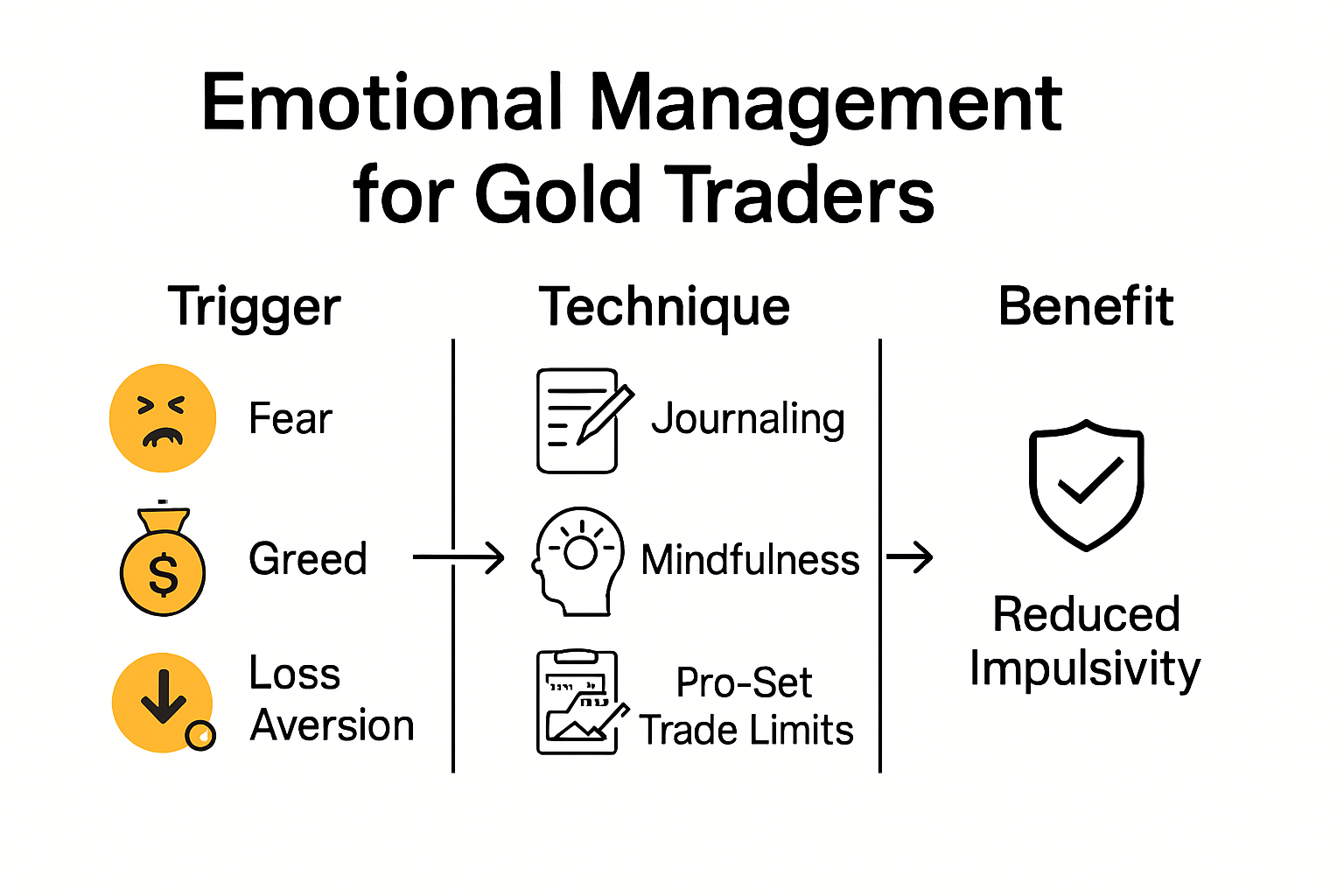
Controlling emotional responses requires deliberate practice and self-awareness. Successful gold traders develop robust psychological frameworks that help them maintain objectivity. This involves creating predefined trading rules, maintaining a disciplined approach, and implementing strict risk management techniques.
Key emotional management strategies include:
- Maintaining a Trading Journal: Document your emotional states during trades to identify patterns and triggers.
- Practicing Mindfulness: Develop techniques to stay present and reduce impulsive decision-making.
- Setting Clear Risk Parameters: Establish stop-loss and take-profit levels before entering a trade to minimize emotional interference.
Understanding and managing trading psychology is not about eliminating emotions but channeling them constructively. By recognizing emotional patterns, gold traders can transform potential psychological vulnerabilities into strategic advantages, ultimately improving their trading performance and long-term success.
Developing a Disciplined Trading Mindset
A disciplined trading mindset is the foundation of consistent success in gold trading. Professional traders understand that psychological control is just as critical as technical analysis and market knowledge.
The Core of Trading Discipline
Discover strategic trading discipline techniques that transform your approach to gold markets. According to research from the National Bureau of Economic Research, disciplined traders who adhere to pre-defined strategies consistently outperform those who trade impulsively. Discipline is not about eliminating emotions but channeling them strategically.
The essence of a disciplined mindset involves three fundamental components: emotional regulation, consistent strategy execution, and continuous self-improvement. Traders must develop the ability to make rational decisions under pressure, separating logical analysis from emotional impulses.
Building Psychological Resilience
Trading gold requires mental fortitude. The market’s inherent volatility demands traders maintain composure during unpredictable price movements. Psychological resilience involves creating robust mental frameworks that allow traders to:
- Maintain Emotional Neutrality: Avoid getting overly excited during winning trades or devastated during losses.
- Accept Market Uncertainty: Recognize that no trade is guaranteed and market conditions constantly change.
- Practice Detachment: View trading as a probabilistic endeavor rather than an emotional rollercoaster.
Successful gold traders develop a systematic approach that transcends momentary market fluctuations. This means establishing clear rules for entry and exit points, risk management, and position sizing before executing any trade.
Strategic Self-Management Techniques
Developing a disciplined trading mindset requires deliberate practice and continuous learning. Traders can enhance their psychological approach through several strategic techniques:
- Regular Performance Review: Conduct systematic evaluations of trading performance, analyzing both successful and unsuccessful trades.
- Mental Conditioning: Implement meditation and mindfulness practices to improve focus and emotional control.
- Continuous Education: Stay updated with market trends, psychological research, and advanced trading methodologies.
The table below summarizes self-management techniques and their benefits for trading discipline:
| Self-Management Technique | Description | Trading Benefit |
|---|---|---|
| Regular Performance Review | Systematic analysis of trades and outcomes | Identifies strengths and weaknesses |
| Mental Conditioning | Meditation and mindfulness to regulate emotions | Improved focus and resilience |
| Continuous Education | Staying informed with market and psychological updates | Enhanced knowledge and adaptability |
| Routine Rule Establishment | Predefining entry, exit, and risk management rules | Supports discipline and reduces impulse |
Trading discipline is not an innate trait but a skill cultivated through consistent practice and self-awareness. By understanding psychological patterns, gold traders can transform potential mental obstacles into strategic advantages, ultimately achieving more consistent and profitable trading outcomes.
Effective Stress Management for Gold Traders
Stress management is a critical skill for gold traders navigating the complex and volatile financial markets. The high-stakes nature of trading can trigger significant psychological and physiological responses that directly impact decision-making and overall performance.
Understanding Trading Stress Mechanisms
Explore advanced stress management techniques tailored for gold traders. Research from the University of Cambridge reveals that elevated cortisol levels can lead to increased risk aversion, potentially compromising trading strategies. Traders experience stress through multiple channels: market uncertainty, financial pressures, and the constant need for rapid decision-making.
The physiological impact of trading stress goes beyond emotional discomfort. Chronic stress can impair cognitive functions, reduce analytical capabilities, and lead to burnout. Recognizing stress triggers becomes the first step in developing effective management strategies.
Holistic Stress Reduction Strategies
According to the National Center for Biotechnology Information, mindfulness-based stress reduction (MBSR) programs offer powerful techniques for managing professional stress. These approaches include:
- Meditation Practices: Develop daily meditation routines to enhance mental clarity and emotional regulation.
- Breathing Techniques: Implement controlled breathing exercises to manage immediate stress responses during trading.
- Physical Exercise: Engage in regular physical activity to reduce stress hormones and improve overall mental resilience.
The National Institute for Occupational Safety and Health emphasizes the importance of creating a balanced approach to professional challenges. For gold traders, this means developing a comprehensive stress management framework that addresses both psychological and physiological dimensions.
Practical Stress Management Techniques
Successful gold traders develop a multilayered approach to stress management that extends beyond traditional relaxation techniques. Key strategies include:
- Structured Trading Routine: Create a consistent daily schedule that includes dedicated time for market analysis, trading, and personal recovery.
- Risk Management Protocols: Establish clear risk parameters that provide psychological safety and reduce decision-related anxiety.
- Professional Support Networks: Build connections with fellow traders and mental health professionals who understand the unique challenges of financial trading.
Stress management is not about eliminating stress entirely but developing robust mechanisms to navigate and transform stressful experiences. By implementing strategic techniques, gold traders can maintain peak performance, protect their mental well-being, and create sustainable success in the dynamic world of financial markets.
Adapting Psychology to Trading Signals and Market Trends
Successful gold trading demands more than technical analysis. Traders must develop a sophisticated psychological approach that interprets market signals while managing their own cognitive biases and emotional responses.
Understanding Signal Interpretation Psychology
Learn sophisticated signal interpretation techniques that transform your trading strategy. Research examining over 28.5 million trades reveals complex psychological patterns underlying market behavior. Traders often unconsciously adopt strategies like ‘Market Imitation’ and ‘Win-Stay Lose-Shift’, which significantly impact decision-making processes.
The psychological landscape of trading signals involves understanding how traders perceive and react to market information. Cognitive biases such as confirmation bias and recency bias can distort signal interpretation, leading traders to seek information that confirms their existing beliefs or overemphasize recent market movements.
Cognitive Flexibility in Market Trends
Adapting to market trends requires developing cognitive flexibility. Research demonstrating technical trading memory effects highlights the importance of dynamic psychological approaches. Successful traders must:
- Challenge Existing Assumptions: Continuously question and validate trading hypotheses.
- Remain Objective: Separate emotional responses from analytical decision-making.
- Develop Adaptive Strategies: Create flexible trading frameworks that can quickly respond to changing market conditions.
Traders who maintain psychological adaptability can more effectively navigate the complex landscape of gold trading. This involves developing a nuanced understanding of market signals beyond simple technical indicators.
Strategic Signal Processing

Psychological adaptation to trading signals involves a multifaceted approach. Key strategies include:
- Systematic Signal Evaluation: Create structured processes for analyzing and interpreting trading signals.
- Emotional Detachment: Develop techniques to maintain psychological distance from individual trade outcomes.
- Continuous Learning: Regularly review and adjust trading strategies based on market performance and psychological insights.
The most successful gold traders view signal interpretation as a dynamic psychological process. By understanding the intricate relationship between market trends, trading signals, and individual psychological responses, traders can develop more robust and adaptive trading strategies that transcend traditional analytical approaches.
Frequently Asked Questions
How can emotions impact gold trading decisions?
Emotions such as fear and greed can significantly influence trading decisions. Behavioral studies indicate that these emotions can affect up to 80 percent of trading choices, leading to premature exits from profitable positions or excessive risk-taking during losses.
What strategies can help manage emotions while trading gold?
Traders can manage their emotions by maintaining a trading journal, practicing mindfulness, and setting clear risk parameters to establish rules for entering and exiting trades, which can minimize emotional interference during trading.
Why is a disciplined mindset important in gold trading?
A disciplined mindset is essential for consistent success in gold trading as it helps traders separate logical analysis from emotional impulses. It leads to better strategy execution and improved trading performance, particularly during market volatility.
What are effective stress management techniques for gold traders?
Effective stress management techniques for gold traders include establishing a structured trading routine, implementing risk management protocols, engaging in physical exercise, and practicing mindfulness and meditation to enhance mental resilience and decision-making.
Turn Your Gold Trading Psychology Into Real Profits—Start Winning Now
You have learned how emotions like fear, greed, and loss aversion can hold traders back. Mastering your mindset is only the first step. If you want to turn personal growth into consistent profit, you need rock-solid strategies and tools that reinforce discipline and remove emotional guesswork. Our How To Guides walk you through actionable techniques that align with the psychology tips covered in this article, giving you a trusted framework for every gold trade.

Ready to stop letting emotions sabotage your XAU/USD trades? Join https://xau-gold-signals.com now and get access to the industry’s most accurate gold signals, proven trading strategies, and professional support. Take action today and see how powerful it feels to trade gold with confidence, clarity, and real financial results.
Recommended
- Gold Trading For Beginners 2025: Smart Strategies And Signals | XAU/USDT Gold Trading Signals
- Day Trading Gold Tips: Smart Strategies For 2025 | XAU/USDT Gold Trading Signals
- Maximizing Gold Trading Profits In 2025: Top Strategies For Traders | XAU/USDT Gold Trading Signals
- How To Analyze Gold Trends For Smart Trading In 2025 | XAU/USDT Gold Trading Signals
