


Gold trading attracts everyone from cautious savers to wild speculators, and for good reason. In 2024, the average daily trading volume for XAU/USD hit over $200 billion worldwide, outpacing even some major stock markets. But here’s the curveball. Most beginners believe that mastering gold means simply watching price spikes or chasing market news. The twist is even sharper: the real edge comes from blending technical signals with psychological resilience and strict risk management. What separates profitable traders is not luck, but knowing how to read the pulse of global events and using robust strategies that limit losses while seizing genuine profit opportunities.
Table of Contents
- How The Gold Market Works For Forex Traders
- Essential Gold Trading Strategies And Signals
- Swing Trading And Technical Analysis For XAU/USD
- Beginner Tips For Risk Management And Profitable Gold Trades
Quick Summary
| Takeaway | Explanation |
|---|---|
| Understand Global Economic Dynamics | Gold prices are driven by intricate global economic factors, including geopolitical tensions and investor sentiment, making it essential for traders to stay informed on these trends. |
| Utilize Technical Analysis | Successful gold trading requires employing multiple technical indicators, such as Moving Averages, RSI, and Fibonacci retracement, across various timeframes to enhance trading precision. |
| Implement Effective Risk Management | Traders should develop comprehensive risk management strategies, including predefined entry and exit rules, to limit losses and protect capital, while maintaining a minimum risk-to-reward ratio of 1:2. |
| Adopt Swing Trading Strategies | Swing trading for XAU/USD combines technical analysis and understanding market cycles, relying on precise entry/exit timing across multiple timeframes to capitalize on price movements. |
| Cultivate Psychological Resilience | Successful trading involves mental discipline and the ability to learn from losses; viewing risk management as insurance rather than just numbers is crucial for long-term success. |
How the Gold Market Works for Forex Traders
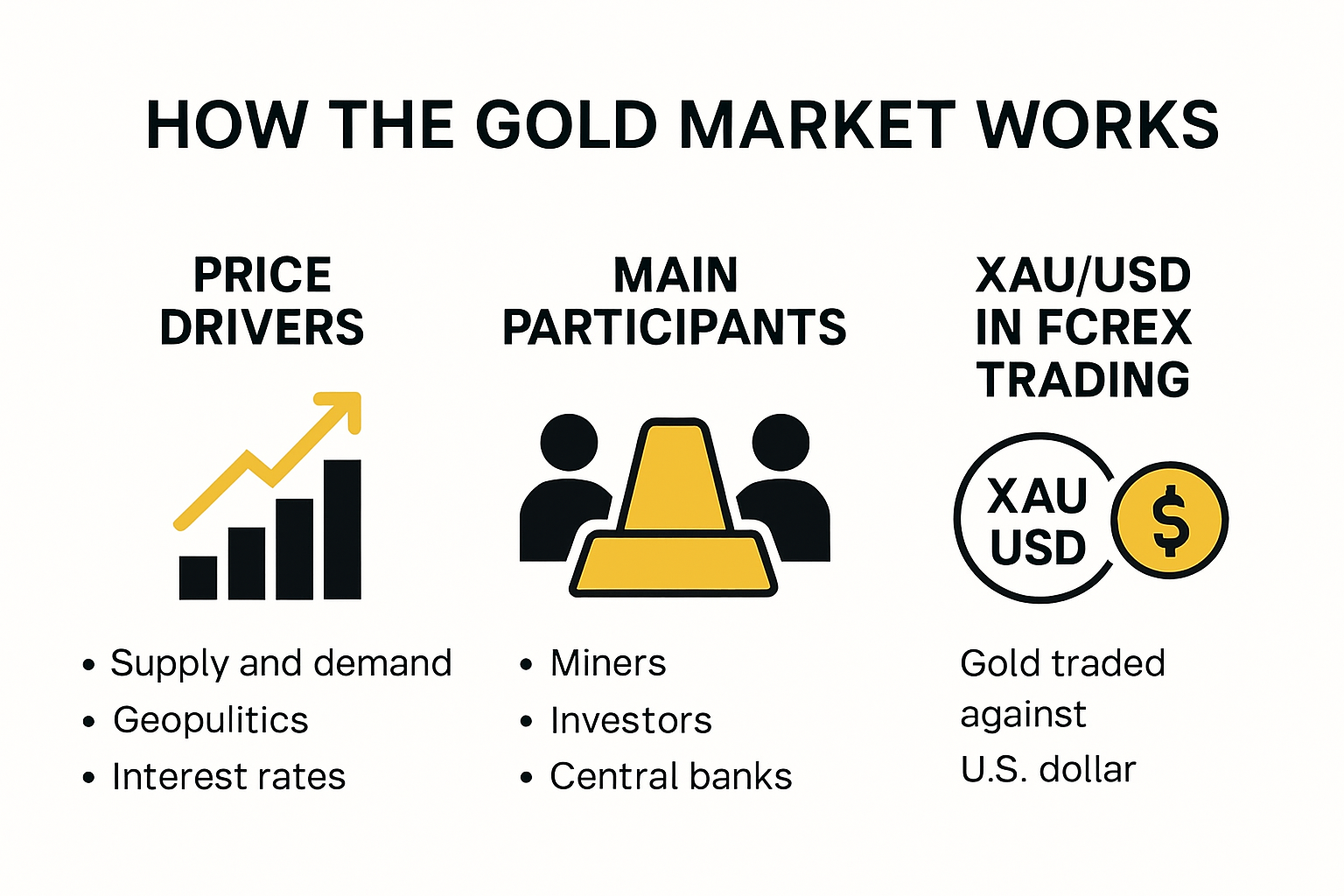
Understanding the gold market requires deep insight into complex global economic dynamics that drive trading strategies. Gold trading in forex represents a unique investment arena where traders can capitalize on price movements of this precious metal against the U.S. dollar (XAU/USD).
The Global Economic Machinery Behind Gold Pricing
Gold prices are not random but result from intricate interactions between global economic indicators, geopolitical tensions, and investor sentiment. Our guide on market trends reveals that gold serves as a critical barometer for economic health and uncertainty.
According to Liquidity Finder, gold’s price in forex markets is heavily influenced by global risk sentiment. During periods of geopolitical or economic uncertainty, gold typically surges as traders seek safe-haven assets. Major price movements are often triggered by headline news and global events that signal potential economic instability.
Key Drivers of Gold Price Movements
The U.S. dollar plays a pivotal role in gold trading. Research from Isabel Bullion demonstrates that dollar strength directly impacts gold prices. When the USD strengthens, gold prices typically decline, and vice versa. Traders must closely monitor economic indicators such as:
- GDP Growth: Signals overall economic performance
- Employment Rates: Indicates economic stability
- Trade Policies: Influences currency and commodity valuations
Successful gold trading requires a nuanced understanding of these interconnected factors. OPO Finance Blog emphasizes that traders must blend fundamental analysis with technical tools like moving averages, Relative Strength Index (RSI), and Fibonacci retracement to identify optimal trading opportunities.
To help you quickly understand the fundamental drivers of gold price movements, the table below summarizes the key indicators and their effects on gold prices.
| Key Economic Indicator | Influence on Gold Price | Typical Effect When Indicator Strengthens |
|---|---|---|
| U.S. Dollar (USD) Strength | Inverse correlation | Gold price usually decreases |
| GDP Growth | Direct/Indirect, reflects health | Gold price may fall as economic optimism rises |
| Employment Rates | Indicates economic stability | Higher rates can lower gold’s safe-haven appeal |
| Trade Policies | Influences currency & gold demand | Unfavorable policies often boost gold prices |
| Geopolitical Tensions | Drives safe-haven demand | Gold price usually rises |
| Global Risk Sentiment | Drives volatility & flows | Risk aversion boosts gold price |
Strategic Considerations for Gold Forex Trading
Forex traders approaching the gold market must develop a multi-dimensional strategy. This involves understanding not just price movements, but the broader economic narrative driving those changes. Technical analysis provides entry and exit points, while fundamental analysis offers context about potential long-term trends.
The most successful gold traders combine rigorous economic research, real-time market monitoring, and disciplined risk management. They recognize that gold is more than a commodity it’s a complex financial instrument reflecting global economic sentiment. By staying informed and adaptable, traders can transform market volatility into profitable trading opportunities.
Remember: gold trading is not about predicting exact prices, but understanding the intricate dance of global economic forces that influence XAU/USD valuations.
Essential Gold Trading Strategies and Signals
Mastering gold trading requires a sophisticated approach that combines multiple strategic frameworks and signal recognition techniques. Traders seeking consistent success must develop a nuanced understanding of market dynamics and deploy robust trading methodologies.
Technical Analysis and Indicator Strategies
Effective gold trading hinges on skillful technical analysis. Research from OPO Finance Blog reveals that combining multiple technical indicators can dramatically enhance trading precision. Successful traders typically integrate:
- Moving Averages: Identifying trend direction and momentum
- Relative Strength Index (RSI): Detecting overbought and oversold conditions
- Fibonacci Retracement: Pinpointing potential price reversal zones
Professional traders recommend analyzing these indicators across multiple timeframes—weekly, daily, and 4-hour charts—to improve entry and exit timing. Our comprehensive signals guide highlights the importance of multi-timeframe analysis for robust trading decisions.
Strategic Trading Approaches
According to EBC Forex Research, three primary trading strategies dominate gold market approaches:
- Trend Following: Riding established market momentum
- Breakout Trading: Capitalizing on significant price movements
- Mean Reversion: Trading price returns to average levels
Crucial to these strategies is risk management. No single approach guarantees success in all market conditions. Traders must remain adaptable and always implement stop-loss orders to protect against unexpected market volatility.
To compare the main gold trading strategies discussed, see the table below for an overview of their core focus and ideal market conditions.
| Strategy | Core Focus | Ideal Market Condition |
|---|---|---|
| Trend Following | Riding established trends | Strong, directional markets |
| Breakout Trading | Capturing large price movements | Periods of volatility/consolidation |
| Mean Reversion | Trading return to average price | Range-bound or oscillating markets |
Price Action and Pattern Recognition
LiteFinance’s market analysis emphasizes the effectiveness of price action strategies in gold trading. Traders should focus on recognizing specific chart patterns such as:
- Triangles
- Flags
- Pennants
- Clearly defined support and resistance levels
Gold’s relatively smoother price movements compared to other assets make it particularly suitable for pattern-based trading strategies. By combining technical indicators, strategic approaches, and precise pattern recognition, traders can develop a comprehensive framework for navigating the complex gold trading landscape.

Remember: successful gold trading is not about predicting perfect movements but about developing a disciplined, adaptable approach that manages risk while capitalizing on market opportunities.
Swing Trading and Technical Analysis for XAU/USD
Swing trading represents a sophisticated approach to gold trading that bridges the gap between day trading and long-term investing. For XAU/USD traders, this strategy demands precision, analytical skill, and a deep understanding of market dynamics.
Multitimeframe Technical Analysis
Research from OPO Finance Blog reveals that successful XAU/USD swing trading relies on analyzing multiple timeframes strategically. Traders typically use:
- Weekly Charts: Identifying overall market trend
- Daily Charts: Developing trading setups
- 4-Hour Charts: Pinpointing precise entry and exit points
This multitiered approach allows traders to contextualize short-term price movements within broader market trends. Our comprehensive price action guide provides deeper insights into interpreting these complex chart interactions.
Critical Technical Indicators for Swing Trading
According to Investopedia, effective swing trading demands a nuanced approach to risk management and technical analysis. Key indicators include:
- Moving Averages: Track trend direction and momentum
- Relative Strength Index (RSI): Detect overbought and oversold conditions
- MACD (Moving Average Convergence Divergence): Identify potential trend reversals
Professional traders emphasize a disciplined risk management strategy. Most limit individual trade risks to 1-2% of total capital and seek a minimum risk-to-reward ratio of 1:2. This approach ensures sustainability even when individual trades do not succeed.
Market Cycle and Turning Point Analysis
EBC Forex Research highlights critical technical levels for XAU/USD in 2025. Traders are monitoring:
- Support levels around $3,321 and $3,310
- Critical threshold at $3,290
- Institutional interest zones near $3,335
Successful swing traders do not merely react to market movements but anticipate them. By combining volume profile analysis, technical indicators, and a deep understanding of market psychology, traders can develop a robust strategy for navigating XAU/USD’s complex landscape.
Remember: swing trading is an art of patience. It’s about capturing meaningful market moves while managing risk intelligently, not about making rapid, impulsive decisions.
Beginner Tips for Risk Management and Profitable Gold Trades
Successful gold trading requires more than technical knowledge—it demands a disciplined approach to risk management and strategic decision-making. Beginners must develop a comprehensive framework that protects capital while maximizing potential profits.
Fundamental Risk Management Strategies
Research from PrimeXBT emphasizes the critical importance of creating a detailed trading plan. This blueprint should encompass:
- Entry and Exit Rules: Predefined criteria for trade initiation and closure
- Stop-Loss Configurations: Precise levels to limit potential losses
- Trading Hour Restrictions: Identifying optimal market activity periods
Our comprehensive trading guide provides deeper insights into developing a robust trading strategy that balances risk and opportunity.
Capital Preservation Techniques
According to Metadoro’s trading research, successful traders follow critical risk management principles:
- Position Sizing: Risking no more than 1-2% of total account capital per trade
- Diversification: Spreading investments across multiple asset classes
- Emotional Discipline: Avoiding impulsive trading decisions based on fear or excitement
OPO Finance Blog recommends maintaining a minimum risk-to-reward ratio of 1:2. This means potential profits should always be at least twice the amount of potential losses, providing a mathematical edge in long-term trading.
Psychological Aspects of Risk Management
Risk management extends beyond numerical calculations. Successful traders cultivate:
- Mental resilience
- Consistent trading discipline
- Ability to accept and learn from losses
Beginners must understand that gold trading is a skill developed through continuous learning, practice, and emotional control. Each trade represents an opportunity to refine strategy, not just generate immediate profits.
The most successful traders view risk management as a form of insurance. By protecting capital and making calculated decisions, you transform trading from a high-stakes gamble into a methodical, strategic pursuit.
Remember: in gold trading, surviving is the first step to thriving. Protect your capital, manage your risks, and let consistent strategy guide your path to profitability.
Frequently Asked Questions
What is gold trading and how does it work?
Gold trading involves buying and selling gold as a commodity, primarily through forex markets. Traders monitor gold prices, which fluctuate based on various global economic indicators, geopolitical tensions, and investor sentiment to make informed trading decisions.
What are the key strategies for trading gold?
The key strategies for trading gold include technical analysis using indicators like Moving Averages and RSI, trend following, breakout trading, and mean reversion. Each strategy has its strengths and is suited for different market conditions.
How can beginners manage risks in gold trading?
Beginners can manage risks by setting predefined entry and exit rules, implementing stop-loss orders, and restricting individual trade risks to 1-2% of total capital. Maintaining a minimum risk-to-reward ratio of 1:2 is also crucial for long-term success.
What is swing trading in gold trading?
Swing trading is a trading strategy for gold that focuses on capturing short- to medium-term price movements. It involves using technical analysis across multiple timeframes to identify optimal entry and exit points, allowing traders to profit from price shifts during a market cycle.
Ready to Trade Gold Like a Pro in 2025?
You’ve seen how essential accurate signals, swing trade timing, and risk management are for real gold trading profits. But inconsistent entries and lack of expertise leave many beginners stuck or frustrated by market noise. Why keep struggling alone? Our How To Guides give you step-by-step solutions and practical tips tailored to XAU/USD gold, making your path from rookie to expert much smoother. You can study the signals and strategies proven to work in the article, then apply them instantly with our expert help.
Take your next step and join XAU Gold Signals now for real-time, high-probability gold trading alerts. Members access a private Telegram group and actionable insights designed to boost your win rate and confidence. Don’t wait for market opportunities to pass you by—sign up and start trading smarter today!
Recommended Articles
- Free Vs. Paid Gold Trading Signals: Which One Should You Choose?
- Best XAU/USD Gold Trading Signals For Consistent Profits
- Master Gold Scalping: Strategies For Rapid Gains
- News & Updates | XAU/USDT Gold Trading Signals
- Unlocking The Power Of Support & Resistance In Gold Trading
- Home | XAU/USDT Gold Trading Signals
