


Gold prices are on track to hit new records in 2025, with some analysts forecasting an average of $3,675 per ounce. Think you already know why this matters for forex traders? Think again. The biggest moves are being driven not by speculators, but by central banks and geopolitical risks that are rewriting the rules of gold trading faster than most traders can react.
Table of Contents
- Key Gold Market Drivers In 2025
- Impact On Forex And Gold Trading Signals
- Effective Strategies For Gold Traders
- Expert Analysis And Price Forecasts
Quick Summary
| Takeaway | Explanation |
|---|---|
| Central banks are increasing gold reserves | 95% of financial institutions expect a rise in global central bank gold reserves due to geopolitical tensions and currency volatility, impacting gold prices significantly. |
| Geopolitical risks drive gold investment | Ongoing political instability and trade tensions encourage investors to view gold as a safe-haven asset, highlighting the importance of monitoring global events. |
| Monetary policy affects gold attractiveness | The U.S. Federal Reserve’s interest rate decisions directly influence gold’s investment appeal; lower rates boost attraction while higher rates diminish it. |
| Advanced trading strategies are essential | Successful traders are employing machine learning, predictive modeling, and advanced technical analyses to adapt to the increasingly complex gold market dynamics. |
| Flexibility in risk management is crucial | Traders should implement dynamic portfolio allocation and adaptive position sizing to navigate the market’s volatility and changing economic conditions effectively. |
Key Gold Market Drivers in 2025
Forex traders navigating the gold market in 2025 must understand the complex web of factors driving gold prices. Multiple interconnected global dynamics are reshaping gold’s investment landscape, presenting both challenges and opportunities for strategic traders.
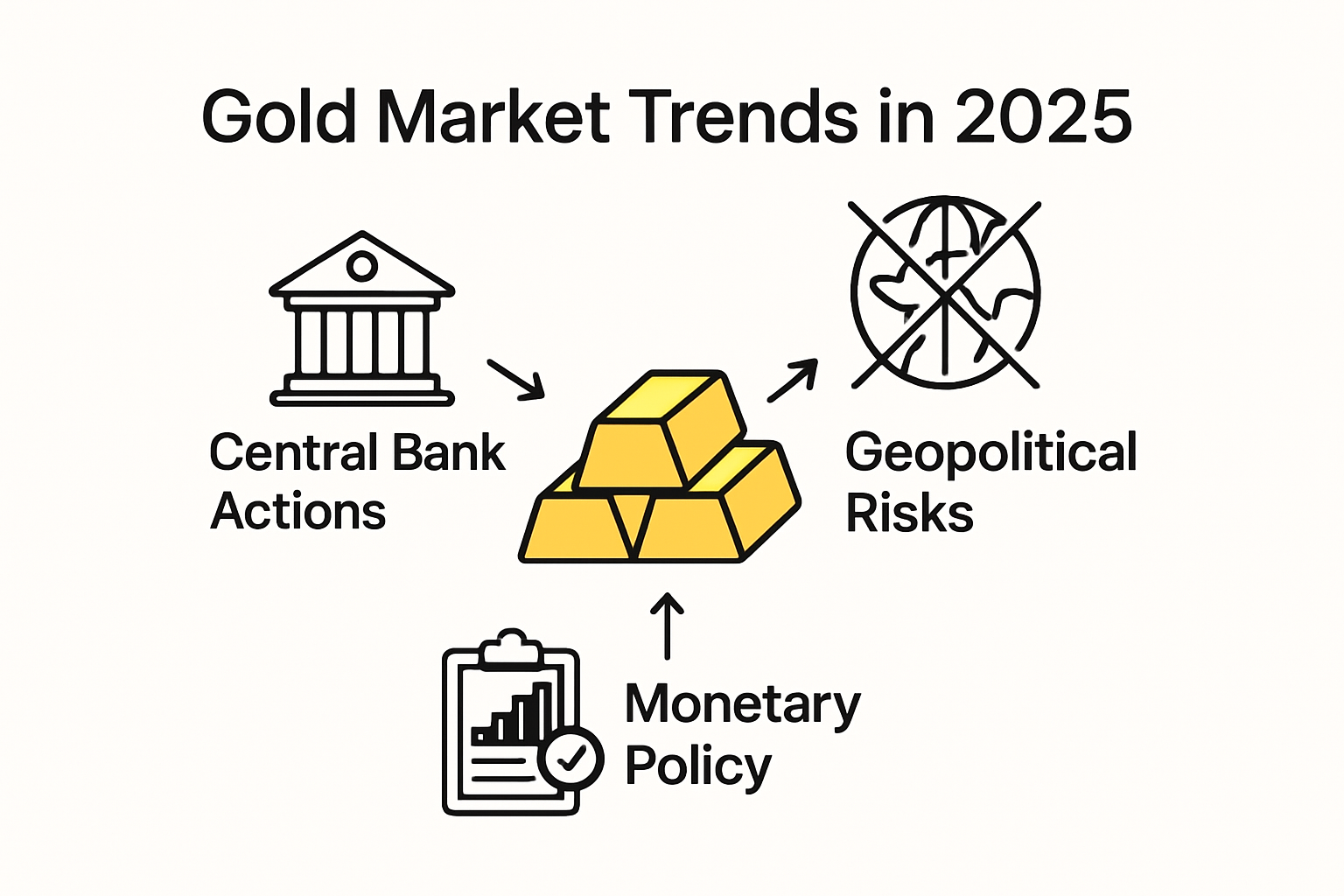
Central Bank Gold Reserves Strategy
Central banks worldwide are fundamentally transforming their gold reserve strategies. According to World Gold Council, 95% of surveyed financial institutions expect global central bank gold reserves to increase over the next 12 months. This unprecedented trend stems from gold’s proven performance during economic uncertainties and its critical role in portfolio diversification.
The strategic shift reflects growing geopolitical tensions and a desire to reduce dependence on traditional currency reserves. Emerging economies are particularly aggressive in gold accumulation, viewing it as a hedge against potential currency volatilities. Forex traders must closely monitor these institutional movements, as large-scale central bank purchases can significantly impact gold pricing dynamics.
Geopolitical Risks and Economic Uncertainty
Geopolitical instability continues to be a primary driver of gold market trends in 2025. London Bullion Market Association research highlights escalating trade tensions and policy uncertainties as key factors pushing investors toward gold as a safe-haven asset. The intricate global political landscape creates an environment where gold maintains its reputation as a reliable store of value.
Traders should pay special attention to potential conflict zones, international trade negotiations, and systemic economic challenges. Regions experiencing political turbulence or economic restructuring often see increased gold investment as investors seek protection against potential market disruptions. The interconnected nature of global financial markets means that a significant event in one region can trigger substantial gold price movements worldwide.
Federal Reserve and Monetary Policy Implications
The U.S. Federal Reserve’s monetary policy remains a critical determinant of gold market trends. Interest rate decisions and inflation control measures directly influence gold’s investment attractiveness. Federal Reserve Economic Projections suggest a nuanced approach to monetary policy that could create both challenges and opportunities for gold traders.
When interest rates rise, gold becomes relatively less attractive compared to yield-generating assets. Conversely, dovish monetary stances and lower interest rates can enhance gold’s appeal as an alternative investment. Forex traders must develop sophisticated strategies that anticipate and respond to these policy shifts, understanding how each Federal Reserve decision can potentially recalibrate gold market dynamics.
To stay ahead of these complex market trends, explore our comprehensive gold trading signals for real-time insights and expert analysis. Understanding these key drivers will empower traders to make informed decisions in the dynamic 2025 gold market landscape.
To help you quickly compare the key drivers impacting gold prices in 2025, the following table summarizes the main influences and their effects on the market:
| Market Driver | Influence on Gold Price | Key Considerations |
|---|---|---|
| Central Bank Reserve Buying | Drives prices higher | 95% expect increased reserves, led by emerging economies |
| Geopolitical Risks | Increases safe-haven demand | Trade tensions, conflicts, policy uncertainty |
| Monetary Policy (Fed) | Alters gold’s relative appeal | Rising rates decrease appeal; lower rates increase value |
| Currency Volatility | Boosts demand for gold | Hedge against unstable fiat currencies |
| Institutional Movements | Shifts price dynamics rapidly | Large-scale purchases/sales reshape market landscape |
Impact on Forex and Gold Trading Signals
The gold market in 2025 presents a complex landscape for forex traders, with trading signals becoming increasingly sophisticated and data-driven. Navigating this intricate environment requires a deep understanding of how global economic shifts translate into actionable trading strategies.
Volatility and Signal Precision
Gold prices have demonstrated remarkable volatility, with Sucden Financial reporting a 27% increase in 2024, reaching an all-time high of $2,790 per ounce in October. This unprecedented movement underscores the critical importance of precision in gold trading signals. Traders must now rely on more nuanced analysis that goes beyond traditional technical indicators.
The emerging signal ecosystem demands a multi-layered approach. Successful traders are integrating advanced machine learning algorithms with real-time geopolitical analysis to generate more accurate predictions. These sophisticated signals can detect subtle market shifts that traditional methods might miss, providing a competitive edge in an increasingly complex trading environment.
Central Bank Impact on Trading Strategies
Central bank activities are dramatically reshaping gold trading signals. According to research from Sucden Financial, countries like Poland, Turkey, and India accounted for 70% of total reported net gold purchases in 2024. Poland’s gold holdings reached an impressive 448.2 tons by year-end, signaling a significant shift in national investment strategies.
Forex traders must now incorporate central bank movement analysis into their signal interpretation. This means tracking not just price movements, but also geopolitical decisions, monetary policies, and institutional investment patterns. Learn more about crafting effective trading strategies that can adapt to these complex market dynamics.
The following table provides a snapshot of central bank gold accumulation activities referenced in 2024 and their market impact:
| Country | Gold Holdings End 2024 (tons) | Share of Net Global Purchases (2024) | Strategic Implication |
|---|---|---|---|
| Poland | 448.2 | Major (out of 70% total by 3 nations) | Signals aggressive accumulation |
| Turkey | Not specified | Major (part of 70%) | Influences regional stability |
| India | Not specified | Major (part of 70%) | Hedge against currency risk |
Market Volatility and Signal Adaptation
In April 2025, gold prices dramatically surpassed $3,500 per ounce, driven by a significantly weaker US dollar and heightened market volatility, as reported by World Gold Council. This unprecedented movement highlights the need for adaptive trading signals that can respond to rapid market changes.
Traders are increasingly turning to real-time signal services that offer:
- Instant market sentiment analysis
- Machine learning-powered predictive models
- Comprehensive risk management recommendations
The most successful forex traders in 2025 will be those who can quickly interpret complex signal data, understanding that gold trading is no longer about simple price predictions but about comprehending a global economic narrative. By combining technological sophistication with strategic insight, traders can transform market volatility from a challenge into a significant opportunity.

Effective Strategies for Gold Traders
In the dynamic gold trading landscape of 2025, successful traders must employ sophisticated, data-driven strategies that go beyond traditional market analysis. The complexity of global economic interactions demands a nuanced approach that integrates multiple analytical techniques and risk management protocols.
Advanced Technical Analysis Techniques
Cutting-edge technical analysis has become crucial for gold traders. Quantpedia research reveals that strategic market timing approaches can significantly outperform traditional buy-and-hold strategies. Traders are now leveraging advanced algorithmic techniques that identify subtle market trends and potential price movements.
Research suggests that behavioral biases can induce predictable patterns in gold markets. By understanding these psychological factors, traders can develop strategies that anticipate market reactions. Master gold scalping techniques that exploit these short-term market inefficiencies can provide traders with a competitive edge.
Machine Learning and Predictive Modeling
Machine learning has revolutionized gold trading strategies in 2025. According to empirical research using Long Short-Term Memory (LSTM) neural networks, sophisticated predictive models can now accurately forecast price trends. These advanced algorithms process vast amounts of historical and real-time data to generate high-probability trading signals.
Traders are increasingly adopting multi-dimensional approaches that combine:
- Technical price analysis
- Geopolitical sentiment tracking
- Machine learning predictive models
- Automated risk management protocols
The integration of these techniques allows for more precise decision-making and risk mitigation. By leveraging algorithmic insights, traders can develop more robust strategies that adapt quickly to market changes.
Risk Management and Diversification
Research from MDPI highlights the importance of understanding interdependencies between different precious metals. Linear regression techniques have proven particularly effective in forecasting price trends, revealing that daily returns are often negatively correlated with previous days’ performance.
Successful gold traders in 2025 recognize that risk management extends beyond simple stop-loss strategies. They implement comprehensive approaches that include:
- Dynamic portfolio allocation
- Continuous strategy backtesting
- Real-time risk assessment
- Adaptive position sizing
By unlocking the power of support and resistance techniques, traders can develop more sophisticated entry and exit strategies. The key is maintaining flexibility and continuously refining analytical approaches in response to evolving market conditions.
The gold trading landscape of 2025 demands a holistic approach that combines technological sophistication, deep market understanding, and adaptive strategic thinking. Traders who embrace these multifaceted methodologies will be best positioned to navigate the complex and dynamic global gold market.
Expert Analysis and Price Forecasts
The gold market in 2025 presents a complex landscape of diverse expert perspectives and nuanced price projections. Forex traders must navigate a multifaceted environment where institutional forecasts, geopolitical dynamics, and economic indicators converge to shape potential market trajectories.
Global Financial Institutions’ Perspectives
J.P. Morgan Research projects an ambitious forecast, anticipating gold prices to average $3,675 per ounce by the fourth quarter of 2025, with potential to approach $4,000 by mid-2026. This projection stems from ongoing global trade uncertainties and persistent geopolitical tensions that continue to drive investor interest in safe-haven assets.
HSBC’s analysis further reinforces this bullish outlook, raising their average gold price forecast to $3,215 per ounce. The institution attributes this increased projection to sustained economic risks and escalating government debt levels worldwide. These institutional forecasts underscore the complex interplay of global economic factors influencing gold’s valuation.
Macroeconomic Drivers and Price Dynamics
The World Bank’s commodity market outlook reveals a critical perspective on gold’s trajectory. Their forecast suggests gold prices will reach a new record in 2025 before potentially stabilizing in 2026. This projection reflects the intricate balance between global economic uncertainties, monetary policies, and investor sentiment.
Key macroeconomic factors driving these forecasts include:
- Persistent global trade tensions
- Fluctuating currency valuations
- Ongoing geopolitical uncertainties
- Central bank monetary policies
- Emerging market economic strategies
Traders seeking deeper insights can explore our comprehensive gold price forecast to understand the nuanced factors influencing market movements.
Risk Assessment and Strategic Implications
Expert analyses consistently highlight the importance of adaptive strategies in navigating the 2025 gold market. The forecasts suggest a market characterized by significant volatility and potential for substantial price movements. Successful traders will need to develop flexible approaches that can quickly respond to rapidly changing global economic conditions.
Risk management becomes paramount in this environment. Traders must integrate multiple analytical perspectives, considering not just price projections but also the underlying economic and geopolitical drivers. This requires a holistic approach that combines technical analysis, fundamental research, and real-time market sentiment tracking.
The convergence of expert perspectives suggests that while gold presents significant opportunities, it also demands sophisticated, data-driven trading strategies. Forex traders who can effectively interpret these complex market signals will be best positioned to capitalize on the dynamic gold market landscape of 2025.
Frequently Asked Questions
What are the main drivers of gold prices in 2025?
Gold prices in 2025 are primarily driven by central bank reserve strategies, geopolitical risks, and the U.S. Federal Reserve’s monetary policies. Central banks are increasing their gold reserves due to economic uncertainties, while geopolitical instability encourages investment in gold as a safe-haven asset.
How can Forex traders adapt to the changes in the gold market?
Forex traders can adapt by utilizing advanced trading strategies, such as machine learning and predictive modeling. They should also incorporate real-time geopolitical analysis and adapt their risk management techniques to navigate the increased volatility in gold prices.
What impact does central bank activity have on gold trading?
Central bank activities significantly impact gold trading by influencing price dynamics. Large-scale purchases or sales by central banks can lead to rapid shifts in gold prices, making it essential for traders to monitor these movements and incorporate them into their trading strategies.
What are the forecasts for gold prices in 2025?
Analysts forecast that gold prices could average around $3,675 per ounce in 2025, with some projections suggesting they may approach $4,000 by mid-2026 due to ongoing economic risks and geopolitical tensions.
Accelerate Your Gold Trading Success in 2025
Staying ahead of gold volatility and central bank moves can be overwhelming, especially when market drivers shift fast. As discussed in our article, the 2025 gold market demands more than simple predictions. You face real challenges: sudden price swings, complex signals, and the growing influence of major global institutions. The competition is tougher than ever, so you need actionable insights that cut through the noise right now. For the latest shifts and opportunities, see our News & Updates for real-time trade ideas and trends.
Why settle for uncertainty when you can trade with precision? Our XAU/USD gold trading signals offer more than just alerts. Tap into strategies proven to maximize profits and minimize risks. Join our private group and start receiving accurate, high-probability signals every day. Give yourself a better chance to profit today—visit xau-gold-signals.com and take control of your gold trading journey before the next price surge.
