


Gold is on every trader’s radar this year and for good reason. Technical indicators like the Relative Strength Index have predicted gold price moves with over 97 percent accuracy, which might sound unbelievable. Most people think gold just rides on old myths and market fear, but in reality, the hidden influences shaping each price jump will surprise even experienced investors.
Table of Contents
- What Drives Gold Market Fundamentals
- Top Economic Factors Affecting Gold Prices
- Using Gold Market Fundamentals For Trading Signals
- Tips For Profitable Gold Market Analysis
Quick Summary
| Takeaway | Explanation |
|---|---|
| Monetary Policy Impacts Gold Prices | Central banks’ interest rate decisions greatly influence gold’s attractiveness; lower rates boost gold investment as opportunity costs decrease. |
| Geopolitical Risks Drive Demand | Economic instability and global tensions elevate gold’s status as a safe haven, affecting investment behaviors significantly. |
| Utilize Technical Indicators | Tools like the Relative Strength Index (RSI) can help predict gold price movements with high accuracy, allowing traders to identify entry and exit points effectively. |
| Integrate Multi-faceted Analysis | Combining technical analysis, sentiment tracking, and macroeconomic indicators enhances market understanding and decision-making for traders, improving profitability. |
| Stay Adaptive and Informed | Continuous learning, adaptability, and monitoring evolving market dynamics are essential to successful gold trading strategies. |
What Drives Gold Market Fundamentals
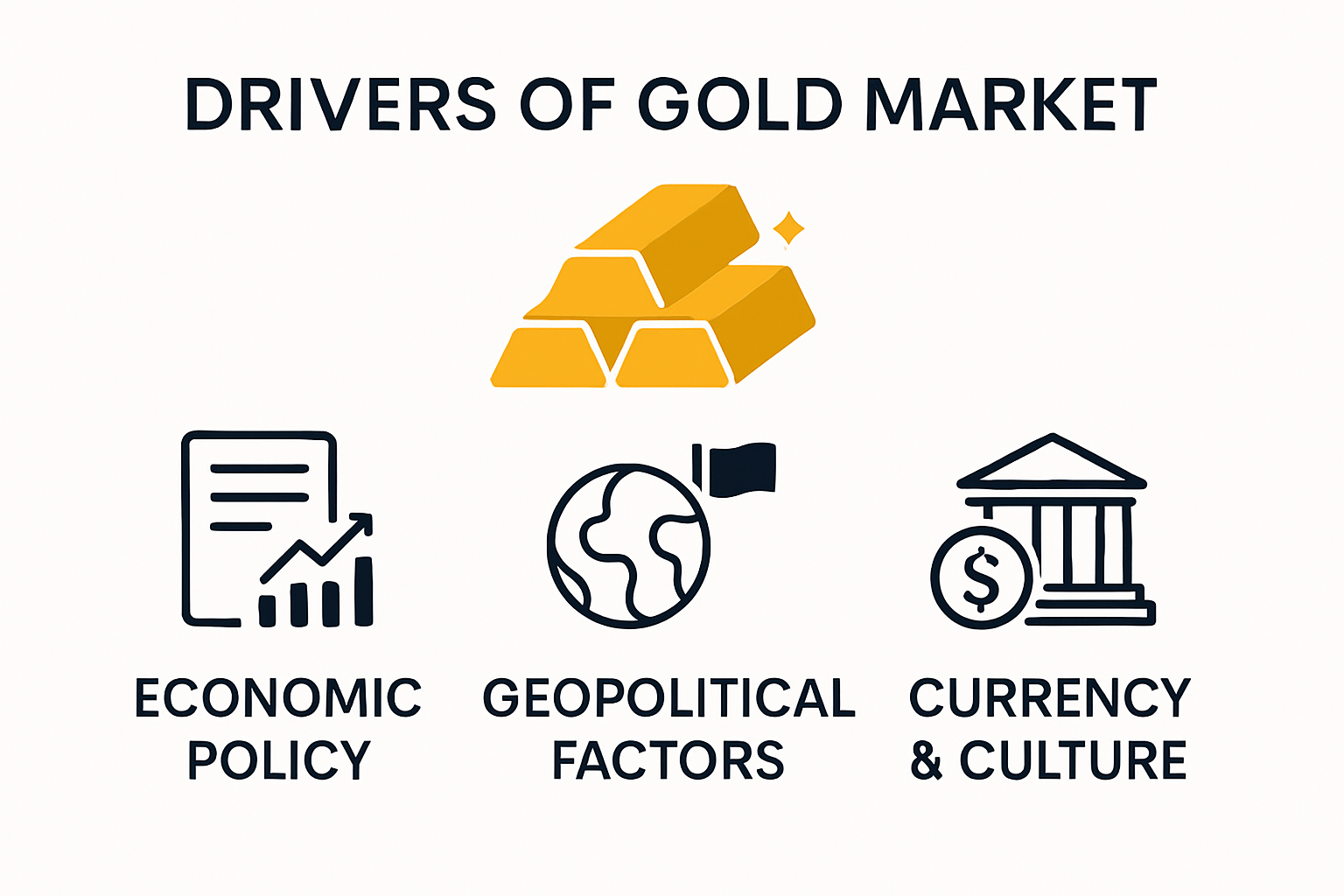
Economic Policy and Monetary Signals
Monetary policies significantly impact gold market fundamentals. Central banks worldwide play a critical role in determining gold’s attractiveness as an investment asset. When central banks implement expansionary monetary policies or maintain low interest rates, gold becomes more appealing. According to a 2022 study analyzing macroeconomic factors, stock markets, trade balances, and consumer confidence are key drivers of gold market volatility.
The federal funds rate and dollar index inversely correlate with gold prices. When interest rates decrease, gold becomes more attractive since its opportunity cost declines. Investors seek gold as a hedge against potential economic uncertainties, making it a preferred safe haven asset during periods of financial instability.
Global Economic and Cultural Dynamics
Interestingly, cultural dimensions also substantially influence gold market fundamentals. Research from 2023 examining 24 global economies revealed that national cultural perspectives significantly impact gold demand. The COVID-19 pandemic, for instance, demonstrated how different cultural contexts can drive gold consumption patterns.
Traders must consider multiple interconnected factors beyond traditional economic metrics. Geopolitical tensions, inflation rates, currency fluctuations, and international trade dynamics all contribute to gold’s market fundamentals. A comprehensive approach requires analyzing these multifaceted influences rather than relying on singular indicators.
Price Determination Mechanisms
Gold prices are determined through a sophisticated mechanism involving multiple variables. A 2019 analysis utilizing response surface methodology identified several crucial factors affecting global gold prices. The study highlighted that the dollar index, federal funds rate, exchange rates, oil prices, and S&P 500 index typically exert negative pressure on gold prices, while the Consumer Price Index demonstrates a positive correlation.

Below is a summary table highlighting the fundamental factors mentioned in this section and their typical influence on gold prices:
| Factor | Type of Impact on Gold Price | Notes |
|---|---|---|
| Dollar Index | Negative | Higher dollar index generally lowers gold prices |
| Federal Funds Rate | Negative | Interest rate increases decrease gold’s appeal |
| Exchange Rates | Negative | Stronger local currencies can put downward pressure on gold |
| Oil Prices | Negative | Higher oil costs raise mining costs, but typically suppress gold price |
| S&P 500 Index | Negative | Stock market strength can divert investment from gold |
| Consumer Price Index (Inflation) | Positive | Higher inflation increases gold’s appeal as a hedge |
| Stock Markets (General) | Negative | Strong stock markets often mean reduced demand for gold |
| Trade Balances | Variable | Affects currency and, in turn, gold demand |
| Consumer Confidence | Variable | Confidence shifts can signal risk-on/off attitudes affecting gold |
Understanding these fundamental drivers empowers traders to develop more nuanced strategies. By recognizing how different economic signals interact and influence gold market dynamics, investors can better anticipate potential price movements and make more informed trading decisions. Successful gold trading requires continuous learning, adaptability, and a holistic understanding of global economic ecosystems.
Remember, gold market fundamentals are not static. They evolve continuously, reflecting complex global economic interactions. Staying informed, maintaining analytical flexibility, and understanding these intricate relationships will be crucial for traders seeking consistent success in the gold market.
Top Economic Factors Affecting Gold Prices
Gold prices are influenced by a complex network of economic factors that create intricate market dynamics. Understanding these drivers is crucial for traders seeking to navigate the gold market effectively and make informed investment decisions.
Monetary Policy and Interest Rate Dynamics
Monetary policy represents a critical determinant of gold prices. Central banks worldwide significantly impact gold’s attractiveness through their interest rate decisions. Research published in Resources Policy demonstrates that federal funds rates and the U.S. dollar index typically exert negative pressure on gold prices.
When interest rates decline, gold becomes more appealing as an investment. Lower opportunity costs mean investors can hold gold without sacrificing potential returns from other financial instruments. This relationship underscores why traders closely monitor central bank policies and economic indicators that might signal potential rate changes.
Global Economic Indicators and Market Sentiment
Multiple economic indicators play pivotal roles in gold price determination. According to a study in Advances in Economics, Management and Political Sciences, oil prices emerge as particularly significant, influencing gold prices through their impact on mining and transportation costs.
Key economic factors that traders must monitor include:
- Exchange rates: Currency value fluctuations directly impact gold pricing
- Inflation rates: Higher inflation typically increases gold’s appeal as a hedge
- GDP growth: Economic expansion or contraction influences investor sentiment
Traders can explore our gold price forecast to gain deeper insights into these complex market interactions.
Geopolitical Risk and Investment Behavior
Geopolitical uncertainties significantly influence gold prices. During periods of global tension, economic instability, or financial market volatility, investors often shift towards gold as a safe-haven asset. Research from the Journal of Commerce and Accounting Research highlights how macroeconomic variables like unemployment rates and stock market indices can impact gold investment behaviors.
The interplay between these factors creates a dynamic environment where gold prices constantly adjust. Successful traders recognize that no single indicator provides a complete picture. Instead, a holistic approach considering multiple economic signals enables more accurate market predictions.
Understanding these economic factors requires continuous learning and adaptability. Gold market fundamentals are not static but evolve with global economic shifts, technological changes, and emerging market trends. Traders who develop a nuanced, comprehensive view of these interconnected dynamics position themselves for more strategic and potentially profitable investment decisions.
Using Gold Market Fundamentals for Trading Signals
Trading gold requires a sophisticated approach that integrates multiple analytical techniques to generate reliable trading signals. By leveraging gold market fundamentals, traders can develop more robust and strategic investment strategies that capitalize on complex market dynamics.
Technical Indicators and Price Analysis
Technical analysis plays a crucial role in generating gold trading signals. Research from technical forecasting studies reveals remarkable precision in predicting gold price movements. The Relative Strength Index (RSI) demonstrated an impressive 97.345% accuracy rate over a 226-day period, highlighting the potential of technical indicators in signal generation.
Key technical indicators traders should consider include moving averages, Bollinger Bands, and momentum oscillators. These tools help identify potential entry and exit points by analyzing price patterns, market momentum, and potential trend reversals. Explore our guide on effective trading strategies to understand how to apply these indicators more effectively.
Below is a table summarizing key technical indicators mentioned and their roles in gold trading signal generation:
| Indicator | Function/Role | Accuracy/Notes |
|---|---|---|
| Relative Strength Index (RSI) | Identifies overbought/oversold levels | 97.345% accuracy over 226 days (per cited study) |
| Moving Averages | Detect trends and trend reversals | Helps filter out short-term volatility |
| Bollinger Bands | Measures price volatility and range | Useful for identifying potential breakout conditions |
| Momentum Oscillators | Tracks speed/strength of price movement | Assists in spotting trend changes and entry/exit points |
Sentiment and News-Based Analysis
News sentiment has emerged as a powerful tool in gold market analysis. A comprehensive study examining news headlines from 2000 to 2019 demonstrated that information extracted from news flow significantly impacts future gold prices. Traders can leverage this insight by monitoring global economic news, geopolitical developments, and central bank announcements.
Understanding market sentiment requires a multifaceted approach. Economic indicators, geopolitical tensions, and global market conditions all contribute to gold price fluctuations. Successful traders develop a holistic view that combines technical analysis with fundamental economic insights.
Risk Management and Uncertainty Signals
Gold’s unique position as a safe-haven asset provides critical insights for traders. Research analyzing gold’s performance during uncertain periods reveals a strong positive relationship between gold returns and market uncertainty. This relationship is particularly pronounced during high-uncertainty scenarios, making gold an essential component of risk management strategies.
Traders should focus on:
- Volatility indicators: Measuring market uncertainty
- Correlation analysis: Understanding gold’s relationship with other assets
- Economic cycle tracking: Identifying optimal investment periods
Successful gold trading is not about predicting exact price movements but understanding the complex ecosystem that drives gold market fundamentals. It requires continuous learning, adaptability, and a nuanced approach to market analysis.
Remember that no single indicator provides a complete picture. Advanced gold trading signals combine multiple analytical techniques, providing traders with a more comprehensive view of potential market opportunities. By integrating technical analysis, sentiment tracking, and fundamental economic understanding, traders can develop more sophisticated and potentially profitable gold trading strategies.
Tips for Profitable Gold Market Analysis
Profitable gold market analysis requires a strategic approach that combines multiple analytical techniques, deep market understanding, and continuous learning. Traders who develop comprehensive analysis skills can significantly improve their potential for successful gold trading.
Understanding Dollar Dynamics and Price Relationships
Gold pricing is intrinsically linked to the U.S. dollar, creating a complex inverse relationship that traders must carefully monitor. Research from economic analysis platforms reveals that a stronger dollar typically suppresses gold prices, while a weaker dollar can boost them.
Key dollar-related considerations include:
- Exchange rate fluctuations: Direct impact on gold valuation
- Federal Reserve monetary policies: Influence dollar strength and gold attractiveness
- Global economic stability: Affects currency and gold market movements
Macroeconomic Indicator Analysis
Successful gold market analysis demands a holistic view of macroeconomic factors. According to economic outlook research, critical indicators include inflation rates, consumer spending patterns, and global economic stability.
Traders should pay special attention to:
- Interest rate trends: Historically, rising interest rates negatively correlate with gold prices
- Inflation indicators: Gold often serves as a hedge against inflationary pressures
- Geopolitical tensions: Impact investment sentiment and gold demand
Learn advanced scalping techniques to enhance your market analysis and trading performance.
Advanced Analysis Techniques
Profitable gold market analysis goes beyond traditional indicators. Developing a multi-dimensional approach involves combining technical analysis, fundamental research, and sentiment tracking. This comprehensive strategy allows traders to identify nuanced market opportunities that single-method approaches might miss.
Essential advanced analysis techniques include:
- Correlation analysis: Understanding gold’s relationship with other assets
- Sentiment tracking: Monitoring news and market perception
- Risk assessment: Evaluating potential market volatility
Successful traders recognize that gold market analysis is an ongoing learning process. Markets evolve continuously, and adaptability becomes a crucial skill. Continuous education, staying updated with global economic trends, and maintaining a disciplined approach are fundamental to developing profitable gold trading strategies.
Remember, no single analysis method guarantees success. The most effective approach combines multiple analytical tools, maintains flexibility, and adapts to changing market conditions. By developing a comprehensive understanding of gold market fundamentals and maintaining a strategic, informed perspective, traders can improve their potential for consistent and profitable trading outcomes.
Frequently Asked Questions
What factors drive gold prices in 2025?
Gold prices are primarily influenced by monetary policy, interest rates, geopolitical risks, and economic indicators such as inflation and GDP growth. Understanding these factors can help traders make informed decisions.
How do technical indicators help in gold trading?
Technical indicators like the Relative Strength Index (RSI) can predict gold price movements with high accuracy, helping traders identify entry and exit points for optimal trading strategies.
Why is gold considered a safe-haven asset?
Gold is viewed as a safe-haven asset during times of economic instability and geopolitical tension. Investors often turn to gold to protect their assets when markets are volatile.
How can I integrate fundamental analysis into my gold trading strategy?
Traders can enhance their strategies by combining fundamental analysis, such as macroeconomic indicators, with technical analysis and sentiment tracking. This multi-faceted approach allows for a more comprehensive understanding of market dynamics.
Transform Gold Market Insights Into Real Profits
Struggling to keep up with shifting gold fundamentals, complex signals, and unpredictable market moves? You are not alone. The journey from understanding core indicators like monetary policy, the dollar index, and technical tools such as RSI, to actually making winning trades can feel overwhelming. If you want to turn breakthrough market knowledge from our News & Updates into actionable results, there is a smarter path forward.
Cut through the noise and start trading with confidence. Our expert-driven signals combine deep gold market analysis with real-time trade alerts, ensuring you never miss a key opportunity. Join our private Telegram group via xau-gold-signals.com and receive unbeatable daily guidance. Take the next step and explore our How To Guides for practical strategies you can trust. Do not wait on the sidelines. Access the tools and analysis that help you grow your portfolio now.
Recommended
- Best XAU/USD Gold Trading Signals For Consistent Profits
- Effective Strategies For Using Gold Trading Signals
- Blog | XAU/USDT Gold Trading Signals
- Gold Price Forecast: What’s Next For XAU/USD?
- Market Structure in Forex: Pro Strategies for 2025 Success – Earnex
- High Yield Real Estate Investments for Expats and Investors 2025 – costaricaloanexperts.net
