


Gold trading catches eyes every time global news jolts the markets. Here is the wild part. Gold’s daily trading volume hit roughly US$163 billion in 2023, making it one of the most liquid assets worldwide. Yet, that same liquidity can dry up in a heartbeat when global crises strike or new regulations kick in. If you think gold promises a safe haven, wait until you see how fast those tides can turn in 2025.
Table of Contents
- Market Volatility And Price Fluctuations
- Liquidity Risks In Gold Trading
- Impact Of Global Events On Gold Prices
- Risk Management Strategies For Gold Traders
Quick Summary
| Takeaway | Explanation |
|---|---|
| Market Volatility Is A Major Risk | Gold prices are highly sensitive to geopolitical and economic uncertainties, leading to rapid price fluctuations that traders must prepare for. |
| Liquidity Is Crucial For Trading | Understanding the liquidity dynamics of the gold market, including potential constraints during extreme conditions, is vital for executing trades effectively. |
| Global Events Significantly Impact Prices | Major global events like health crises and geopolitical tensions can drive substantial changes in gold prices, requiring traders to be aware of ongoing developments. |
| Risk Management Is Essential | Employing strategies such as position sizing, technical risk mitigation, and maintaining psychological discipline is key to navigating the complexities of gold trading. |
| Continuous Market Monitoring Is Necessary | Successful gold traders must develop the capability to continuously assess global economic trends and flexibility in their trading strategies to adapt to market changes. |
Market Volatility and Price Fluctuations
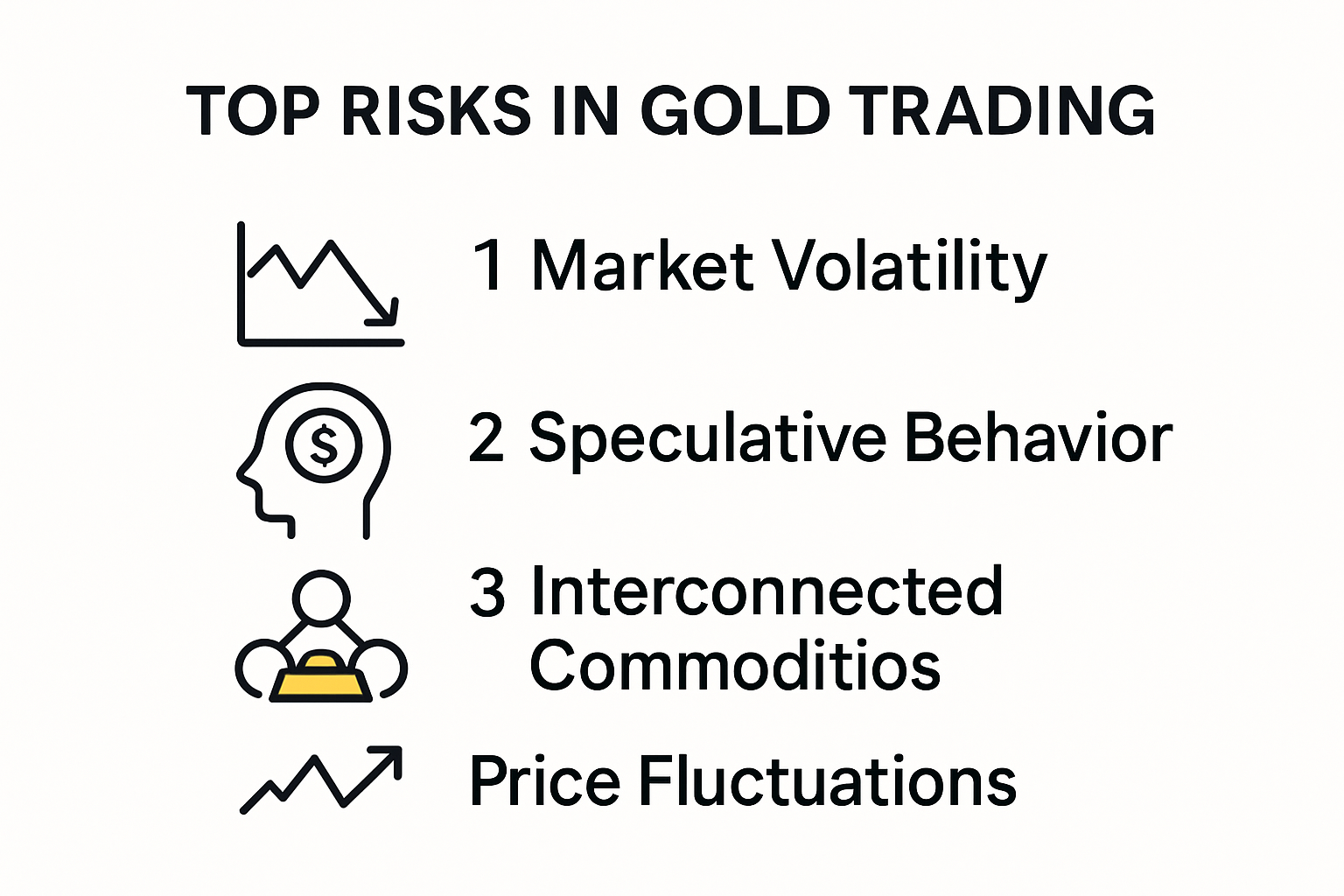
Gold trading presents complex challenges for investors, with market volatility standing as a critical risk factor that can dramatically impact trading outcomes. Understanding the intricate dynamics of price fluctuations becomes essential for traders seeking to navigate the unpredictable gold market landscape.

Geopolitical and Economic Uncertainty Drivers
Gold prices demonstrate extreme sensitivity to global political and economic conditions. Research from financial analysts reveals that geopolitical tensions can trigger substantial price swings within short timeframes. Investors must recognize that events such as international conflicts, trade disputes, and economic policy changes can instantaneously transform gold’s market valuation.
The relationship between global uncertainty and gold pricing is particularly complex. When traditional financial markets experience turbulence, investors often perceive gold as a safe-haven asset, driving rapid price movements. These fluctuations can occur with remarkable speed, creating significant risks for traders who are not prepared for sudden market shifts.
Speculative Trading and Market Sentiment
Investor behavior plays a crucial role in gold price volatility. Studies examining market dynamics demonstrate that speculative trading can amplify price fluctuations exponentially. Traders react quickly to news, economic indicators, and global events, generating rapid sentiment changes that translate into immediate price adjustments.
The psychological aspects of trading contribute substantially to gold’s price unpredictability. Traders’ collective perceptions, fear, and investment strategies can create self-reinforcing cycles of price movement. This means that market sentiment can become a powerful independent force driving gold prices, independent of fundamental economic indicators.
Interconnected Commodity Interactions
Research published in scientific journals highlights gold’s unique interactions with other commodities, particularly during periods of economic instability. During events like the COVID-19 pandemic, gold demonstrated remarkable resilience, often serving as a protective asset against extreme market volatility.
The interconnected nature of global financial markets means that gold prices do not exist in isolation. Fluctuations in currency values, oil prices, and international economic indicators can simultaneously influence gold trading. Successful traders must develop sophisticated strategies that account for these multifaceted relationships.
Traders confronting risks in gold trading must adopt a comprehensive approach. This involves continuous market monitoring, understanding global economic trends, and maintaining flexible trading strategies that can quickly adapt to changing market conditions. Developing robust risk management techniques becomes paramount in mitigating potential losses stemming from rapid price fluctuations.
Key strategies for managing market volatility include implementing stop-loss orders, diversifying investment portfolios, and maintaining a disciplined approach to trading that is not driven by emotional reactions. By recognizing that volatility is an inherent characteristic of gold trading, investors can transform potential risks into calculated opportunities.
Liquidity Risks in Gold Trading
Liquidity represents a critical dimension of risk in gold trading that can significantly impact investor strategies and potential returns. Understanding the nuanced landscape of gold market liquidity becomes essential for traders seeking to navigate complex financial environments.
Global Trading Volume and Market Depth
Research from gold market analysts reveals that gold’s average daily trading volume reached approximately US$163 billion in 2023, positioning it as a highly liquid financial asset. This substantial trading volume suggests robust market participation but simultaneously introduces complex liquidity challenges for traders.
The depth of the gold market means rapid position entry and exit are possible, yet traders must remain vigilant about potential liquidity constraints during extreme market conditions. Sudden market disruptions can quickly transform seemingly liquid markets into challenging trading environments where executing trades becomes difficult or financially disadvantageous.
Regulatory Impact on Market Liquidity
Basel III regulations have introduced significant changes to gold market liquidity dynamics. The Net Stable Funding Ratio (NSFR) now requires banks to maintain stable funding equivalent to 85% of their unallocated gold positions. This regulatory requirement increases the operational cost of maintaining large gold positions, potentially reducing market liquidity and creating additional complexity for traders.
European financial data indicates that gross notional exposures to gold derivatives reached €1 trillion in March 2025, with a substantial portion traded over-the-counter (OTC) and not centrally cleared. These unregulated trading environments introduce heightened counterparty risks that can rapidly impact market liquidity. Learn more about advanced trading strategies to navigate these complex market conditions effectively.
Counterparty and Execution Risks
Liquidity risks extend beyond simple market depth, encompassing complex counterparty and execution challenges. Traders must assess not just the ability to execute trades but also the potential for counterparty default or execution delays. The OTC nature of many gold derivative contracts means that transparency and immediate settlement are not guaranteed.
Strategic risk management involves developing comprehensive liquidity assessment protocols. This includes monitoring market depth, understanding regulatory constraints, evaluating counterparty reliability, and maintaining flexible trading strategies that can adapt to rapidly changing market conditions.
Successful gold traders recognize that liquidity is not a static concept but a dynamic environment requiring constant vigilance. Implementing robust risk management techniques, maintaining diversified trading approaches, and staying informed about global market conditions become crucial strategies for mitigating liquidity-related risks.
Ultimately, navigating liquidity risks demands a multifaceted approach combining technical analysis, regulatory awareness, and strategic flexibility. Traders who develop sophisticated understanding of market liquidity dynamics position themselves to transform potential challenges into strategic opportunities within the gold trading landscape.
To help clarify the various liquidity risks and their implications, the following table summarizes the key types discussed in this section:
| Liquidity Risk Type | Description | Implications for Traders |
|---|---|---|
| Market Depth | Ability to enter/exit positions quickly at desired prices | Thin depth in crises can cause slippage, wider spreads, or inability to trade |
| Regulatory Impact | Rules like Basel III change bank costs and liquidity requirements | Reduced liquidity, higher trading costs, or restricted product access |
| Counterparty Risk | Risk one party fails to fulfill OTC contract obligations | Potential defaults, delayed settlement, financial loss |
| Execution Risk | Difficulty executing trades promptly at expected prices | Trades may be delayed or executed at worse prices during volatile conditions |
Impact of Global Events on Gold Prices
Global events represent a profound and complex mechanism for influencing gold prices, creating intricate dynamics that can transform market landscapes within remarkably short timeframes. Understanding these interconnections becomes crucial for traders seeking to navigate the sophisticated terrain of gold trading.
Pandemic and Health Crisis Dynamics
Research examining investor behavior during global health emergencies reveals compelling patterns of gold price movements during significant crises. Historical data demonstrates that gold prices increased rapidly during both the SARS outbreak in 2003 and the COVID-19 pandemic, underscoring gold’s status as a stable and secure commodity during periods of global uncertainty.
Comprehensive studies analyzing pandemic impacts found distinctive variations in gold demand across different economic systems. Notably, Confucian economies experienced significant increases in gold demand during the COVID-19 pandemic, highlighting gold’s critical role as a safe-haven asset when traditional economic structures experience disruption.
Geopolitical Risk and Financial Volatility
Advanced research on geopolitical risk demonstrates gold’s unique positioning during major global disruptions. Comparative analyses of financial assets during events like the Global Financial Crisis, COVID-19 pandemic, and Russia-Ukraine conflict reveal that gold consistently offers superior diversification opportunities compared to oil and stock indices.
Geopolitical tensions create complex ripple effects across financial markets. Military conflicts, diplomatic breakdowns, and international sanctions can instantaneously trigger significant gold price fluctuations. Investors perceive gold as a protective asset during these periods, driving rapid capital reallocation and creating substantial market movements.
Economic Policy and Global Uncertainty
Central bank policies, international trade negotiations, and macroeconomic shifts represent additional critical factors influencing gold prices. Check our latest gold price forecast to understand how emerging global trends might impact your trading strategy.
Traders must develop sophisticated monitoring capabilities to anticipate potential global event impacts. This involves comprehensive analysis integrating geopolitical intelligence, economic indicators, and historical market behavior. Successful strategies require dynamic risk management approaches that can quickly adapt to rapidly changing global conditions.
The relationship between global events and gold prices is not linear but multidimensional. Psychological market sentiment, institutional investor behavior, and complex global economic interdependencies all contribute to gold’s price trajectory during significant world events.
Ultimately, gold remains a critical asset for investors seeking stability during periods of global uncertainty. Traders who develop nuanced understanding of these complex dynamics position themselves to transform potential risks into strategic investment opportunities. Continuous learning, adaptable strategies, and comprehensive global awareness become essential tools for navigating the intricate world of gold trading.
For a side-by-side look at how specific major global events have moved gold prices, see the summary below:
| Global Event | Gold Price Reaction | Notes/Context |
|---|---|---|
| SARS Outbreak (2003) | Rapid increase | Perceived as safe haven during health crisis |
| COVID-19 Pandemic | Sustained, sharp rise | Global uncertainty and economic disruption |
| Global Financial Crisis | Significant appreciation | Diversification, protection from financial volatility |
| Russia-Ukraine Conflict | Surge followed by volatility | Elevated geopolitical risk, rapid capital inflows |
Risk Management Strategies for Gold Traders
Risk management represents the cornerstone of successful gold trading, transforming potential market uncertainties into strategic opportunities for professional investors. Developing comprehensive risk mitigation techniques becomes essential for traders seeking to protect their capital and optimize trading performance.
Position Sizing and Capital Allocation
Research from financial trading experts emphasizes the critical importance of precise position sizing in gold trading. Professional traders recommend allocating only 1-2% of total trading capital per individual trade, a strategy that ensures sustainable risk management and prevents catastrophic losses during market volatility.
Effective capital allocation goes beyond simple percentage rules. Traders must develop sophisticated approaches that consider multiple risk factors, including market volatility, personal risk tolerance, and overall investment objectives. This requires continuous assessment and dynamic adjustment of trading strategies to maintain optimal risk exposure.
Technical and Fundamental Risk Mitigation
Successful gold traders employ a multifaceted approach combining technical analysis and fundamental risk assessment. Explore our comprehensive risk management guide to understand advanced techniques for protecting your investments.
Technical risk management involves implementing strategic tools like stop-loss orders, which automatically exit trades when predetermined price thresholds are reached. These mechanisms provide crucial protection against unexpected market movements, limiting potential losses and preserving trading capital.
Fundamental risk assessment requires continuous monitoring of global economic indicators, geopolitical events, and market sentiment. Traders must develop robust information processing capabilities that allow rapid adaptation to changing market conditions. This includes tracking central bank policies, international trade dynamics, and broader economic trends that can impact gold pricing.
Psychological Discipline and Strategic Flexibility
Risk management extends beyond mathematical calculations into the critical realm of trader psychology. Emotional discipline represents a fundamental component of successful trading strategies. Professional traders recognize that psychological resilience often determines long-term trading success more significantly than technical skills.
Developing a structured trading plan with predefined risk parameters helps mitigate emotional decision-making. This involves establishing clear entry and exit criteria, maintaining consistent position sizing, and avoiding impulsive trades driven by fear or greed. Traders who maintain psychological equilibrium can make more rational decisions during periods of market uncertainty.
Strategic flexibility becomes another crucial risk management technique. The most successful gold traders understand that no single strategy works universally. They continuously evaluate and adapt their approaches, remaining open to new information and willing to modify strategies based on evolving market conditions.
Ultimately, risk management in gold trading is a dynamic, multidimensional process. It requires technical expertise, psychological discipline, and a comprehensive understanding of global market dynamics. Traders who invest time in developing sophisticated risk management skills position themselves to transform potential market challenges into consistent, sustainable trading opportunities.
Frequently Asked Questions
What are the main risks involved in gold trading?
Gold trading involves several key risks, including market volatility influenced by geopolitical tensions, liquidity risks during extreme market conditions, and the impact of global events such as health crises and economic policy changes.
How can I manage risks when trading gold?
Effective risk management strategies for gold trading include precise position sizing, implementing stop-loss orders, and continuously monitoring global economic indicators to adapt to market changes and maintain psychological discipline.
Why is liquidity important in gold trading?
Liquidity is crucial in gold trading because it affects the ability to enter and exit positions at desired prices. During market crises, liquidity can diminish quickly, making trades difficult and increasing the risk of slippage and unfavorable pricing.
How do global events affect gold prices?
Global events, such as pandemics or geopolitical tensions, can significantly impact gold prices. These events often lead to increased demand for gold as a safe-haven asset, resulting in rapid price movements and volatility that traders need to be prepared for.
Turn Gold Trading Risks Into Consistent Profit With Expert Signals
Are you feeling the pressure of unpredictable gold price swings or struggling to manage market volatility and liquidity risks? You are not alone. Many traders face the same uncertainty discussed in our article. If you want actionable ways to navigate the real risks of gold trading with greater confidence, take the first step by exploring our How To Guides that reveal expert strategies and proven setups specifically tailored for the XAU/USD market.
Do not just watch gold prices move while your portfolio stands still. Join our Private Telegram Group today at https://xau-gold-signals.com and get immediate access to accurate, real-time gold trading signals powered by in-depth technical and risk management analysis. Let our professional traders help you minimize losses and turn your knowledge into steady results. Start now and take control of your trading journey before market conditions shift again.
