

Gold trading is set for a major shakeup in 2025 as new strategies and technologies are changing how smart traders make money. Most people expect gold prices to follow simple rules or old habits from years past. But here is the surprise. One algorithmic trading model recently posted a staggering 901 percent total return, leaving traditional approaches in the dust. That means the biggest wins next year will go to those who ditch guesswork and embrace powerful data-driven tactics that few are even talking about yet.
Table of Contents
- Key Factors Influencing Gold Prices
- Proven Strategies For Maximizing Gold Trading Profits
- Using XAU Signals And Market Analysis Effectively
- Risk Management And Common Mistakes To Avoid
Quick Summary
| Takeaway | Explanation |
|---|---|
| Understand economic indicators | Monitor the U.S. Dollar Index, interest rates, and GDP growth to gauge gold price trends. |
| Emphasize risk management | Effective traders use position sizing, diversification, and stop-loss orders to manage risks. |
| Leverage algorithmic trading | Utilize advanced algorithms and machine learning for better trading outcomes and reduced costs. |
| Stay informed on geopolitical events | Track global tensions that influence gold demand to anticipate market shifts. |
| Adopt predictive modeling techniques | Implement techniques like ARIMA and machine learning to forecast gold prices accurately. |
Key Factors Influencing Gold Prices
Gold trading demands a sophisticated understanding of complex market dynamics. Successful traders recognize that gold prices are influenced by a multifaceted array of global economic, geopolitical, and market-specific factors that interact in intricate ways.
Economic Indicators and Monetary Policy
Monetary policy represents a critical driver of gold price movements. Central bank decisions regarding interest rates and quantitative easing directly impact gold’s attractiveness as an investment vehicle. Explore our detailed gold price forecast to understand these nuanced relationships.
According to research published in Advances in Economics, Management and Political Sciences, several key macroeconomic factors significantly predict gold price fluctuations. The study identified crucial indicators including:
- U.S. Dollar Index: An inverse relationship exists between gold prices and dollar strength
- Interest Rates: Lower rates typically enhance gold’s investment appeal
- GDP Growth: Economic expansion can influence investor sentiment toward gold
- Oil Prices: Critical for understanding mining and transportation cost implications
Global Geopolitical Tensions
Geopolitical uncertainty consistently drives gold demand as investors seek safe-haven assets. Political instability, international conflicts, and economic sanctions can trigger rapid gold price shifts. An empirical analysis examining market causalities revealed complex interconnections between global markets, demonstrating how geopolitical events can create cascading economic impacts.
Traders must monitor international news, diplomatic tensions, and regional conflicts that could potentially destabilize financial markets. Events such as trade disputes, regional conflicts, or significant policy changes can instantaneously reshape gold trading landscapes.
Market Sentiment and Information Flow
Market sentiment plays an increasingly sophisticated role in gold price determination. Sophisticated traders understand that news flow and information dissemination can dramatically influence trading behaviors. Research analyzing over 11,000 news headlines from 2000 to 2019 conclusively demonstrated how news sentiment significantly impacts future gold prices.
Traders need to develop robust analytical frameworks that integrate:
- Technical Analysis: Chart patterns and historical price movements
- Fundamental Analysis: Economic indicators and global events
- Sentiment Analysis: Market psychology and news flow
Successful gold trading in 2025 requires a holistic approach that synthesizes these multidimensional factors. By understanding the intricate relationships between economic indicators, geopolitical dynamics, and market sentiment, traders can develop more nuanced and adaptive trading strategies.
Remember that no single factor determines gold prices in isolation. The most effective traders continuously learn, adapt, and integrate multiple perspectives to navigate the complex gold trading environment.
Proven Strategies for Maximizing Gold Trading Profits
Successful gold trading requires more than intuition. Traders seeking consistent profits must deploy sophisticated strategies that leverage advanced analytical techniques and adaptive market approaches.
Algorithmic Trading and Machine Learning Techniques
Advanced algorithmic strategies are revolutionizing gold trading profitability. Learn advanced scalping techniques that can enhance your trading performance.
According to research on Deep Reinforcement Learning for Trading, sophisticated algorithms can outperform traditional trading methods by capturing complex market trends. The study demonstrates that machine learning approaches can:
- Adapt Dynamically: Respond quickly to market changes
- Minimize Transaction Costs: Optimize trading entry and exit points
- Capture Large Market Trends: Identify profitable trading opportunities
Research on Algorithmic Strategies for Precious Metals Price Forecasting revealed remarkable performance metrics. The proposed algorithmic model achieved an impressive 901% total return, significantly outperforming traditional indicators like Moving Average and Relative Strength Index.
Time Series Forecasting and Predictive Modeling
Predictive modeling represents a critical strategy for maximizing gold trading profits. A comprehensive study examining time series trading strategies developed an innovative approach using ARIMA time series forecasting. By analyzing five years of daily price data, researchers created a model capable of predicting next-day prices with remarkable accuracy.
Key predictive modeling techniques include:
- ARIMA Forecasting: Analyze historical price patterns
- Machine Learning Algorithms: Detect complex market signals
- Recursive Prediction Methods: Continuously refine trading strategies
Traders should focus on developing robust predictive frameworks that integrate multiple data sources and analytical techniques. This approach allows for more nuanced and adaptive trading decisions.
Risk Management and Strategic Diversification
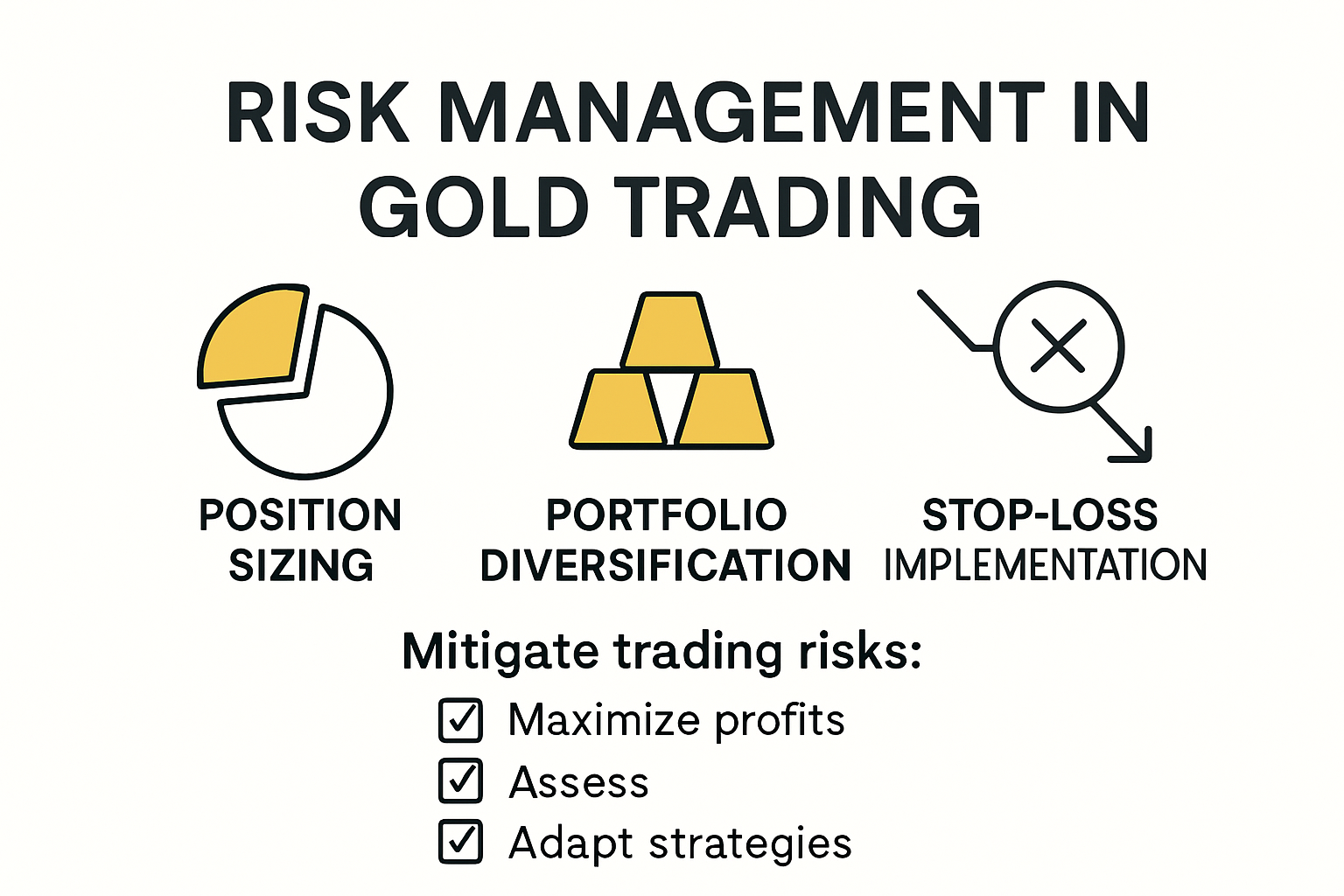
Maximizing gold trading profits requires sophisticated risk management techniques. Successful traders understand that consistent profitability stems from strategic diversification and controlled risk exposure.
Effective risk management strategies include:
- Position Sizing: Limiting individual trade risk
- Portfolio Diversification: Spreading investments across different market segments
- Stop-Loss Implementation: Protecting against significant market downturns
By combining advanced algorithmic techniques, predictive modeling, and disciplined risk management, traders can develop a comprehensive approach to maximizing gold trading profits. The most successful strategies integrate technological innovation with deep market understanding.
Remember that no single strategy guarantees success. Continuous learning, adaptation, and a willingness to embrace new analytical techniques are essential for long-term profitability in gold trading.
To help you compare the effectiveness of various gold trading strategies discussed, here’s a table summarizing their key strengths and features:
| Strategy | Key Advantage | Highlighted Outcome |
|---|---|---|
| Algorithmic Trading & Machine Learning | Dynamic adaptation to market changes | 901% total return possible |
| Time Series Forecasting (ARIMA, etc.) | Accurate next-day price prediction | High model reliability |
| Predictive Modeling | Integration of multiple complex signals | Nuanced trading decisions |
| Risk Management & Diversification | Controlled risk, capital protection | Consistent profitability |
Using XAU Signals and Market Analysis Effectively
Navigating the complex landscape of gold trading requires sophisticated signal interpretation and advanced market analysis techniques. Traders must develop a comprehensive approach that integrates multiple analytical tools and strategic insights.
Advanced Signal Interpretation Techniques
Explore our guide to effective trading signal strategies to enhance your trading precision. Modern gold trading demands more than simple signal recognition. Sophisticated traders leverage advanced analytical frameworks to maximize signal effectiveness.
Research applying tree-based classifiers demonstrated remarkable predictive capabilities, achieving over 85% accuracy in forecasting gold price directions for 10 to 20-day horizons. This highlights the potential of sophisticated machine learning techniques in signal analysis.
Key strategies for effective signal interpretation include:
- Multi-Indicator Validation: Cross-referencing signals across different analytical tools
- Contextual Analysis: Understanding broader market conditions
- Probabilistic Assessment: Evaluating signal reliability and potential outcomes
Machine Learning and Predictive Modeling
Cutting-edge machine learning techniques are transforming gold trading signal analysis. A groundbreaking 2023 study employed advanced models like Gradient Boosted Regression Trees and XGBoost to predict gold prices with unprecedented accuracy.
The research revealed critical insights:
- Index Correlation: One-day lagged data from indices like ASX, S&P500, and VIX significantly impact gold price forecasting
- Multidimensional Analysis: Integrating multiple market indicators enhances predictive accuracy
- Dynamic Modeling: Adaptive algorithms that continuously refine prediction models
Technical Analysis and Signal Optimization
An innovative study exploring trading strategies introduced advanced techniques using fractals and Triangular Moving Average Centered Bands, demonstrating superior trade performance.
Optimization strategies for XAU signals include:
- Fractal Pattern Recognition: Identifying complex market structures
- Moving Average Refinement: Developing more precise entry and exit points
- Signal Confirmation Protocols: Establishing rigorous validation mechanisms
Successful gold traders understand that signals are not absolute predictions but probabilistic guidance. The most effective approach combines technological sophistication with nuanced market understanding.
Remember that signal analysis is an evolving discipline. Continuous learning, technological adaptation, and a critical approach to market data are essential for long-term trading success. Stay informed, remain flexible, and consistently refine your analytical strategies.
Below is a summary table highlighting top analytical techniques used for effective XAU (gold) signal interpretation and optimization, along with their unique benefits:
| Technique | Application | Unique Benefit |
|---|---|---|
| Multi-Indicator Validation | Signal analysis | Reduces false positives |
| Tree-Based Classifiers (ML) | Direction prediction | Achieves over 85% accuracy |
| Fractal Pattern Recognition | Technical analysis | Identifies complex market structures |
| Moving Average Centered Bands | Signal optimization | Improves trade entry/exit precision |
| Sentiment Analysis | Market context | Quantifies news & psychology impact |
Risk Management and Common Mistakes to Avoid
Gold trading presents unique opportunities and challenges that demand strategic risk management. Successful traders understand that protecting capital is equally important as generating profits. Implementing robust risk mitigation strategies separates professional traders from amateur speculators.
Fundamental Risk Management Principles
Learn advanced risk management techniques to safeguard your trading capital. According to research from the World Gold Council, effective risk management involves understanding gold’s unique role in portfolio diversification and capital preservation.
Key risk management principles include:
- Position Sizing: Limiting individual trade exposure
- Diversification: Spreading risk across multiple trading instruments
- Capital Allocation: Protecting overall portfolio from significant drawdowns
- Emotional Discipline: Maintaining rational decision-making under market volatility
Common Trading Mistakes and Mitigation Strategies
IUX Education’s comprehensive analysis highlights critical mistakes traders frequently make. Understanding these pitfalls is crucial for developing a resilient trading approach.
Most prevalent trading mistakes include:
- Overleveraging: Risking excessive capital on single trades
- Ignoring Stop-Loss Orders: Failing to implement automatic loss protection
- Emotional Trading: Making decisions based on fear or greed
- Inadequate Market Research: Trading without comprehensive analysis
Advanced Risk Mitigation Techniques
TechCabal’s advanced risk management research provides sophisticated strategies for professional gold traders. These techniques go beyond basic risk management, offering nuanced approaches to trade protection.
Advanced risk mitigation strategies encompass:
- Hedging Techniques: Using complementary financial instruments to offset potential losses
- Volatility Analysis: Understanding and predicting market fluctuations
- Scenario Planning: Developing multiple trading contingencies
- Technical Risk Assessment: Utilizing advanced analytical tools for comprehensive risk evaluation
Successful gold trading requires a holistic approach that balances potential gains with systematic risk management. Traders must continuously educate themselves, adapt to changing market conditions, and maintain strict discipline.
Remember that risk management is not about eliminating risk entirely but about understanding, measuring, and controlling potential negative outcomes. Your ability to manage risk effectively will ultimately determine your long-term trading success.

Frequently Asked Questions
What factors influence gold prices in 2025?
Gold prices in 2025 are influenced by economic indicators like the U.S. Dollar Index, interest rates, GDP growth, global geopolitical tensions, and market sentiment. Traders should consider how these factors interact to understand price movements.
How can algorithmic trading improve gold trading profits?
Algorithmic trading leverages advanced algorithms and machine learning to analyze market trends, minimize transaction costs, and optimize entry and exit points, resulting in potentially higher profits—models have achieved returns as high as 901%.
What risk management strategies should gold traders use?
Effective risk management strategies include position sizing to limit trade risk, portfolio diversification, implementing stop-loss orders, and maintaining emotional discipline to navigate market volatility.
How can predictive modeling enhance gold trading accuracy?
Predictive modeling, such as ARIMA forecasting and machine learning techniques, can analyze historical data to predict future gold prices with high accuracy, helping traders make informed decisions based on complex market signals.
Ready to Turn 2025 Gold Strategies Into Real Profits?
You have just learned how new trading technologies and data-driven strategies can make the difference between being left behind and reaching your gold trading goals in 2025. But trying to spot every market signal or managing risk alone can feel overwhelming. Imagine having access to daily, high-accuracy XAU/USD gold trading signals that do the heavy lifting for you and guide you through unpredictable markets.
Explore practical How-To Guides on maximizing gold profits
Achieve more consistent wins, protect your capital, and trade with clarity. Our expert-driven strategies combine technical analysis, powerful algorithms, and precise trade signals with a 90%+ accuracy rate. No more second-guessing every move. Take action now to join our exclusive trading community at https://xau-gold-signals.com and get real-time support designed for ambitious traders like you. Your journey to smarter, safer gold trading starts today.
