
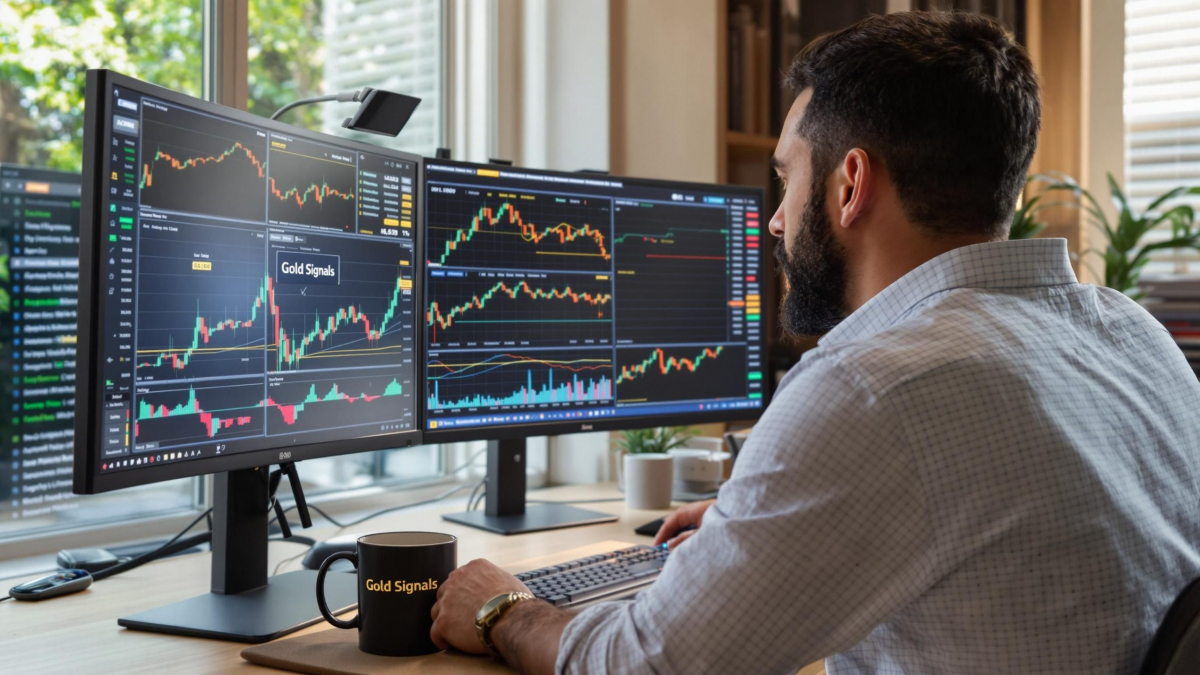
Gold price signals are driving drastic changes in forex trading, with advanced machine learning models now generating daily profit results like $1,623.52 over just 23 days. Most traders expect gold signals to be straightforward green lights or red flags for buy and sell. In reality, these signals are anything but simple routines—they are complex probabilistic tools packed with insights and blind spots, and understanding their true potential can completely shift how you trade gold.
Table of Contents
- What Are Gold Signals And How They Work
- Essential Tools For Interpreting Gold Signals
- Common Mistakes To Avoid In Gold Signal Analysis
- Applying Gold Signals To Real Trading Strategies
Quick Summary
| Takeaway | Explanation |
|---|---|
| Understand gold signals as probabilistic tools | Gold signals provide probabilities of market movements, not certainties. Proper interpretation is essential for informed trading decisions. |
| Utilize advanced analytical tools for better insights | Employ tools like machine learning and technical indicators to enhance gold signal accuracy and trading strategies. |
| Adhere to robust risk management practices | Establish clear risk parameters, including stop-loss orders, to protect capital from unexpected market volatility. |
| Avoid common psychological trading errors | Emotional decision-making can harm trading performance; develop discipline by following a structured trading plan. |
| Implement systematic trading strategies | Create structured approaches for signal application, including clear entry and exit criteria, to enhance trading effectiveness. |
What Are Gold Signals and How They Work
Trading gold requires precision and strategic insights. Gold signals represent sophisticated analytical tools that help forex traders make informed decisions about XAU/USD market movements. These signals are essentially expert-generated recommendations that provide traders with specific entry, exit, and risk management parameters for gold trading.
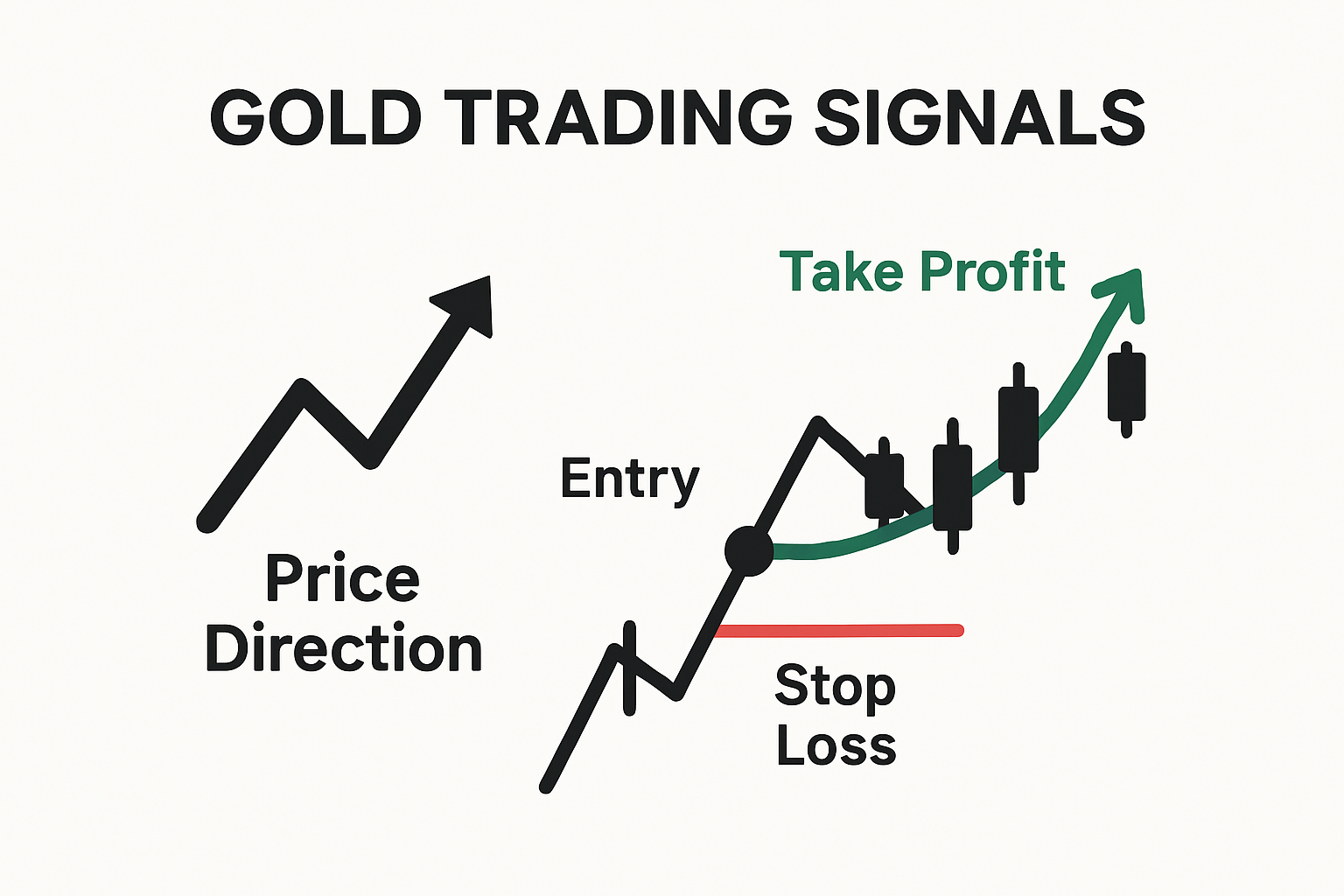
The Anatomy of Gold Trading Signals
Gold signals are complex mathematical and analytical outputs derived from multiple market analysis techniques. According to research from the International Finance Research Center, these signals incorporate sophisticated sentiment analysis and technical indicators to predict potential market movements. The primary components typically include:
- Price Direction: Indicates whether gold prices are likely to move up or down
- Entry Points: Specific price levels recommended for opening a trade
- Stop Loss: Predetermined price levels to limit potential losses
- Take Profit: Target price points for closing the trade with desired profits
Professional traders rely on these signals because they synthesize massive amounts of market data into actionable insights. Advanced computational models now utilize machine learning algorithms and neural networks to generate increasingly accurate predictive signals, transforming how traders approach gold market strategies.
Signal Generation Methodologies
The process of generating gold signals involves multiple sophisticated analytical approaches. Traders and algorithmic systems typically combine several key methodological frameworks:
-
Technical Analysis: Examining historical price charts, identifying patterns, tracking moving averages, and using statistical indicators like Relative Strength Index (RSI) and Moving Average Convergence Divergence (MACD).
-
Fundamental Analysis: Evaluating macroeconomic factors such as central bank policies, global economic indicators, geopolitical events, and currency fluctuations that might impact gold prices.
-
Sentiment Analysis: Monitoring news sources, social media, and financial platforms to gauge market sentiment and potential investor behavior.
These methodologies work synergistically to produce gold signals that offer traders a comprehensive view of potential market movements. The integration of multiple analytical techniques helps minimize individual methodological biases and provides a more robust predictive framework.
Understanding gold signals requires recognizing they are probabilistic tools, not guaranteed predictions. Successful traders use these signals as part of a broader, disciplined trading strategy that includes risk management, continuous learning, and adaptive decision making. While signals provide valuable insights, they should always be combined with personal market analysis and a thorough understanding of individual trading goals.
For traders looking to enhance their gold trading strategies, continuous education and staying updated with the latest signal generation technologies remain critical. The gold market’s inherent complexity demands a nuanced, data-driven approach that balances technological insights with human judgment.
Essential Tools for Interpreting Gold Signals
Successful gold trading requires a strategic arsenal of analytical tools that transform raw market data into actionable insights. Professional traders leverage sophisticated technological platforms and advanced indicators to decode complex gold market signals with precision and confidence.
Technical Analysis Platforms and Indicators
Trading platforms serve as the primary infrastructure for interpreting gold signals. According to research from the International Finance Research Center, key technical indicators play a crucial role in signal interpretation. Traders typically rely on platforms that offer comprehensive analytical capabilities:
- MetaTrader 4/5: Industry-standard platforms with robust charting tools
- TradingView: Advanced visualization and social trading features
- Bloomberg Terminal: Professional-grade market data and analysis system
Critical technical indicators for gold signal analysis include:
- Relative Strength Index (RSI)
- Moving Average Convergence Divergence (MACD)
- Bollinger Bands
- Fibonacci Retracement Levels
Advanced Computational Analysis Tools
Cutting-edge computational models are revolutionizing gold signal interpretation through machine learning and artificial intelligence technologies. These advanced tools utilize neural networks and deep learning algorithms to process massive datasets and generate predictive insights.
Key computational analysis approaches include:
- Neural encoder-decoder frameworks
- Deep reinforcement learning models
- Conditional Generative Adversarial Networks (cGANs)
- Time series prediction algorithms
These sophisticated tools enable traders to:
- Identify complex market patterns
- Predict potential price movements
- Minimize human cognitive biases
- Process information faster than traditional methods
Risk Management and Signal Validation Tools
Interpreting gold signals goes beyond mere technical analysis. Professional traders employ comprehensive risk management tools to validate and optimize trading decisions. These tools help assess signal reliability, potential market volatility, and overall trade performance.
Essential risk management technologies include:
- Monte Carlo simulation tools
- Portfolio risk calculators
- Automated stop-loss systems
- Real-time volatility tracking algorithms
Traders must understand that no single tool guarantees success. The most effective approach combines multiple analytical methods, continuous learning, and adaptive strategies. By integrating advanced technological tools with human expertise, traders can develop a nuanced understanding of gold market dynamics and improve their signal interpretation capabilities.
Continuous technological adaptation remains critical in the rapidly evolving forex trading landscape. Staying informed about emerging analytical technologies and refining signal interpretation skills will be key to maintaining a competitive edge in gold trading.

Common Mistakes to Avoid in Gold Signal Analysis
Navigating the complex world of gold signal analysis requires more than just technical knowledge. Even experienced traders can fall into predictable traps that undermine their trading performance. Understanding and avoiding these common mistakes is crucial for maintaining a disciplined and profitable trading approach.
Misinterpreting Signal Reliability
One of the most critical errors traders make is overestimating the absolute reliability of gold signals. According to research from Finance World, blindly following signals without understanding their underlying rationale can lead to significant financial losses. Professional traders recognize that signals are probabilistic tools, not guaranteed predictions.
Key reliability misconceptions include:
- Treating Signals as Absolute Guarantees: Signals represent potential market movements, not certainties
- Ignoring Contextual Market Conditions: Failing to consider broader economic factors that influence gold prices
- Signal Confirmation Bias: Selectively interpreting signals that confirm preexisting market expectations
Risk Management Failures
Forex Market Analyst research highlights that inadequate risk management is a fundamental error in signal-based trading. Successful traders implement robust risk mitigation strategies that protect their capital from unexpected market volatility.
Critical risk management mistakes include:
- Not setting appropriate stop-loss orders
- Risking excessive capital on a single trade
- Failing to diversify trading strategies
- Neglecting position sizing principles
Traders should establish clear risk parameters, typically limiting individual trade risks to 1-2% of their total trading capital. This approach ensures that a series of unsuccessful trades will not dramatically impact overall portfolio performance.
Emotional and Psychological Trading Errors
According to expert analysis from Forex Academy, psychological factors play a significant role in trading failures. Emotional decision-making can quickly erode carefully developed trading strategies.
Common psychological pitfalls include:
- Chasing losses
- Becoming overly attached to specific trade positions
- Letting fear or greed drive trading decisions
- Abandoning established trading plans during market volatility
Successful gold signal traders develop emotional discipline through structured approaches. This involves creating predefined trading rules, maintaining a trading journal, and regularly reviewing performance without emotional bias.
Mitigating these mistakes requires a holistic approach that combines technical knowledge, psychological awareness, and disciplined execution. Traders must continuously educate themselves, remain adaptable, and approach gold signal analysis with a balanced, analytical mindset.
Remember that mastering gold signal interpretation is an ongoing journey. Each mistake represents an opportunity to refine strategies, improve analytical skills, and develop a more nuanced understanding of complex market dynamics. Consistent learning, self-reflection, and a commitment to disciplined trading are the ultimate keys to long-term success in gold forex trading.
To help clarify the most common pitfalls in gold signal analysis, the following table summarizes key mistakes across three main categories:
| Category | Mistake/Description | Potential Outcome |
|---|---|---|
| Signal Reliability | Treating signals as absolute guarantees | Financial losses |
| Signal Reliability | Ignoring broader market/economic conditions | Missed market shifts |
| Signal Reliability | Signal confirmation bias (favoring signals that match your view) | Skewed trading results |
| Risk Management | Not using stop-loss orders | Large, unmanaged losses |
| Risk Management | Risking too much capital on one trade | Rapid capital depletion |
| Risk Management | Failing to diversify or ignoring position sizing | Higher portfolio risk |
| Psychological/Emotional Error | Making trades based on fear or greed | Erosion of discipline |
| Psychological/Emotional Error | Abandoning your plan during volatility or chasing losses | Increased losses |
Applying Gold Signals to Real Trading Strategies
Transforming gold signals into actionable trading strategies requires a systematic and disciplined approach. Traders must move beyond theoretical knowledge and develop practical methods for implementing signals effectively in real market conditions.
Strategic Signal Implementation Frameworks
Research from the journal Risks highlights the importance of integrating multiple data sources to enhance gold price forecasting. Successful implementation involves creating robust frameworks that combine technical analysis, fundamental insights, and adaptive strategies.
Key strategic implementation approaches include:
- Multi-Timeframe Analysis: Examining signals across different time horizons
- Signal Confirmation Techniques: Cross-referencing multiple indicators
- Dynamic Risk Allocation: Adjusting position sizes based on signal strength
- Contextual Market Assessment: Considering broader economic indicators
Traders can develop systematic approaches by establishing clear rules for:
- Signal entry criteria
- Position sizing
- Risk management parameters
- Exit strategy protocols
Advanced Predictive Modeling Techniques
Cutting-edge research on event-driven price prediction demonstrates the potential of sophisticated machine learning models in developing trading strategies. Neural network approaches, particularly Long Short-Term Memory (LSTM) models, offer sophisticated methods for interpreting complex market signals.
Advanced predictive modeling strategies include:
- Neural network-based trend prediction
- Machine learning signal validation
- Automated trading bot integration
- Real-time market sentiment analysis
One remarkable study showcased a neural network model that generated a profit of $1,623.52 over a 23-day testing period, illustrating the potential of sophisticated algorithmic approaches.
Practical Signal Application Methodology
Effective gold signal application requires a structured methodology that balances technological insights with human judgment. Traders must develop a comprehensive approach that combines:
- Rigorous backtesting of signal strategies
- Continuous performance monitoring
- Adaptive strategy refinement
- Psychological discipline
Successful implementation involves creating a systematic trading plan that:
- Defines clear entry and exit criteria
- Establishes strict risk management protocols
- Incorporates ongoing learning and strategy adjustment
- Maintains emotional neutrality
The following table outlines a step-by-step process for applying gold signals to real trading, helping traders visualize an effective methodology:
| Step | Action | Purpose |
|---|---|---|
| 1. Strategy Backtesting | Test signals with historical data | Validate signal effectiveness and consistency |
| 2. Define Entry/Exit Rules | Set clear criteria for trade entry and exit | Establish discipline and reduce ambiguity |
| 3. Risk Management Setup | Apply stop-loss, position sizing, max risk per trade | Limit potential losses |
| 4. Live Signal Monitoring | Continuously monitor signals in real-time | Ensure strategy adapts to changing markets |
| 5. Performance Review | Review trades, journal outcomes, refine strategies | Continuous improvement and learning |
| 6. Emotional Discipline | Follow plan, avoid impulsive trades | Maintain consistency across market cycles |
Traders should view gold signals as probabilistic tools rather than absolute predictors. The most effective strategies combine technological insights with human expertise, allowing for nuanced interpretation and adaptive decision-making.
Ultimately, applying gold signals to real trading strategies is an ongoing process of learning, refinement, and disciplined execution. Successful traders continuously evolve their approaches, integrating new technologies and insights while maintaining a core focus on risk management and strategic consistency.
Frequently Asked Questions
What are gold signals in forex trading?
Gold signals are analytical tools that provide traders with insights into potential market movements for gold. They offer recommendations on entry and exit points, as well as risk management parameters based on complex market analysis.
How can I interpret gold trading signals effectively?
To interpret gold signals effectively, combine technical analysis, fundamental insights, and sentiment analysis. Utilize advanced analytical tools and remember that signals represent probabilities rather than certainties.
What tools can enhance the accuracy of gold signals?
Tools such as technical analysis platforms (MetaTrader 4/5, TradingView), advanced computational models using machine learning, and risk management tools like stop-loss systems can significantly enhance the accuracy of gold signals.
What common mistakes should I avoid when analyzing gold signals?
Common mistakes to avoid include treating signals as absolute guarantees, neglecting proper risk management, and allowing emotional factors to influence trading decisions. Cultivate a disciplined approach to minimize these errors.
Transform Gold Signal Insights Into Real Profits
Are you struggling to make sense of complex gold trading signals and feeling frustrated by inconsistent results? If you want to move beyond confusing numbers and complicated analysis, you need more than just theory. You deserve proven, actionable guidance. Discover how the right trading partner can help you turn those probabilistic signals into steady profit and real confidence in your trading journey by visiting XAU Gold Signals.
Now is the time to bridge the gap between market analysis and results. Our high-accuracy gold signals deliver simple, real-time strategies for gold traders at every skill level. Get instant access to our private Telegram group, daily trading signals, and expert-driven analyses that remove guesswork. Take the step toward profitable, stress-free gold trading by joining us at XAU Gold Signals today.
