

Gold trading sounds simple at first glance but the reality is loaded with complex words that can trip up even experienced forex traders. Picture this—the spot price of gold can change dozens of times in a single minute as global markets react. Most people assume learning these terms is just for financial pros. Knowing the right terminology could be the edge that separates consistent winners from everyone else.
Table of Contents
- Key gold trading terminology explained
- Understanding trading signals in gold markets
- Gold market analysis terms for forex traders
- Advanced terminology for gold investment strategies
Quick Summary
| Takeaway | Explanation |
|---|---|
| Understand key gold trading terms. | Familiarity with terms like Spot Price and Gold Fixing enhances trading decisions in the gold market. |
| Utilize technical indicators for signals. | Indicators such as RSI and MACD aid in identifying trading opportunities through price movement analysis. |
| Combine technical and fundamental analysis. | Successful traders analyze both price trends and economic indicators to better predict gold market movements. |
| Implement risk management strategies. | Using Stop Loss and understanding Volatility helps traders minimize potential losses while maximizing gains. |
| Learn advanced trading concepts. | Concepts like arbitrage and hedging deepen understanding, allowing more strategic investment in gold markets. |
Key Gold Trading Terminology Explained
Understanding gold trading terminology is crucial for forex traders looking to navigate the complex world of precious metal investments. This comprehensive guide breaks down essential terms that will empower traders to make more informed decisions in the gold market.
Fundamental Market Terminology
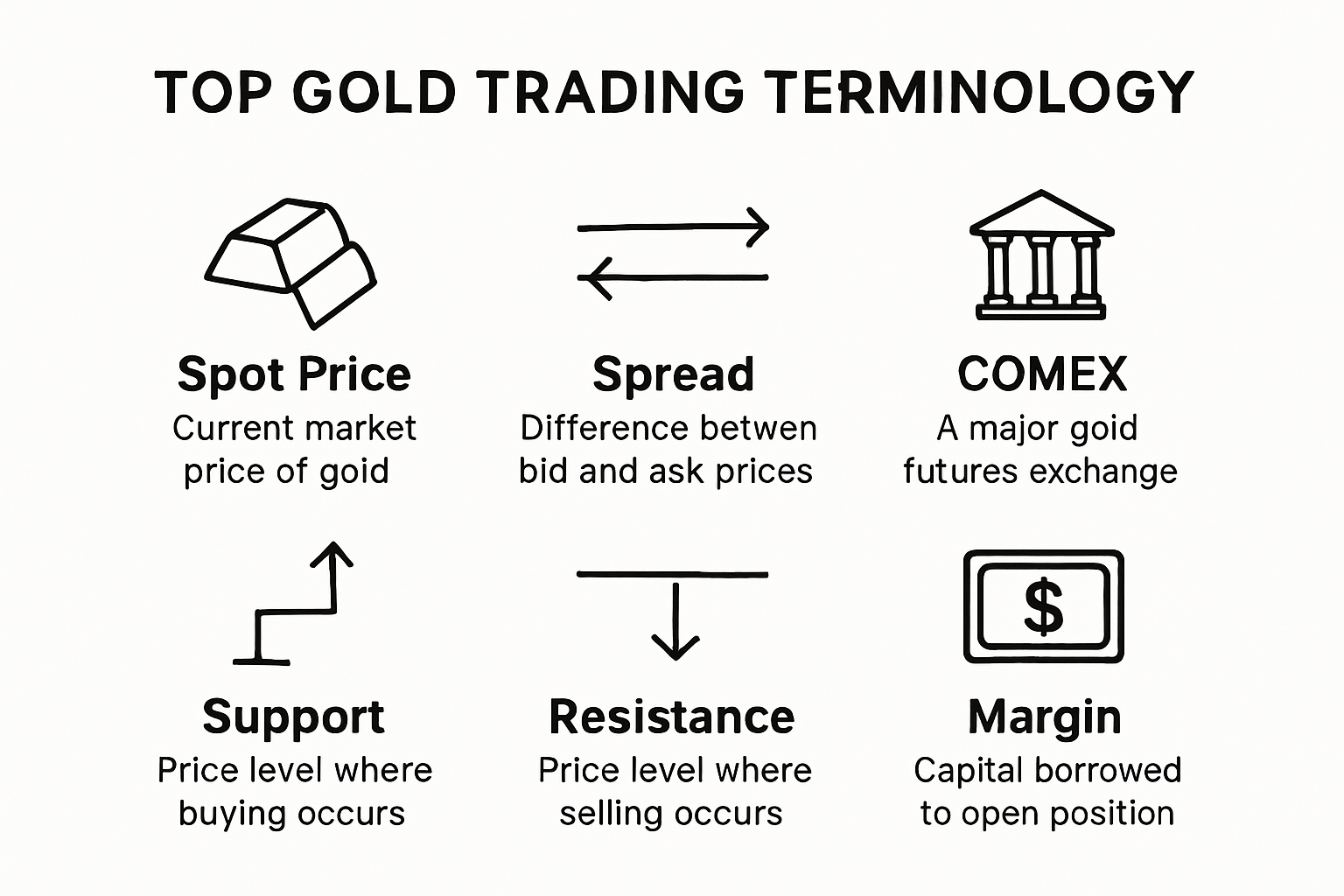
Traders must first grasp the core terminology that defines gold trading mechanics. Spot Price represents the current market value of gold for immediate delivery, which serves as the baseline for most trading activities. The Commodity Futures Trading Commission highlights that spot prices fluctuate continuously based on global market conditions, economic indicators, and trading volume.
A critical concept is Gold Fixing, which refers to the process of determining the official gold price at specific times. This mechanism, traditionally conducted by major London bullion banks, provides a benchmark for global gold transactions. Traders use this reference point to evaluate potential entry and exit points in their trading strategies.
Advanced Trading Concepts
Beyond basic pricing, traders encounter more sophisticated terminology that impacts trading decisions. Spread represents the price difference between buying and selling gold, which directly influences potential profitability. According to the University of Missouri Extension, understanding spreads is essential for managing transaction costs and potential returns.
The COMEX (Commodity Exchange) plays a pivotal role in gold trading. Investopedia explains that COMEX is the primary futures and options market for metals, where traders can execute complex trading strategies involving gold contracts. Professionals use COMEX to hedge positions, speculate on price movements, and manage risk.
Technical Analysis Terminology
Technical traders rely on specific terminology to analyze gold price movements. Support and Resistance levels are crucial concepts that help predict potential price reversals. Learn more about advanced trading strategies to understand how these levels can guide trading decisions.
Additional key terms include Long Position (betting on price increases) and Short Position (anticipating price declines). Traders must also understand Margin requirements, which determine the amount of capital needed to open and maintain trading positions.
Mastering these gold trading terminologies transforms complex market dynamics into actionable insights. Whether you are a beginner or an experienced trader, comprehending these terms provides a solid foundation for navigating the intricate world of gold trading with confidence and precision.
Understanding Trading Signals in Gold Markets
Trading signals are critical tools that help forex traders make informed decisions in the volatile gold markets. These signals provide strategic insights into potential trading opportunities by analyzing complex market dynamics and price movements.
Technical Analysis Signals
Technical analysis plays a crucial role in generating gold trading signals. Research from ResearchGate reveals that indicators like Relative Strength Index (RSI) and Moving Average Convergence Divergence (MACD) are powerful tools for predicting gold price movements. These technical indicators help traders identify potential buy and sell points by examining historical price patterns, trading volume, and momentum.
Traders typically use multiple technical indicators simultaneously to increase signal reliability. Moving Averages can reveal trend directions, while Bollinger Bands help assess market volatility. Stochastic Oscillators provide insights into potential trend reversals, giving traders a comprehensive view of market conditions.

Fundamental Analysis Signals
Beyond technical indicators, fundamental analysis offers critical context for gold trading signals. The Economic Times emphasizes the importance of combining technical and fundamental analysis to understand comprehensive market movements.
Fundamental signals include economic indicators such as inflation rates, currency strength, geopolitical events, and central bank policies. These factors significantly impact gold prices. For instance, during economic uncertainties, investors often view gold as a safe-haven asset, driving up its value. Traders must monitor global economic news, interest rate changes, and geopolitical tensions to generate accurate trading signals.
Signal Generation and Interpretation
Investopedia defines a trade signal as a trigger for action, generated through complex analysis involving mathematical algorithms and market factors. In gold trading, signals can be human-generated or produced by advanced trading software.
Understanding signal quality is crucial. Traders should explore different signal strategies to develop a robust trading approach. Not all signals are equal, and experienced traders learn to distinguish between high-probability and low-probability signals.
Successful gold trading requires continuous learning, risk management, and a nuanced understanding of how different signals interact. Traders must remain adaptable, using signals as guidance while maintaining their own critical analysis and risk assessment strategies.
Gold Market Analysis Terms for Forex Traders
Forex traders navigating the gold market must develop a comprehensive understanding of specialized analysis terminology. These critical terms enable precise market interpretation, risk management, and strategic decision-making in the complex world of gold trading.
Fundamental Analysis Terminology
Fundamental analysis provides traders with crucial insights into gold market dynamics. The Commodity Futures Trading Commission emphasizes understanding key economic indicators that influence gold prices. Economic Indicators such as inflation rates, currency strength, and global economic stability play pivotal roles in determining gold’s market value.
Key fundamental analysis terms include Purchasing Power Parity (PPP), which compares currency values across different economies, and Gross Domestic Product (GDP) trends. Traders must also comprehend Interest Rate Differentials, which significantly impact gold pricing by influencing investor sentiment and currency movements.
To help clarify the distinctions, the following table summarizes key fundamental analysis terminology and their impact on the gold market:
| Term | Definition | Impact on Gold Trading |
|---|---|---|
| Economic Indicators | Statistics reflecting the health of an economy | Strong indicators may depress gold, weak ones can raise prices |
| Purchasing Power Parity | Measurement comparing currency values across economies | Affects gold pricing through currency strength |
| Gross Domestic Product | The total value of goods/services produced by a country | Economic growth or decline influences investor demand for gold |
| Interest Rate Differentials | Difference in interest rates between countries | Changes can alter gold’s appeal relative to other assets |
Technical Analysis Terminology
Technical analysis offers traders sophisticated tools for interpreting gold market movements. Trend Lines help identify potential price directions, while Fibonacci Retracements provide insights into potential support and resistance levels. Explore advanced trading strategies to enhance your market analysis skills.
Critical technical terms include Candlestick Patterns, which reveal market sentiment and potential price reversals. Volume Analysis helps traders understand the strength behind price movements, while Momentum Indicators provide insights into the speed and force of price changes.
Risk Management Terminology
Investopedia highlights the importance of understanding risk management terminology in forex trading. Volatility measures the rate and magnitude of price fluctuations, while Beta indicates a gold asset’s sensitivity to market movements.
Traders must be familiar with terms like Stop Loss, which limits potential losses, and Take Profit, which secures gains at predetermined levels. Correlation helps traders understand how gold interacts with other financial instruments, providing a more comprehensive market perspective.
The CFTC advises traders to thoroughly understand these terms and associated market risks before engaging in gold trading. Mastering this terminology transforms complex market data into actionable trading strategies, empowering traders to make more informed decisions in the dynamic gold market.
Successful gold trading requires continuous learning, adaptability, and a nuanced understanding of these critical analysis terms. Traders who invest time in comprehending these concepts position themselves for more strategic and potentially profitable trading experiences.
Advanced Terminology for Gold Investment Strategies
Advanced gold investment strategies require a sophisticated understanding of complex trading terminology. Professional traders leverage nuanced techniques that go beyond basic market interactions, employing strategic approaches to maximize potential returns and minimize risks in the volatile gold market.
Strategic Trading Techniques
Convergence trading represents a sophisticated investment approach. Wikipedia defines convergence trade as a strategy involving simultaneous buying and selling of related assets, expecting their prices to align over time. This technique allows traders to exploit minute price differentials between similar gold-related financial instruments.
Hedging Strategies play a critical role in advanced gold investment. Traders utilize complex options contracts to protect against potential market downturns while maintaining exposure to potential price appreciation. Put Options and Call Options provide strategic flexibility, allowing investors to design intricate risk management frameworks.
The following table summarizes advanced gold trading techniques and the benefits they offer:
| Technique | Description | Primary Benefit |
|---|---|---|
| Convergence Trading | Simultaneous buy and sell of related gold assets expecting price alignment | Profit from price discrepancies |
| Hedging Strategies | Use of options like puts and calls to offset potential losses | Risk reduction during market volatility |
| Arbitrage Trading | Simultaneous purchase and sale in different markets to exploit price variation | Opportunity to profit from price inefficiencies |
Risk Management Terminology
Advanced risk management goes beyond traditional stop-loss mechanisms. Technical analysis reveals that sophisticated traders employ dynamic hedging techniques to continuously adjust their market positions. Position Sizing becomes crucial, with traders allocating specific capital percentages to manage overall portfolio exposure.
Key risk management terms include Volatility Index, which measures market uncertainty, and Beta Coefficient, indicating an asset’s sensitivity to broader market movements. Traders use these metrics to develop probabilistic models that anticipate potential market fluctuations and design corresponding investment strategies.
Advanced Investment Concepts
The most sophisticated gold investors understand complex investment terminology that extends beyond traditional trading approaches. Research on advanced hedging techniques highlights the importance of understanding nuanced investment concepts.
Arbitrage Trading represents a high-level strategy where traders simultaneously purchase and sell gold across different markets to capitalize on price discrepancies. Derivative Instruments like futures and forward contracts allow traders to speculate on future gold prices without physically owning the asset.
Understanding these advanced terminologies transforms gold trading from a simple transactional activity to a sophisticated financial discipline. Successful traders continuously educate themselves, adapting their strategies to evolving market conditions and developing a comprehensive understanding of these complex investment mechanisms.
Mastering these advanced gold investment terms requires dedication, continuous learning, and a willingness to embrace complex financial strategies. Traders who invest time in understanding these nuanced concepts position themselves to make more informed, strategic decisions in the dynamic world of gold trading.
Frequently Asked Questions
What is the spot price of gold in trading?
The spot price of gold is the current market value at which gold can be bought or sold for immediate delivery. It fluctuates continuously based on global market conditions and economic indicators.
What does ‘gold fixing’ mean in the gold market?
Gold fixing refers to the process of determining the official price of gold at specific times, traditionally conducted by major banks. This price serves as a benchmark for gold transactions around the world.
How do technical analysis signals help in gold trading?
Technical analysis signals, such as RSI and MACD, help traders predict potential price movements by examining historical data and market conditions. These indicators assist in making informed buy and sell decisions.
What are risk management strategies for gold trading?
Risk management strategies in gold trading include using Stop Loss orders to limit potential losses, understanding volatility to assess market risks, and employing position sizing to allocate appropriate capital to trades.
Level Up Your Gold Trading Confidence With Pro Signals
Understanding gold trading terminology is a powerful first step, but real results come when you apply that knowledge directly in the market. If you have ever struggled to translate terms like spot price, support and resistance, or margin into consistent profits, you are not alone. Many traders know the theory, but still face setbacks managing complex signals and pinpointing the best trade entries. That is where a proven edge makes all the difference.
Discover practical, high-win rate strategies in our How To Guides designed for both new and experienced gold traders. You can easily bridge the gap between learning the key terminology from this guide and turning expert concepts into reliable trade outcomes with our daily XAU/USD signals.
Ready to transform your market insight into action? Join our Private Telegram Group for real-time gold trading signals supported by technical, fundamental, and price action analysis. Experience steady profits with our 90 percent plus accuracy rate. Do not leave your gains up to chance. Visit XAU Gold Signals now and access industry-leading support for your next gold trade.
