

Gold prices are getting harder to predict with traditional tools. In 2023, machine learning models like XGBoost delivered some of the most accurate gold forecasts ever, leaving many traders surprised. Most people assume forecasting gold is only about watching interest rates, but new strategies using deep data analysis and AI are actually rewriting the rules—and might give everyday traders an unexpected edge this year.
Table of Contents
- Key Factors Affecting Gold Price Movements
- Popular Gold Price Forecasting Methods Explained
- How To Apply Forecasting Techniques In Trading
- Choosing The Best Gold Forecasting Approach For You
Quick Summary
| Takeaway | Explanation |
|---|---|
| Economic Indicators are Crucial | Real interest rates and inflation expectations significantly influence gold prices, making it essential for traders to monitor these factors closely. |
| Utilize Advanced Forecasting Techniques | Incorporating machine learning and statistical models can enhance prediction accuracy by analyzing complex market dynamics and integrating multiple variables. |
| Develop a Systematic Trading Strategy | Establishing clear entry and exit rules, alongside rigorous risk management, is vital for maintaining discipline and optimizing trading performance. |
| Continuous Learning is Key | Traders should remain adaptable and continuously update their forecasting models based on new data and technological advancements to navigate the evolving market effectively. |
| Match Methods to Trading Profiles | Selecting forecasting techniques that align with individual trading goals, skill levels, and resources is essential for successful gold trading. |
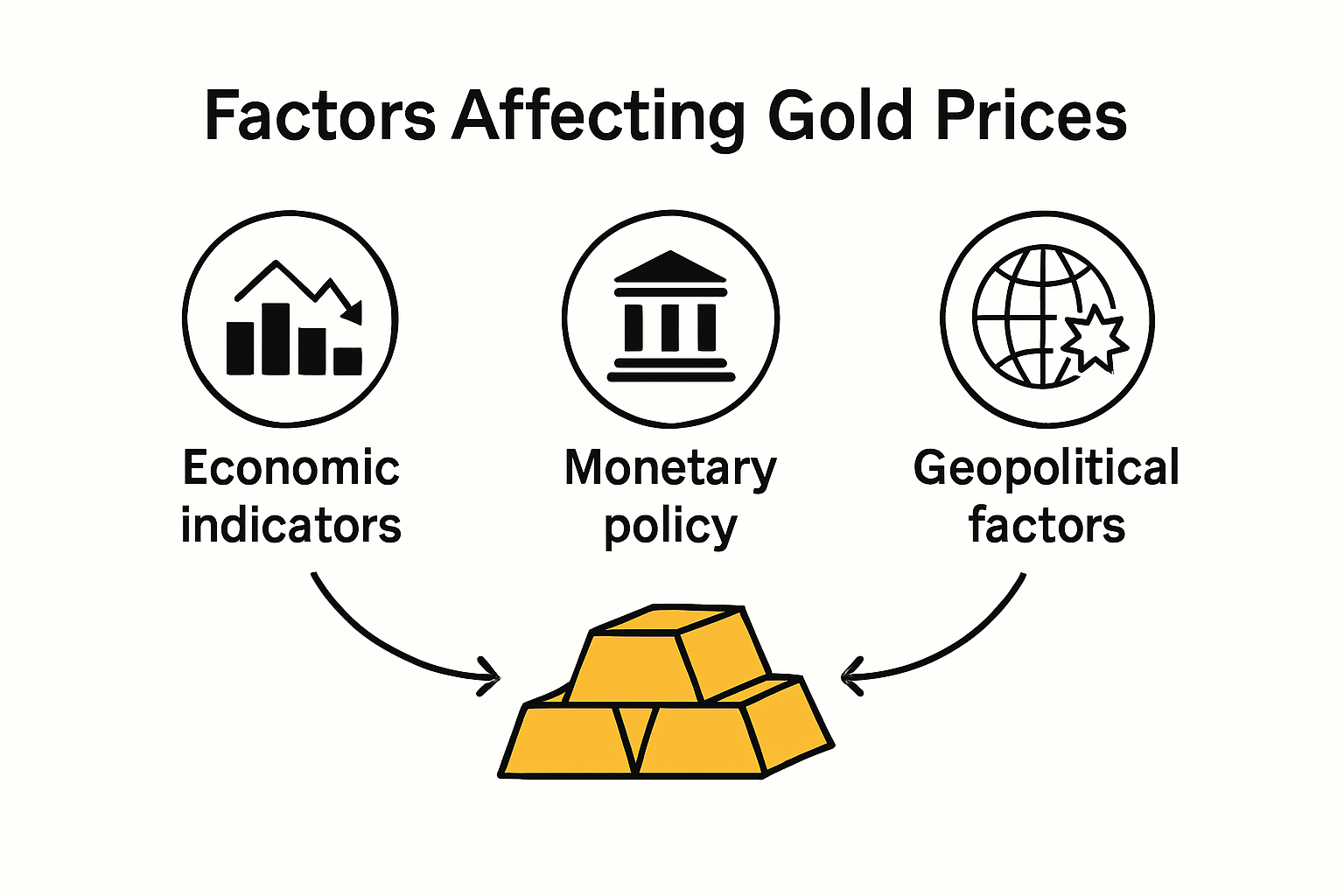
Key Factors Affecting Gold Price Movements
Gold price movements represent a complex interplay of global economic, geopolitical, and market dynamics that traders must carefully analyze. Understanding these intricate factors is crucial for developing accurate gold price forecasting methods in 2025 and beyond.
Economic Indicators and Monetary Policy Influences
Economic indicators play a pivotal role in determining gold price trajectories. According to the International Monetary Fund, real interest rates stand out as a critical driver of gold prices. When interest rates decline, gold becomes more attractive as an investment, typically causing prices to rise. Inflation expectations also significantly impact gold valuations, with investors frequently turning to gold as a hedge against currency devaluation.
Monetary policies implemented by central banks create substantial ripple effects in gold markets. Quantitative easing programs, interest rate adjustments, and overall economic stimulus strategies directly influence investor sentiment and gold demand. The National Bureau of Economic Research highlights how macroeconomic indicators like employment data and broader economic stability metrics contribute to gold price volatility.
Global Geopolitical and Market Uncertainty Factors
Geopolitical tensions and market uncertainties emerge as powerful catalysts for gold price movements. Traders recognize gold as a traditional safe-haven asset during periods of economic instability. Political conflicts, international trade disputes, and unexpected global events can trigger rapid shifts in gold valuations. Investors often view gold as a protective financial instrument when traditional markets experience heightened volatility.
Currency exchange rates, particularly the US dollar’s performance, represent another crucial determinant of gold prices. A weakening dollar typically correlates with rising gold prices, as gold becomes more affordable for international investors. Conversely, a strong dollar can exert downward pressure on gold valuations.
Market Sentiment and Investment Flows
Investor psychology and sentiment play an increasingly important role in gold price forecasting. Institutional and retail investor behaviors, commodity market trends, and alternative investment landscapes significantly influence gold demand. Emerging investment vehicles like cryptocurrency and digital assets create additional competitive dynamics in the broader investment ecosystem.
Traders focused on gold price forecasting methods must develop sophisticated analytical approaches that integrate these multifaceted factors. By understanding the nuanced interactions between economic indicators, geopolitical events, and market sentiment, traders can construct more robust predictive models. Explore our advanced gold trading signals to gain deeper insights into navigating these complex market dynamics.
Successful gold trading requires continuous monitoring of these interconnected factors, adaptable strategies, and a comprehensive understanding of global economic trends.
Popular Gold Price Forecasting Methods Explained
Gold price forecasting demands sophisticated analytical techniques that combine multiple methodologies to enhance predictive accuracy. Traders seeking to navigate the complex gold market must understand and leverage advanced forecasting approaches that integrate statistical, technological, and market-driven strategies.
Machine Learning and Statistical Forecasting Models
Advanced computational techniques have revolutionized gold price prediction. Research published in 2023 demonstrated the effectiveness of machine learning algorithms in forecasting gold price movements. Techniques like random forests, gradient boosting regression trees (GBRT), and XGBoost have shown remarkable performance in analyzing complex market dynamics.
These machine learning models process vast amounts of historical data, identifying intricate patterns that traditional statistical methods might overlook. By integrating multiple variables such as economic indicators, market sentiment, and historical price trends, these algorithms can generate more nuanced and precise predictions. Explore our advanced gold trading signals to understand how cutting-edge techniques transform trading strategies.
Technical Analysis and Trading Algorithms
Research from 2022 highlighted several effective algorithmic trading systems for precious metal futures, including gold. Techniques like linear regression, Darvas boxes, and Bollinger bands offer traders structured approaches to understanding potential price movements. Linear regression, in particular, demonstrated superior effectiveness in forecasting gold price trends.
Technical analysis involves studying price charts, identifying historical patterns, and using statistical indicators to predict future movements. Traders utilize tools like moving averages, relative strength index (RSI), and support and resistance levels to make informed trading decisions. Price action trading strategies provide additional insights into market sentiment and potential price trajectories.
Comprehensive Predictive Frameworks
Modern gold price forecasting increasingly relies on holistic approaches that combine multiple data sources and modeling techniques. A 2023 study proposed an integrated framework that merges classical statistical techniques, machine learning algorithms, and deep learning architectures.
This comprehensive approach captures complex market dynamics by incorporating financial indicators, macroeconomic data, and sentiment analysis. By leveraging diverse data sources, traders can develop more robust predictive models that account for linear and nonlinear market patterns, seasonal variations, and long-range dependencies.
Successful gold trading requires continuous learning and adaptation. Traders must remain flexible, understanding that no single forecasting method guarantees absolute accuracy. The most effective approach combines multiple techniques, maintains rigorous risk management, and stays attuned to global economic shifts.
As technology advances, gold price forecasting methods will continue evolving, offering traders increasingly sophisticated tools to navigate market complexities and make informed investment decisions.
To help clarify the strengths and uses of each forecasting approach discussed above, the following table presents a side-by-side comparison of popular gold price forecasting methods, their main techniques, strengths, and the typical profiles of traders best suited to use them:
| Method | Main Techniques | Key Strengths | Best For |
|---|---|---|---|
| Machine Learning & Statistical Models | XGBoost, Random Forest, Regression Trees | Handles complex patterns, high accuracy | Advanced traders, data-savvy |
| Technical Analysis & Trading Algorithms | Moving Averages, RSI, Bollinger Bands, Darvas Box, Linear Regression | Easy to implement, visual, actionable signals | All experience levels |
| Comprehensive Predictive Frameworks | Combines classical, ML, deep learning | Holistic, integrates many data sources | Professionals, institutions |
| Simple Statistical Methods | Exponential Smoothing, Linear Regression | Interpretable, low technical barrier | Beginners, intermediate |
How to Apply Forecasting Techniques in Trading
Successful application of gold price forecasting techniques requires a strategic and disciplined approach that combines advanced analytical methods with robust risk management principles. Traders must develop a comprehensive framework that transforms sophisticated forecasting models into actionable trading strategies.
Developing a Systematic Trading Strategy
Creating a systematic trading strategy begins with understanding the strengths and limitations of different forecasting techniques. Research from the National Bureau of Economic Research emphasizes the importance of integrating macroeconomic indicators into quantitative trading models. Traders should develop a multi-layered approach that combines machine learning algorithms, technical analysis, and fundamental economic insights.
Key components of a systematic strategy include establishing clear entry and exit rules, defining risk tolerance levels, and implementing consistent position sizing methodologies. This approach helps traders minimize emotional decision-making and maintain discipline during volatile market conditions. Learn more about our advanced trading signal strategies to understand how professional traders develop robust trading frameworks.
Risk Management and Performance Optimization
Effective risk management is crucial when applying forecasting techniques in gold trading. Traders must implement sophisticated risk mitigation strategies that protect capital while maximizing potential returns. This involves setting precise stop-loss levels, diversifying trading approaches, and continuously monitoring the performance of forecasting models.
Quantitative backtesting plays a critical role in validating forecasting techniques. Traders should rigorously test their models using historical data, assessing key performance metrics such as win rate, average return, maximum drawdown, and risk-adjusted returns. This analytical approach helps identify the most reliable forecasting methods and refine trading strategies over time.
Continuous Learning and Adaptive Strategies
The gold market’s dynamic nature demands continuous learning and strategy adaptation. Successful traders remain flexible, regularly updating their forecasting models and incorporating new data sources and technological innovations. Machine learning techniques enable traders to develop adaptive models that can quickly respond to changing market conditions.
Implementing a continuous improvement cycle involves several key practices. Traders should maintain detailed trading journals, analyze performance metrics, and be willing to modify their approaches based on empirical evidence. Regular review of trading strategies helps identify patterns, eliminate ineffective techniques, and refine predictive models.
Technology plays a pivotal role in modern gold price forecasting. Advanced trading platforms and analytical tools provide traders with real-time data, sophisticated visualization techniques, and powerful computational capabilities. By leveraging these technologies, traders can develop more nuanced and responsive forecasting strategies.
Ultimately, successful gold trading requires a holistic approach that combines technical expertise, disciplined risk management, and a commitment to continuous learning. Traders must remain adaptable, leveraging the latest forecasting techniques while maintaining a clear understanding of their individual risk tolerance and investment objectives.
Choosing the Best Gold Forecasting Approach for You
Selecting the most appropriate gold price forecasting method requires careful consideration of individual trading goals, skill levels, and available resources. Traders must conduct a comprehensive self-assessment to determine the most suitable approach that aligns with their unique investment objectives and market understanding.
Matching Forecasting Methods to Trading Profile
Research from the Journal of Applied Data Sciences highlights the importance of selecting forecasting techniques that match a trader’s analytical capabilities. Single exponential smoothing, for instance, demonstrated high accuracy with a Mean Absolute Percentage Error of 7.12%, making it an excellent option for traders seeking straightforward predictive models.
Beginners might prefer simpler statistical methods that provide clear, interpretable results. Advanced traders can leverage more complex machine learning algorithms that capture intricate market dynamics. Explore our trading signal strategies to understand which approach best suits your trading profile and experience level.
Evaluating Technical Complexity and Investment Horizon
A 2021 study revealed that different neural network models perform optimally at varying investment timeframes. Long Short-Term Memory (LSTM) models showed superior accuracy for predictions spanning three years or more, while Gated Recurrent Unit (GRU) models performed better for shorter periods. This underscores the critical importance of aligning forecasting techniques with your specific investment horizon.
Traders must consider their technical proficiency, computational resources, and willingness to invest time in learning complex modeling techniques. Some approaches require advanced programming skills and sophisticated software, while others can be implemented using standard trading platforms and basic statistical tools.
To help you evaluate which forecasting methods align with your technical skills, resources, and investment timeline, here is a summary of model suitability based on complexity and horizon:
| Model/Approach | Technical Complexity | Best Investment Horizon | Suitable For |
|---|---|---|---|
| Exponential Smoothing | Low | Short- to Medium-term | Beginners |
| Simple Regression | Low | Short-term | Beginners/Intermediate |
| Technical Indicators | Low-Medium | Short- to Medium-term | All Levels |
| Machine Learning (XGBoost, RF, GBRT) | High | Short- to Long-term | Advanced/Data-Savvy |
| Deep Learning (LSTM, GRU) | High | LSTM: Long-term, GRU: Short-term | Advanced/Algo Traders |
| Comprehensive Frameworks | High | Any, depending on design | Institutions, Professionals |
Comprehensive Approach Selection Framework
Research published in 2023 proposed a holistic framework for gold price forecasting that integrates multiple analytical approaches. This comprehensive method combines classical statistical techniques, machine learning algorithms, and deep learning architectures to capture the multifaceted nature of gold price movements.
Key considerations in selecting a forecasting approach include:
- Data Availability: Assess the quality and quantity of historical data you can access
- Computational Resources: Evaluate your technical capabilities and available technology
- Risk Tolerance: Align forecasting complexity with your comfort level and investment strategy
- Time Commitment: Consider the time required to develop and maintain different forecasting models
Successful gold trading demands continuous learning and adaptation. No single forecasting method guarantees absolute accuracy, so traders should remain flexible and willing to refine their approaches. Experimenting with multiple techniques, conducting rigorous backtesting, and maintaining a disciplined approach are essential for long-term success.
Ultimately, the best gold forecasting approach is one that you understand thoroughly, can implement consistently, and aligns with your unique trading objectives. Continuous education, practice, and a willingness to adapt will be your most valuable tools in navigating the complex gold trading landscape.
Frequently Asked Questions
What are the key factors affecting gold prices?
Economic indicators such as real interest rates and inflation expectations, geopolitical tensions, and market sentiment are the primary factors influencing gold price movements.
How can machine learning improve gold price forecasting?
Machine learning models, such as XGBoost, analyze complex market dynamics and identify patterns in large datasets, resulting in more accurate predictions compared to traditional methods.
What is the best method for beginners to forecast gold prices?
Beginners may find simple statistical methods, such as exponential smoothing and linear regression, to be effective as they are easy to understand and implement.
How important is risk management in gold trading?
Risk management is crucial in gold trading. It helps protect capital, optimizes trading performance, and ensures disciplined decision-making during volatile market conditions.
Tired of Missing Profitable Gold Trades? Make Your Forecasting Methods Work for You
Are you struggling to keep up with rapidly changing gold markets and feeling overwhelmed by complex forecasting tools? Many traders, as mentioned in our article on top gold price forecasting methods for 2025, face challenges predicting gold price movements—even with advanced strategies like machine learning or technical analysis. If you want to turn insights into consistent results, you need more than just theory—you need actionable trading signals grounded in real market analysis.
Explore hands-on strategies and guidance in our How To Guides
Stop relying only on guesswork or lagging indicators. Join our Private Telegram Group at XAU/USDT Gold Trading Signals and get exclusive access to high-accuracy gold trade setups every day. Our expert team uses cutting-edge analysis—combining technical, fundamental, and AI-driven insights—to deliver powerful signals and help you manage risk effectively. Take control of your gold trading now and never miss a high-probability move again.
