


Gold is about to shake up the trading world in a big way. Analysts expect gold could surge to an average of $3,675 per ounce by the end of 2025, a jump of around 35 percent according to the World Bank. You might think political drama or economic downturns are the main drivers everyone talks about, but here’s the twist. The smartest traders are now watching market correlations, advanced risk strategies, and those overlooked technical signals that can make or break fortunes before the big headlines even hit.
Table of Contents
- Factors Influencing Gold Price Movements
- Gold Price Analysis For Forex Traders
- Effective XAU Gold Trading Strategies
- 2025 Gold Market Outlook And Investment Tips
Quick Summary
| Takeaway | Explanation |
|---|---|
| Global Economic Indicators Matter | Currency fluctuations, interest rates, and inflation significantly impact gold’s value; understanding these factors is crucial for informed trading decisions. |
| Geopolitical Events Drive Demand | Political uncertainties and conflicts often lead investors to seek gold as a safe-haven asset, impacting price movements during times of global tension. |
| Supply and Demand Dynamics are Key | Gold prices are shaped by mining production, jewelry consumption, and investment demand, necessitating a comprehensive understanding of these factors for successful trading. |
| Robust Risk Management is Essential | Effective risk strategies, such as diversification and stop-loss mechanisms, are vital for managing potential losses and navigating market volatility in gold trading. |
| Future Projections are Positive | Anticipated price increases, influenced by global economic uncertainties and central bank policies, suggest that gold may reach an average of $3,675 per ounce by late 2025, urging investors to adopt strategic approaches. |
Factors Influencing Gold Price Movements
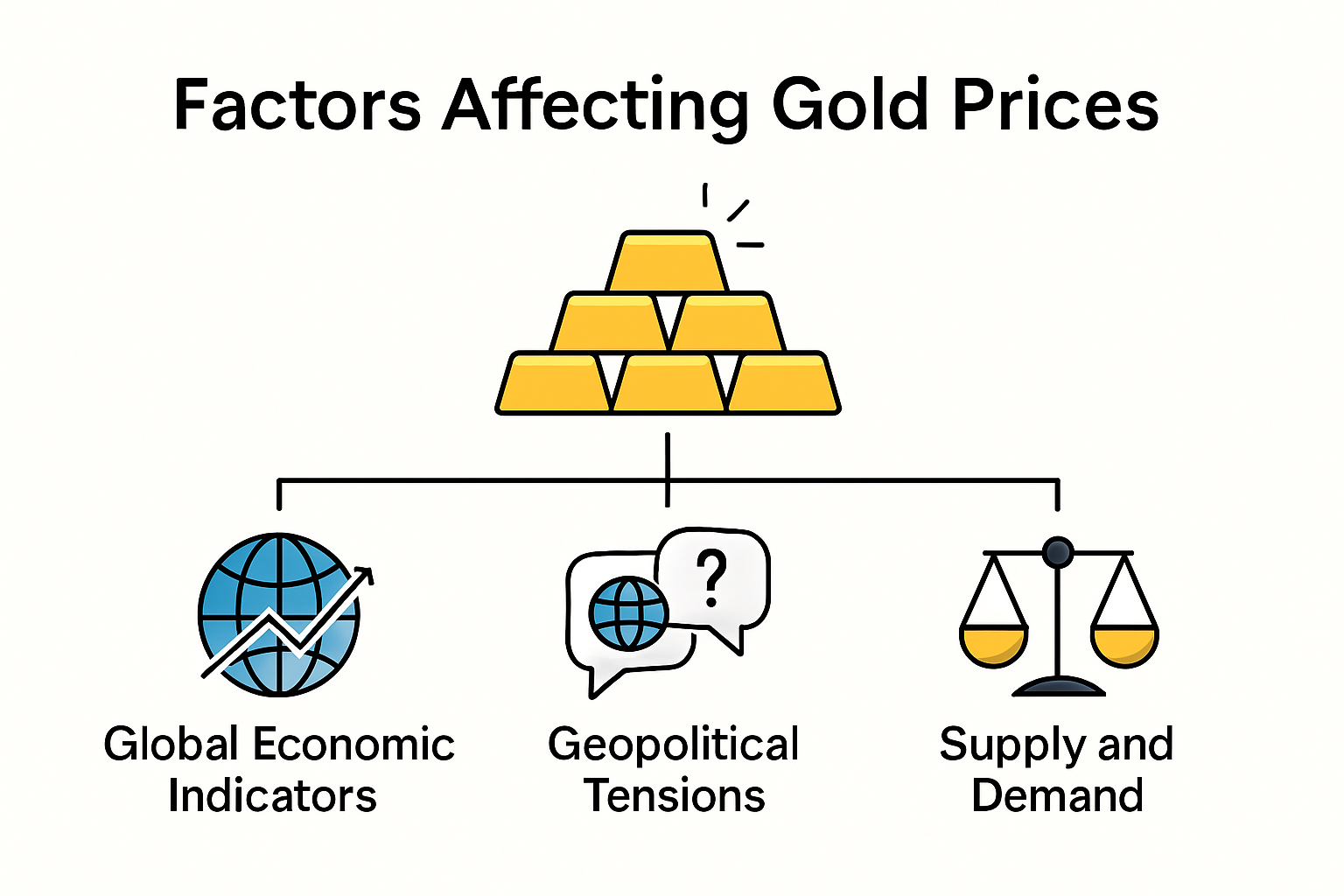
Understanding gold price movements requires a comprehensive analysis of multiple interconnected factors that drive market dynamics. Traders and investors must recognize the complex ecosystem influencing gold valuation to make informed trading decisions.
Global Economic Indicators and Monetary Policy
Economic indicators play a crucial role in determining gold prices. Currency fluctuations, interest rates, and inflation significantly impact gold’s perceived value. Explore our advanced gold price forecasting techniques to understand these nuanced relationships.
According to Federal Reserve Economic Data, when central banks adjust monetary policies, gold prices experience substantial volatility. Low interest rates typically make gold more attractive as an investment, since the opportunity cost of holding non-yielding assets decreases. Investors often view gold as a hedge against inflation, moving capital into the precious metal when traditional currency values become unstable.
Geopolitical Tensions and Market Sentiment
Geopolitical events create significant ripple effects in gold markets. International conflicts, political uncertainties, and economic disruptions can trigger rapid shifts in gold pricing. Research from the World Gold Council demonstrates that during periods of global tension, investors frequently migrate towards gold as a safe-haven asset.
For instance, economic sanctions, trade disputes, and regional conflicts can prompt investors to seek financial protection through gold investments. These events create market uncertainty, driving demand and subsequently influencing price movements. Traders must remain vigilant and monitor global political landscapes to anticipate potential gold market reactions.
Supply and Demand Dynamics
The fundamental economic principle of supply and demand remains paramount in gold price determination. Mining production, industrial demand, jewelry consumption, and investment appetites collectively shape gold’s market value. According to Bloomberg’s commodity analysis, annual gold production and emerging market consumption patterns directly impact pricing.
Key factors influencing supply include:
- Mining output: Global gold extraction rates
- Exploration investments: New mining project developments
- Recycling volumes: Gold recovered from existing sources
Demand drivers encompass:
- Investment sectors: ETFs, futures markets
- Jewelry manufacturing: Consumer preferences
- Industrial applications: Technology and medical sectors
Traders who comprehensively understand these multifaceted influences can develop more strategic approaches to gold trading. By integrating technical analysis, fundamental research, and market sentiment evaluation, investors can navigate the complex gold market with greater confidence and precision.
To clarify the main drivers of gold’s supply and demand outlined above, here’s a summary table:
| Supply Factors | Demand Drivers |
|---|---|
| Mining output | Investment sectors (ETFs, futures) |
| Exploration investments | Jewelry manufacturing |
| Recycling volumes | Industrial applications |
Gold Price Analysis for Forex Traders
Forex traders must develop sophisticated strategies for analyzing gold prices, recognizing the unique characteristics that distinguish gold trading from other financial instruments. Understanding these nuanced analytical approaches can significantly enhance trading performance and risk management.
Technical Analysis Fundamentals
Technical analysis serves as a cornerstone of gold price evaluation for forex traders. Learn advanced support and resistance techniques to refine your trading precision. According to research from the Journal of Forecasting, historical price patterns provide critical insights into potential future movements.
Traders should focus on key technical indicators specific to gold trading:
- Moving Averages: Tracking short and long-term price trends
- Relative Strength Index (RSI): Measuring momentum and potential reversal points
- Fibonacci Retracement: Identifying potential support and resistance levels
Currency Correlation and Market Efficiency
A comprehensive analysis reveals intricate relationships between gold prices and currency markets. Research from arXiv demonstrates significant variations in gold price efficiency across different currencies. The study highlights that gold prices in major currencies exhibit unique behavioral patterns that traders must carefully interpret.
Key correlation factors include:
- USD Inverse Relationship: Gold typically moves inversely to the US dollar
- Cross-Currency Impact: Price variations across different monetary systems
- Economic Indicator Interactions: Inflation rates, interest rates, and monetary policies
Risk Management and Strategic Approaches

Research published in the International Review of Financial Analysis emphasizes the importance of advanced risk management in gold trading. Forex traders must develop multi-dimensional strategies that account for market uncertainty and volatility.
Effective risk management techniques include:
- Diversification: Spreading investments across multiple gold trading instruments
- Hedging Strategies: Using options and futures to mitigate potential losses
- Volatility Assessment: Continuously monitoring market conditions and adjustment potential
Successful gold trading requires a holistic approach that combines technical analysis, market sentiment, and robust risk management. Traders who develop comprehensive strategies and remain adaptable to changing market conditions will be best positioned to capitalize on gold price movements in the forex market.
Effective XAU Gold Trading Strategies
Navigating the complex world of gold trading requires sophisticated strategies that adapt to dynamic market conditions. Successful traders understand that XAU/USD trading demands a nuanced approach combining technical analysis, risk management, and strategic decision-making.
Technical Trading Approaches
Technical strategies form the backbone of effective gold trading. Discover our proven trading signal techniques to enhance your trading precision. According to Quantpedia’s extensive market analysis, certain technical trading strategies can outperform traditional buy-and-hold approaches.
Key technical strategies include:
- Trend Following: Identifying and riding dominant market trends
- Momentum Trading: Capitalizing on strong price movements
- Mean Reversion: Trading based on price returning to average levels
Research from MDPI suggests that linear regression techniques can be particularly effective in forecasting gold price trends. Traders should pay special attention to lagged interdependencies, recognizing that daily returns often exhibit complex correlational patterns.
Risk Management and Position Sizing
Effective risk management is crucial in gold trading. An analysis from the International Journal of Financial Studies emphasizes the importance of systematic position sizing and risk allocation strategies.
Critical risk management techniques include:
- Stop-Loss Mechanisms: Limiting potential losses
- Position Scaling: Adjusting trade sizes based on market volatility
- Diversification: Spreading risk across multiple trading instruments
Traders should implement a disciplined approach to risk, typically risking no more than 1-2% of total trading capital on a single trade. This approach helps preserve capital during market uncertainties.
Advanced Trading Methodologies
Research from the Indian gold futures market reveals that futures markets often provide more efficient price discovery mechanisms. Sophisticated traders can leverage this insight by:
- Futures Market Analysis: Monitoring futures pricing
- Comparative Market Tracking: Analyzing cross-market price movements
- Sentiment Indicator Integration: Incorporating market sentiment metrics
Advanced traders develop multi-dimensional strategies that combine technical analysis, fundamental research, and adaptive risk management. Understanding the nuanced dynamics of gold trading requires continuous learning and a flexible approach.
Ultimately, successful XAU/USD trading is about developing a comprehensive strategy that balances analytical precision with disciplined risk management. Traders who consistently refine their approach and remain adaptable to market changes will be best positioned to achieve sustainable trading success.
For quick comparison, here’s a table summarizing key gold trading strategy types and their core features:
| Strategy Type | Core Feature | Primary Benefit |
|---|---|---|
| Trend Following | Riding dominant price trends | Captures large directional moves |
| Momentum Trading | Capitalizing on strong price action | Maximizes short-term gains |
| Mean Reversion | Trading returns to average levels | Profits from price corrections |
| Linear Regression | Using historical patterns/statistics | Enhances forecasting accuracy |
| Futures Analysis | Analyzing derivatives market prices | Improves price discovery |
2025 Gold Market Outlook and Investment Tips
The gold market in 2025 presents a complex landscape of opportunities and challenges for investors and traders. Understanding the nuanced market dynamics and implementing strategic approaches will be crucial for capitalizing on potential gold market developments.
Market Projections and Price Expectations
According to J.P. Morgan Research, gold prices are forecasted to average $3,675 per ounce by the fourth quarter of 2025, with potential to reach $4,000 by mid-2026. Explore our comprehensive gold price forecast to gain deeper insights into these projections.
Key market projection factors include:
- Global Economic Uncertainty: Ongoing recession probabilities
- Geopolitical Tensions: International trade and political risks
- Central Bank Policies: Monetary interventions and interest rate strategies
The World Bank projects a potential rise of approximately 35% in gold prices, driven by strong demand and elevated policy uncertainties. Investors should carefully analyze these macroeconomic indicators when developing investment strategies.
Here’s a summary table outlining the key gold price forecasts and projection factors for 2025:
| Source | 2025 Avg Price Forecast | Notable Projection Factors |
|---|---|---|
| J.P. Morgan Research | $3,675/oz (Q4 2025) | Economic uncertainty, central bank policy |
| World Bank | 35% increase predicted | Policy uncertainty, strong demand |
| J.P. Morgan (2026) | $4,000/oz (mid-2026) | Continuation of current trends |
Strategic Investment Approaches
The London Bullion Market Association (LBMA) identifies three primary drivers influencing gold prices in 2025:
- U.S. Federal Reserve Policy: Monetary decision impacts
- Central Bank Demand: Institutional investment trends
- Geopolitical Risks: Global conflict and economic instability
Investment strategies for navigating the 2025 gold market should focus on:
- Diversification: Spreading investments across different gold instruments
- Long-Term Positioning: Maintaining flexible investment portfolios
- Risk Management: Implementing robust hedging techniques
Emerging Market Trends and Opportunities
Investors should pay close attention to emerging trends that could significantly impact gold market dynamics. Our latest market analysis suggests several key considerations for 2025:
- Digital Gold Platforms: Increasing accessibility through technology
- Sustainable Investment: Growing interest in environmentally responsible mining
- Geopolitical Hedge: Gold as a protection against economic uncertainties
Successful gold investment in 2025 will require a multifaceted approach that combines comprehensive market research, adaptive strategies, and a nuanced understanding of global economic trends. Investors who remain informed, flexible, and strategic will be best positioned to capitalize on the potential opportunities in the gold market.
Remember that while projections provide valuable insights, the gold market remains inherently dynamic. Continuous learning, real-time analysis, and a disciplined approach to risk management will be critical for navigating the complex investment landscape of 2025.
Frequently Asked Questions
What factors influence gold prices in 2025?
Gold prices in 2025 will be influenced by global economic indicators, geopolitical tensions, and supply and demand dynamics. Currency fluctuations, interest rates, and inflation will also play crucial roles in determining gold’s value.
How can traders analyze gold price movements effectively?
Traders can analyze gold price movements using technical analysis, understanding currency correlation, and implementing robust risk management strategies. Key indicators like moving averages, RSI, and Fibonacci retracement levels are essential for accurate analysis.
What trading strategies are recommended for XAU/USD?
Effective trading strategies for XAU/USD include trend following, momentum trading, and mean reversion. Additionally, employing position sizing, stop-loss mechanisms, and diversification are vital for managing risks and enhancing trading performance.
What are the gold price forecasts for the end of 2025?
Analysts project that gold may reach an average price of $3,675 per ounce by the end of 2025, driven by global economic uncertainties and central bank policies. Additionally, prices may reach $4,000 by mid-2026 based on current trends.
Turn Market Insights Into Real Gold Trading Profits
Struggling to stay ahead of fast-moving gold prices and unpredictable market shifts? If this article helped you break down the factors influencing gold movements for 2025, it’s time to turn those insights into real returns. Many traders know about economic indicators, risk management, and technical analysis, but most find it hard to act confidently and profitably in a volatile market. Discover practical strategies and fresh updates by diving into our News & Updates section.
Ready to apply these gold trading insights to your own portfolio? Act now and join our exclusive community at https://xau-gold-signals.com for daily, high-accuracy XAU/USD signals. Our expert analysis empowers you to trade smarter and minimize risk while others are still wondering what comes next. Don’t just read about gold trends—turn them into consistent profits with our real-time support.
