


Gold trading is pulling in massive attention for 2025, and for good reason. Global gold demand hit 1,206 metric tons in the first quarter alone, while investment demand jumped an eye-popping 170 percent year over year. Sounds like a golden ticket, right? Actually, these big numbers are just the beginning—the real story is how tricky and unpredictable gold trading can be for beginners. Get ready to uncover strategy secrets and smart signals that most newcomers never hear about.
Table of Contents
- Understanding Gold Trading Trends In 2025
- Essential Tools And Signals For Gold Trading
- Effective Strategies For Beginner Gold Traders
- Risk Management And Common Mistakes To Avoid
Quick Summary
| Takeaway | Explanation |
|---|---|
| Surge in Global Gold Demand | Gold demand reached 1,206 metric tons in Q1 2025, with a 170% increase in investment demand year-over-year, highlighting a strong market potential for traders. |
| Central Banks Influence | Projections suggest central banks will purchase around 1,000 metric tons of gold in 2025, indicating a strategic move to diversify reserves amid geopolitical tensions. |
| Utilize Effective Technical Indicators | Employ tools like RSI, Moving Averages, and Bollinger Bands to analyze market trends and make informed trading decisions in a volatile environment. |
| Prioritize Risk Management | Implement techniques such as stop-loss orders and position sizing to mitigate risks and protect capital from major losses. |
| Continuous Learning and Adaptation | Emphasize ongoing education and practice through demo accounts to refine trading strategies and build confidence in market navigation. |
Understanding Gold Trading Trends in 2025
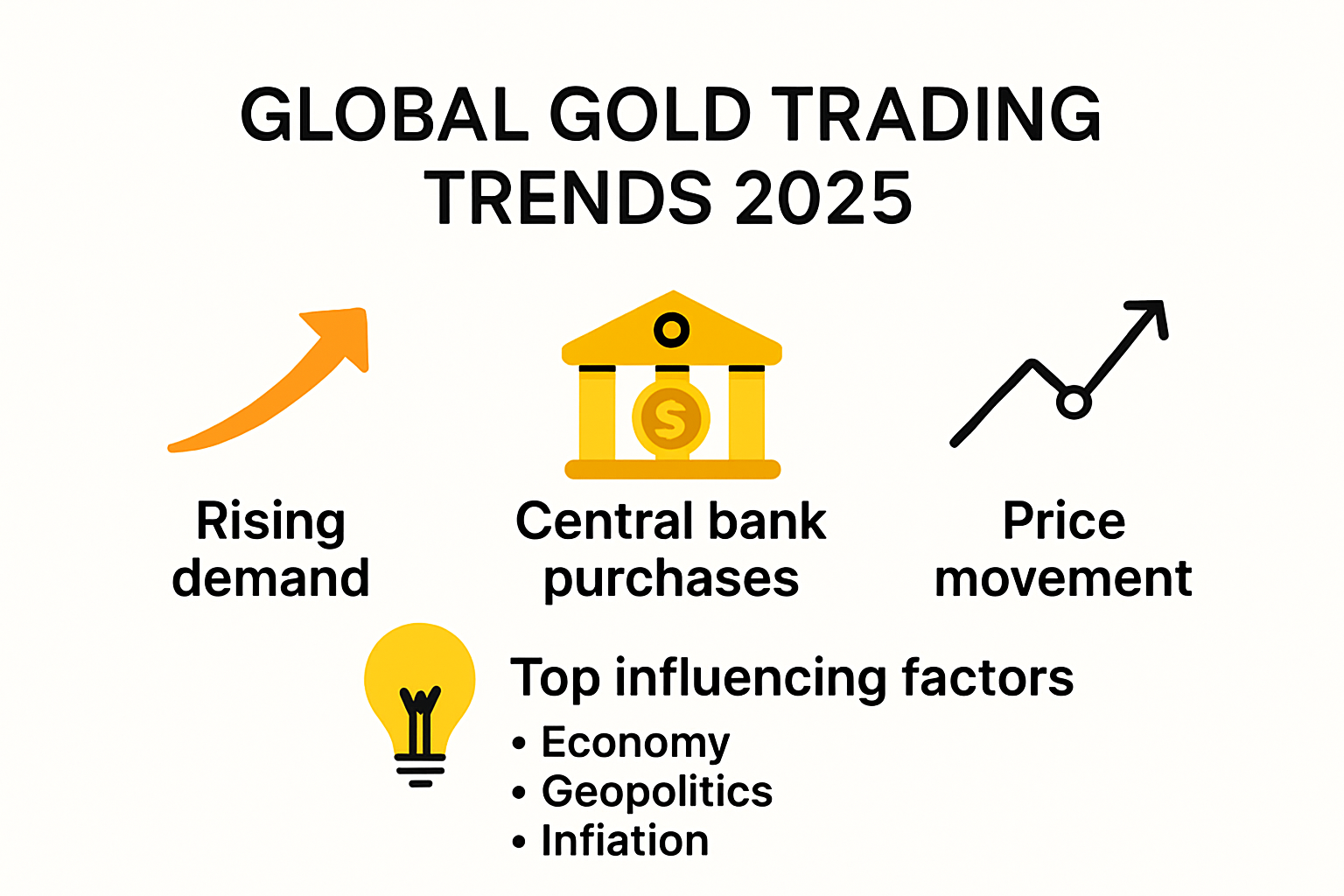
Gold trading in 2025 presents a complex and dynamic landscape for investors and traders seeking strategic opportunities. The global gold market is experiencing unprecedented shifts driven by economic uncertainties, geopolitical tensions, and evolving investment strategies.
Global Demand and Economic Indicators
Recent market analysis reveals significant transformations in gold trading. Research from the World Gold Council indicates that global gold demand reached 1,206 metric tons in Q1 2025, marking the highest first-quarter level since 2016. This surge is particularly noteworthy, with investment demand experiencing a remarkable 170% year-over-year increase, totaling 552 metric tons.
Central banks are playing a pivotal role in reshaping gold market dynamics. According to Reuters, projections suggest central banks will purchase approximately 1,000 metric tons of gold in 2025. This continued trend represents the fourth consecutive year of substantial gold acquisitions, primarily driven by efforts to diversify reserves away from U.S. dollar-denominated assets amid ongoing geopolitical tensions.
To provide a clear overview of critical gold trading statistics in 2025, here is a summary table of key figures and trends discussed above:
| Metric | Q1 2025 Value | Year-Over-Year Change | Source |
|---|---|---|---|
| Total Global Gold Demand | 1,206 metric tons | Highest since 2016 | World Gold Council |
| Investment Demand | 552 metric tons | +170% | World Gold Council |
| Central Bank Purchases (projected 2025) | ~1,000 metric tons | Fourth consecutive year | Reuters |
| Record Gold Price (April 2025) | $3,500.05 per ounce | — | HSBC/Reuters |
| HSBC 2025 Average Price Forecast | $3,215 per ounce | — | HSBC/Reuters |
Price Dynamics and Market Signals
The gold market in 2025 has witnessed unprecedented price movements. HSBC reports a record-breaking gold price surge to $3,500.05 per ounce in April 2025, driven by global economic uncertainty. The financial institution forecasts an average price of $3,215 per ounce for the year, signaling significant potential for gold traders.
These trends underscore the importance of understanding market signals and developing adaptive trading strategies. Traders must remain vigilant, analyzing complex interactions between global economic indicators, geopolitical events, and investment sentiment. Check out our latest gold trading signals to stay ahead of market movements and make informed trading decisions.
Key factors influencing gold trading in 2025 include:
- Global Economic Uncertainty: Continued geopolitical tensions and economic volatility
- Central Bank Policies: Increasing gold purchases as a strategic financial reserve
- Investment Diversification: Growing interest in gold as a hedge against market fluctuations
Successful gold trading requires a nuanced approach that combines technical analysis, fundamental research, and an understanding of broader economic trends. Traders who can quickly interpret market signals and adapt their strategies will be best positioned to capitalize on the dynamic gold market landscape of 2025.
Essential Tools and Signals for Gold Trading

Successful gold trading in 2025 demands a sophisticated approach integrating advanced technical analysis tools, precise trading signals, and strategic market insights. Traders must equip themselves with robust instruments that enable swift, informed decision-making in the dynamic gold market.
Technical Analysis Indicators
Traders rely on several critical technical indicators to navigate gold market complexities. The Relative Strength Index (RSI) serves as a powerful momentum oscillator, measuring price movement speed and potential trend reversals. When the RSI rises above 70, it suggests gold might be overbought, signaling a potential price correction. Conversely, an RSI below 30 indicates an oversold condition, presenting potential buying opportunities.
Additional essential technical indicators include:
- Moving Averages: Track price trends and identify potential support and resistance levels
- Bollinger Bands: Measure market volatility and potential price breakouts
- MACD (Moving Average Convergence Divergence): Detect momentum shifts and trend changes
The following table provides a quick comparison of the most important technical indicators mentioned, showing what each measures and how traders use them:
| Indicator | What It Measures | Typical Use in Gold Trading |
|---|---|---|
| RSI | Momentum, overbought/oversold levels | Identify potential price reversals; buy below 30, sell above 70 |
| Moving Averages | Price trends, support/resistance | Spot trends; identify buy/sell signals as averages cross |
| Bollinger Bands | Market volatility, price breakouts | Detect potential price breakouts/extremes |
| MACD | Momentum shifts and trend changes | Confirm trend direction, spot momentum reversals |
Trading Signals and Market Insights
Trading signals represent crucial tools for gold traders, providing real-time market analysis and actionable recommendations. Learn more about optimizing gold trading signals to enhance your trading performance. Professional traders utilize a combination of:
- Automated trading algorithms
- Real-time market sentiment analysis
- Expert-driven predictive models
- Machine learning-powered trend forecasting
Risk Management Tools
Effective gold trading extends beyond signal interpretation. Comprehensive risk management tools are fundamental to protecting investment capital. Traders should implement:
- Stop-loss orders
- Position sizing calculators
- Diversification strategies
- Volatility tracking mechanisms
Mastering support and resistance techniques can significantly improve trading precision. Understanding these critical price levels helps traders make more informed entry and exit decisions, minimizing potential losses and maximizing profit potential.
Successful gold trading in 2025 requires continuous learning, adaptability, and a disciplined approach to market analysis. By leveraging advanced tools, staying informed about global economic trends, and maintaining a strategic mindset, traders can navigate the complex gold market with increased confidence and potential for success.
Effective Strategies for Beginner Gold Traders
Navigating the gold trading landscape requires strategic thinking, disciplined approach, and continuous learning. Beginners must develop a robust framework that balances risk management, market understanding, and adaptive trading techniques.
Fundamental Risk Management
Risk management represents the cornerstone of successful gold trading. Research from market experts emphasizes the critical importance of implementing strategic risk mitigation techniques. Beginners should prioritize:
- Position Sizing: Limiting individual trade exposure to 1-2% of total trading capital
- Stop-Loss Orders: Establishing predetermined exit points to protect against significant losses
- Diversification: Spreading investment across different trading instruments and market segments
Traders must approach gold trading with a disciplined mindset, treating it as a serious financial endeavor that requires continuous education and strategic planning.
Learning and Skill Development
Successful gold trading demands ongoing skill enhancement. Explore advanced scalping techniques to accelerate your trading proficiency. Beginner traders should focus on:
- Comprehensive market analysis techniques
- Understanding macroeconomic indicators
- Developing emotional discipline
- Practicing consistent trading methodologies
Utilizing demo trading accounts provides an excellent opportunity to practice strategies without financial risk. These simulated environments allow traders to test approaches, understand market dynamics, and build confidence before committing real capital.
Strategic Trading Approach
Developing a structured trading approach is crucial for long-term success. Master support and resistance techniques to enhance your trading precision. Key strategic elements include:
- Creating a personalized trading plan
- Setting realistic profit targets
- Maintaining detailed trading journals
- Continuously analyzing and refining trading strategies
Beginners should recognize that gold trading is not about making quick profits but developing sustainable, long-term trading skills. Patience, continuous learning, and disciplined execution are the true markers of successful gold traders.
The gold market offers significant opportunities for those willing to invest time in understanding its complexities. By focusing on risk management, continuous learning, and strategic execution, beginner traders can build a solid foundation for potential success in the dynamic world of gold trading.
Risk Management and Common Mistakes to Avoid
Gold trading presents complex challenges that can quickly transform potential opportunities into significant financial risks. Understanding and implementing robust risk management strategies is crucial for traders seeking sustainable success in the volatile gold market.
Critical Risk Management Techniques
Research from trading experts highlights several fundamental risk management approaches essential for protecting trading capital. Position sizing emerges as a critical strategy, with professionals recommending limiting individual trade exposure to 1-2% of total trading capital. This disciplined approach prevents catastrophic losses and ensures traders can withstand multiple consecutive unsuccessful trades.
Implement advanced risk mitigation strategies to safeguard your investments. Key risk management techniques include:
- Precise Stop-Loss Orders: Automatically limit potential losses
- Capital Allocation: Strategically distribute investment across multiple positions
- Volatility Assessment: Continuously monitor market fluctuations
- Emotional Discipline: Maintain rational decision-making processes
Common Trading Mistakes
According to trading professionals, beginner traders frequently encounter several recurring mistakes that can significantly undermine their trading performance. These pitfalls include:
- Overleveraging: Risking excessive capital on single trades
- Emotional Trading: Making impulsive decisions based on fear or greed
- Inadequate Research: Trading without comprehensive market analysis
- Neglecting Risk Management: Failing to implement protective strategies
Here is a checklist table summarizing the most common gold trading mistakes for beginners to avoid and their typical status in novice trading:
| Common Mistake | Description | Typical Beginner Status |
|---|---|---|
| Overleveraging | Risking excessive capital on single trades | Frequent |
| Emotional Trading | Making impulsive decisions (fear/greed) | Frequent |
| Inadequate Research | Trading without thorough market analysis | Frequent |
| Neglecting Risk Mgmt | Not implementing stop-loss/risk strategies | Frequent |
Psychological Aspects of Risk Management
Successful gold trading extends beyond technical strategies. Research from investment psychology emphasizes the critical role of psychological resilience. Traders must develop:
- Emotional stability
- Consistent trading discipline
- Objective performance evaluation
- Continuous learning mindset
Diversification represents another crucial risk management strategy. Learn more about strategic investment approaches to spread risk across different market segments and trading instruments. By maintaining a balanced portfolio and implementing rigorous risk management protocols, traders can navigate the complex gold trading landscape with increased confidence and potential for long-term success.
Frequently Asked Questions
What are the key indicators for gold trading in 2025?
Traders should utilize various technical indicators like the Relative Strength Index (RSI), Moving Averages, Bollinger Bands, and MACD to analyze market trends and inform their trading decisions.
How can beginners manage risk effectively in gold trading?
Beginners can manage risk by implementing techniques such as position sizing, using stop-loss orders, and diversifying their investment across different assets to protect against significant losses.
What factors are driving gold demand in 2025?
In 2025, global factors such as economic uncertainty, geopolitical tensions, and increased central bank purchases are significantly driving gold demand and influencing market prices.
Why is continuous learning important for new gold traders?
Continuous learning is essential for new traders to stay updated on market trends, refine their trading strategies, and develop the skills necessary for navigating the complexities of gold trading successfully.
Turn Gold Trading Challenges Into Reliable Wins With Proven Signals
Are you feeling overwhelmed by volatile price swings, uncertain market signals, and the pressure to manage risk as a new gold trader? You are not alone. Many beginners struggle to confidently interpret technical indicators, control emotional decisions, or stay ahead of fast-moving gold markets. If you want to stop second-guessing your trades and start building reliable profits, you need practical guidance and expert strategies tailored for gold trading in 2025. Tap into essential support with our How To Guides, designed specifically for gold trading newcomers.
Take your first step toward consistent gains by joining our XAU/USD Gold Trading Signals community. Gain immediate access to daily, high-accuracy gold signals, expert analysis, and real-time market insights. Now is the best time to put proven strategies on your side and see exactly how professional signals help you maximize profits and minimize risks. Visit our site or explore detailed News & Updates to stay ahead of every gold price move.
Recommended
- Free Vs. Paid Gold Trading Signals: Which One Should You Choose?
- Best XAU/USD Gold Trading Signals For Consistent Profits
- Effective Strategies For Using Gold Trading Signals
- Master Gold Scalping: Strategies For Rapid Gains
- News & Updates | XAU/USDT Gold Trading Signals
- Blog | XAU/USDT Gold Trading Signals
