


Gold and the US dollar have a relationship that shapes global markets, and big changes are coming in 2025. Here is a number everyone is watching. The US dollar dropped 10.8 percent in the first half of 2025, its sharpest fall since 1973. Most traders think when the dollar drops, gold just goes up, simple as that. Except now, both are acting as safe havens at the same time, breaking all the rules. That shakeup could change how every trader approaches these markets.
Table of Contents
- How Gold And US Dollar Interact
- Impact On Gold Traders And Forex Markets
- Signals, Indicators, And Trading Strategies
- 2025 Gold And US Dollar Trends Analysis
Quick Summary
| Takeaway | Explanation |
|---|---|
| Inverse Correlation | Traditionally, gold and the US dollar exhibit an inverse correlation, where a weakening dollar tends to elevate gold prices, influenced by economic uncertainty and investor behavior. |
| Dynamic Market Conditions | Traders must adapt strategies to account for significant transformations in the gold and dollar relationship, particularly as both are increasingly seen as safe havens during economic volatility. |
| Focus on Central Banks | Monitoring Federal Reserve policies and other central bank decisions is crucial, as interest rate changes directly impact both gold attractiveness and dollar strength. |
| Emerging Trends in Reserve Assets | A growing interest from central banks in diversifying reserves away from the dollar signals potential long-term appreciation in gold, prompting traders to reassess their strategies. |
| Comprehensive Risk Management | Effective trading requires sophisticated risk management strategies that consider macroeconomic indicators, geopolitical events, and the evolving landscape of global reserves. |
How Gold and US Dollar Interact
The relationship between gold and the US dollar is complex and dynamic, representing a critical interaction in global financial markets that traders must understand to make informed investment decisions. This intricate connection stems from several fundamental economic mechanisms that influence both assets simultaneously.
The Inverse Correlation Mechanism
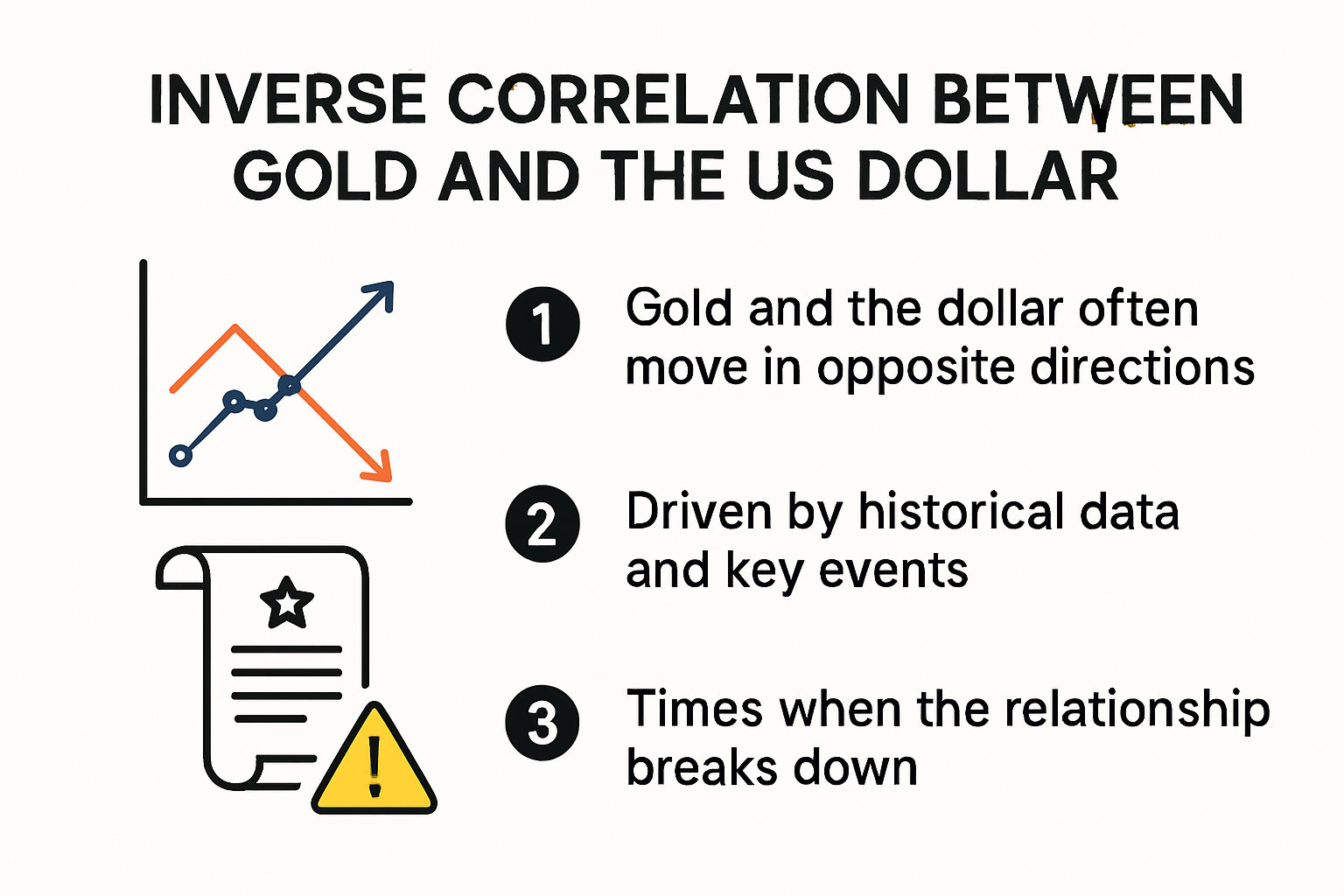
Traditionally, gold and the US dollar exhibit an inverse correlation, meaning when the dollar weakens, gold prices tend to rise. This relationship emerges from gold’s status as a global reserve asset and alternative currency. When the US dollar loses purchasing power or experiences economic uncertainty, investors often pivot towards gold as a stable store of value. Our guide on gold trading strategies provides deeper insights into navigating these market dynamics.
According to a study published in the North American Journal of Economics and Finance, this inverse relationship is not always straightforward. Research indicates that while gold and the U.S. dollar typically demonstrate a negative correlation, this connection can become positive during extreme market conditions. This suggests that the traditional understanding of their interaction is more nuanced than a simple linear relationship.
Economic Uncertainty and Safe Haven Dynamics
During periods of significant economic volatility, both gold and the US dollar can function as safe haven assets, creating interesting market behaviors. An article in the European Journal of Management and Business Economics notes that since 2009, the historical inverse correlation has weakened, with both assets potentially appreciating simultaneously during global crises. This phenomenon highlights the complex ways investors seek financial protection.

Research in Applied Economics further illuminates this complexity, demonstrating that macroeconomic uncertainty profoundly impacts the gold and dollar relationship. Different sources of uncertainty can trigger varied responses, meaning traders cannot rely on a single predictive model. Factors such as geopolitical tensions, monetary policy shifts, and global economic indicators all play crucial roles in determining how these two assets interact.
Trading Implications for Investors
For traders, understanding this relationship means developing sophisticated strategies that account for multiple economic variables. The interaction between gold and the US dollar is not merely about direct price movements but involves understanding broader economic signals. Successful trading requires monitoring:
- Federal Reserve Policies: Interest rate decisions directly influence dollar strength and gold attractiveness
- Global Economic Indicators: GDP growth, inflation rates, and international trade dynamics
- Geopolitical Events: Political instability can drive investors towards safe haven assets
By comprehensively analyzing these interconnected factors, traders can develop more nuanced approaches to trading gold and managing currency exposure. The key is remaining adaptable and recognizing that economic relationships are never static but constantly evolving.
To clarify the main factors influencing gold and US dollar movements for traders, here is a summary table of their key drivers:
| Factor | Impact on Gold Price | Impact on US Dollar |
|---|---|---|
| Federal Reserve Interest Rates | Lower rates boost gold | Lower rates weaken USD |
| Inflation | Rising inflation supports gold | High inflation strains USD |
| Economic Uncertainty | Increases demand for gold | Can boost or weaken USD |
| Geopolitical Tensions | Drives safe haven demand | Drives safe haven demand |
| Central Bank Reserve Policies | Buying gold lifts price | Selling USD weakens dollar |
| Global Trade Dynamics | Supply/demand impacts gold | Trade deficits weaken USD |
Impact on Gold Traders and Forex Markets
The relationship between gold and the US dollar creates profound implications for traders navigating complex global financial markets. In 2025, these dynamics present both unprecedented challenges and strategic opportunities for forex and gold market participants seeking to optimize their investment approaches.
Market Volatility and Trading Strategies
Forex and gold traders must recognize that the traditional inverse correlation between gold and the US dollar is experiencing significant transformations. Our comprehensive gold price forecast highlights the critical need for adaptive trading strategies. According to the Financial Times, the U.S. dollar experienced a sharp decline of 10.8% in the first half of 2025, its most significant drop since 1973, driven by investor concerns over economic and trade policies.
This volatility demands traders develop sophisticated risk management techniques. Successful market participants will need to:
- Monitor Central Bank Policies: Track Federal Reserve and international monetary decisions
- Analyze Geopolitical Signals: Understand how global tensions impact currency and gold valuations
- Implement Dynamic Hedging: Create flexible investment strategies that adapt to rapid market changes
Global Reserve Dynamics
Central banks are playing an increasingly critical role in reshaping gold and dollar market interactions. Research from the Economic Times reveals that nearly half of global central banks are planning to increase their gold reserves. This trend reflects growing concerns about U.S. fiscal policies and a strategic move to diversify away from dollar-denominated assets.
For traders, this shift represents a significant market signal. The increasing interest in gold as a reserve asset suggests potential long-term appreciation and strategic investment opportunities. Traders must remain vigilant about international monetary policy trends and their potential impact on gold and currency markets.
Risk Management and Portfolio Diversification
Navigating the complex interactions between gold and the US dollar requires sophisticated risk management approaches. Traders must develop multifaceted strategies that account for:
- Macroeconomic indicators
- Geopolitical uncertainties
- Shifts in global trade dynamics
- Emerging market trends
The key to success lies in maintaining flexibility and continuously reassessing market conditions. While historical patterns provide valuable insights, the evolving economic landscape demands a forward-looking approach. Traders who can quickly adapt their strategies and understand the nuanced relationship between gold and the US dollar will be best positioned to capitalize on market opportunities.
Ultimately, the gold and US dollar relationship in 2025 is characterized by complexity, volatility, and continuous transformation. Successful traders will combine rigorous analysis, strategic thinking, and an ability to anticipate and respond to rapid market changes.
Signals, Indicators, and Trading Strategies
Navigating the complex interaction between gold and the US dollar requires sophisticated trading strategies that leverage advanced signals and precise market indicators. In 2025, traders must develop nuanced approaches that account for the evolving dynamics of these interconnected financial assets.
Advanced Technical Indicators
Successful gold and forex traders rely on a comprehensive suite of technical indicators to interpret market signals. Explore our effective trading signal strategies to understand the intricate analysis required. Research published in Physica A: Statistical Mechanics and its Applications reveals that the gold-dollar relationship exhibits nonlinear dynamics, with long-term inverse correlations and short-term market variations that demand sophisticated analytical approaches.
Key technical indicators for tracking gold and US dollar interactions include:
- Relative Strength Index (RSI): Measures momentum and potential trend reversals
- Moving Average Convergence Divergence (MACD): Identifies trend changes and market momentum
- Bollinger Bands: Assesses market volatility and potential price breakouts
Traders must remain adaptable, recognizing that no single indicator provides a complete market picture. The complexity of the gold and US dollar relationship requires a multifaceted analytical approach.
For quick reference, here is a comparison table of technical indicators commonly used to analyze gold and US dollar markets:
| Indicator | What It Measures | Typical Use-Case |
|---|---|---|
| RSI | Momentum, overbought/oversold conditions | Identify potential price reversals |
| MACD | Trend direction, momentum | Spot trend changes, market entry/exit |
| Bollinger Bands | Volatility, price range | Detect breakouts and volatility shifts |
Monetary Policy and Market Signals
According to a study in Economies, the elasticity of gold returns to US dollar exchange rate fluctuations varies significantly across different Federal Fund Rate zones. This finding underscores the critical importance of monitoring central bank policies and monetary indicators. Research in Finance Research Letters further demonstrates that gold serves as a safe haven during extreme market conditions, with the negative correlation between gold and USD exchange rates intensifying during financial crises.
Strategic traders should focus on:
- Central bank interest rate decisions
- Inflation rate movements
- Global economic stability indicators
- Geopolitical risk assessments
Risk Management and Strategic Approach
Developing a robust trading strategy requires more than technical analysis. Traders must implement comprehensive risk management techniques that account for the complex interplay between gold and the US dollar. This involves:
- Diversifying investment portfolios
- Using stop-loss and take-profit mechanisms
- Continuously monitoring global economic indicators
- Adapting strategies to changing market conditions
The most successful traders recognize that the gold and US dollar relationship is not static. They maintain flexibility, combine multiple analytical approaches, and remain prepared to adjust their strategies quickly. By understanding the nuanced interactions between these assets, traders can develop more sophisticated and responsive trading approaches.
Ultimately, success in gold and forex trading demands a holistic approach that combines technical expertise, strategic thinking, and a deep understanding of global economic dynamics. Traders who can navigate these complex relationships will be best positioned to capitalize on market opportunities in 2025 and beyond.
2025 Gold and US Dollar Trends Analysis
The year 2025 presents a complex and dynamic landscape for gold and US dollar interactions, characterized by unprecedented economic shifts and evolving global financial strategies. Traders and investors must carefully analyze emerging trends to navigate this intricate market environment effectively.
Macroeconomic Influences and Monetary Policy
Our gold price forecast highlights the critical factors shaping market dynamics in 2025. According to Gold.org, market consensus suggests the Federal Reserve will implement 100 basis points in rate cuts by the end of 2025, with inflation softening but remaining above target. This anticipated monetary policy scenario is expected to keep the U.S. dollar flat or slightly weaker, potentially creating a supportive environment for gold prices.
Key macroeconomic indicators to watch include:
- Inflation Trajectories: Tracking global and domestic inflation rates
- Monetary Policy Shifts: Federal Reserve and international central bank decisions
- Global Economic Stability: Geopolitical tensions and economic recovery patterns
The CME Group notes that the traditional inverse relationship between gold and the U.S. dollar has weakened, with both assets experiencing simultaneous strength due to heightened geopolitical tensions and central bank diversification strategies.
Emerging Market Dynamics
Global economic restructuring is creating unprecedented opportunities and challenges for gold and dollar traders. Central banks worldwide are increasingly diversifying their reserve assets, moving away from traditional dollar-dominated portfolios. This shift is driven by several critical factors:
- Geopolitical uncertainties
- Desire to reduce dollar dependency
- Increased interest in alternative reserve assets
- Strategic economic repositioning
Traders must recognize that the 2025 landscape is characterized by more complex and nuanced interactions between gold and the US dollar. The traditional safe-haven narratives are evolving, requiring more sophisticated analytical approaches.
Strategic Considerations for Investors
Successful navigation of the 2025 market demands a multifaceted approach. Investors should focus on:
- Comprehensive global economic analysis
- Flexible investment strategies
- Continuous monitoring of geopolitical developments
- Understanding emerging market trends
The interplay between gold and the US dollar is no longer a simple inverse relationship. Global economic uncertainties, monetary policy shifts, and changing central bank strategies are creating a more complex and dynamic market environment. Traders who can adapt quickly and develop nuanced strategies will be best positioned to capitalize on emerging opportunities.
Ultimately, the 2025 outlook for gold and the US dollar represents a critical moment of transformation. Success will depend on a deep understanding of global economic dynamics, the ability to interpret complex market signals, and the flexibility to adjust strategies in real-time. Investors must remain vigilant, adaptable, and prepared for a rapidly evolving financial landscape.
Frequently Asked Questions
What is the relationship between gold and the US dollar?
The relationship between gold and the US dollar is traditionally inverse, meaning that when the US dollar weakens, gold prices tend to rise. This occurs as investors seek gold as a safe haven during economic uncertainty.
Why are gold and the US dollar both considered safe havens during economic volatility?
Both gold and the US dollar are viewed as safe havens because they tend to retain value during economic turmoil. Investors often turn to gold for its stability and the US dollar for its liquidity and global acceptance, leading to unique market behaviors.
What trading strategies should investors consider in 2025?
Investors should adopt adaptive trading strategies that factor in Federal Reserve policies, geopolitical events, and macroeconomic indicators. Dynamic hedging and comprehensive risk management are crucial for navigating market volatility in 2025.
How are central banks influencing gold and US dollar movements in 2025?
Central banks are diversifying their reserves away from the US dollar, increasing their gold holdings. This shift reflects growing concerns about U.S. fiscal policies and may lead to potential long-term appreciation in gold, impacting trading strategies.
Ready for the 2025 Gold and Dollar Shakeup? Here’s How You Can Stay Ahead
New data shows the gold and US dollar relationship is changing fast. The old rules about inverse correlation are fading. You want to protect your capital when volatility hits and find the best new opportunities. If you have read our article, you already know that central bank moves, rapid dollar drops, and unpredictable safe haven flows make these markets more challenging than ever. If you want real answers and solutions, you need more than guesswork.
Discover more gold trading clarity in our News & Updates section
Take action before another big market move happens. Join our private Telegram group through https://xau-gold-signals.com for instant access to our 90 percent plus accuracy XAU/USD trading signals. Get the latest strategies and real-time alerts from professionals who know how to turn these changing trends into steady profits. Sign up now so your next trade is based on proven insights instead of uncertainty.
