


Traders everywhere are sizing up the showdown between gold and silver as both markets promise headline-making moves in 2025. Something wild is happening in the numbers. The gold-to-silver price ratio reached a five-year high of 105, signaling silver’s extreme underperformance and hinting at big shifts ahead. But forget thinking you can treat these metals the same. Their signals, risks and opportunities could not be more different and the smartest traders are already reworking their playbooks.
Table of Contents
- Understanding Gold Vs Silver Market Trends
- Best Trading Strategies For Gold And Silver
- Using Signals For Gold Vs Silver Trading
- Risk Management And Profit Potential
Quick Summary
| Takeaway | Explanation |
|---|---|
| Global Market Trends Impact Prices | Gold is projected to rise by 35% due to geopolitical tensions, while silver faces significant industrial demand, indicating differing investment patterns in 2025. |
| Utilize Price Ratio for Insights | The gold-to-silver price ratio reached a five-year high of 105, suggesting silver’s underperformance; traders should analyze individual metal characteristics for strategy development. |
| Implement Robust Risk Management | Essential risk mitigation includes position sizing (2-5% exposure), diversification, stop-loss orders, and hedging strategies to manage potential losses effectively. |
| Adopt Technical and Fundamental Strategies | Successful trading requires combining technical analysis (e.g., moving averages, RSI) with fundamental factors (e.g., interest rates, industrial demand) to optimize entry and exit points. |
| Advanced Signal Interpretation is Key | Machine learning techniques improve trading signal accuracy; traders should continually validate and adjust their strategies based on distinct behaviors of gold and silver. |
Understanding Gold vs Silver Market Trends
Trading gold and silver requires a nuanced understanding of their unique market dynamics and interconnected relationships. While both precious metals serve as investment vehicles, their performance and signals differ significantly in 2025.
Global Market Dynamics and Price Movements
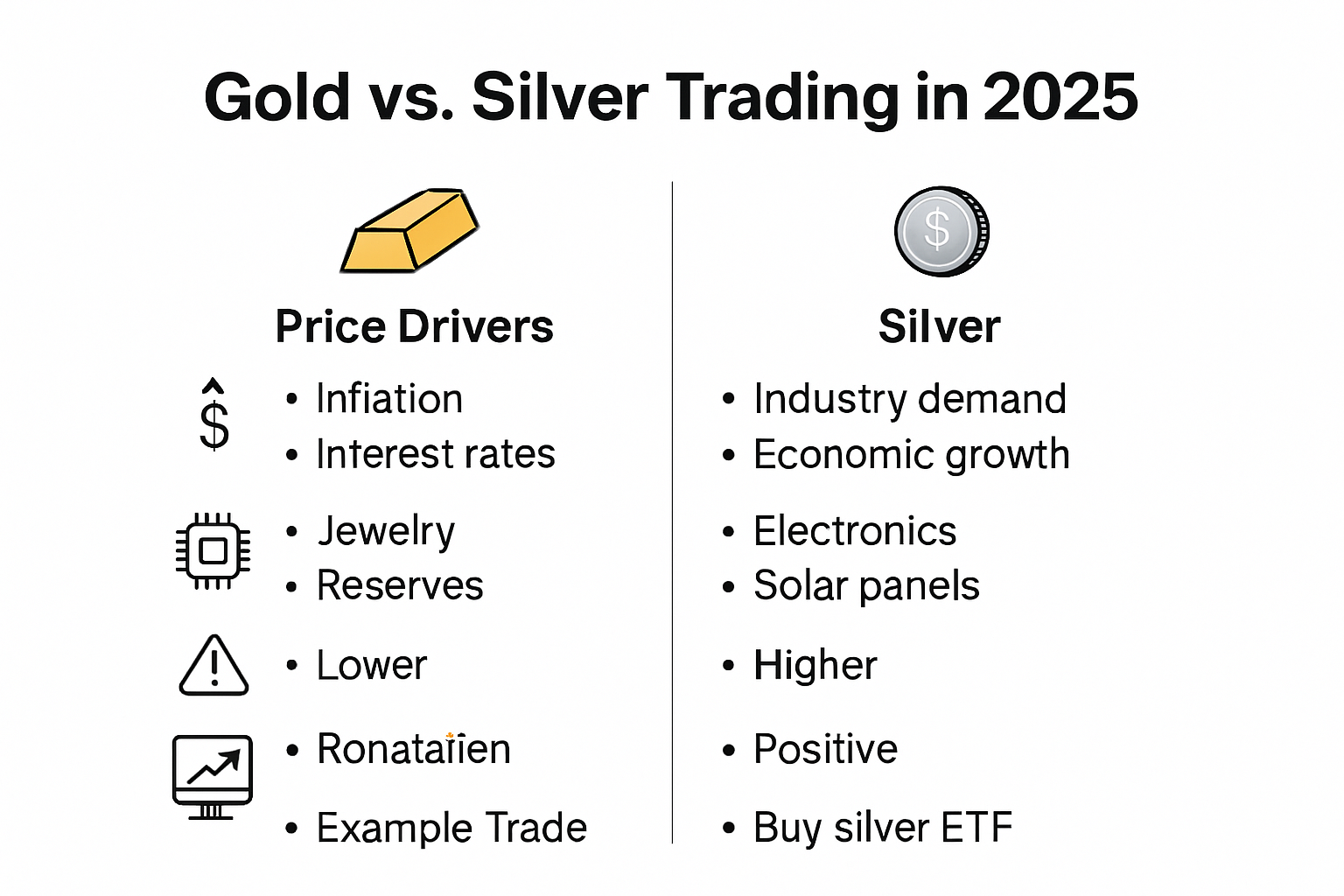
The global precious metals landscape in 2025 reveals complex interactions between gold and silver markets. The World Bank projects gold prices will rise by approximately 35%, driven by geopolitical tensions and economic uncertainty. Simultaneously, the Silver Institute forecasts a substantial market deficit, with industrial demand expected to exceed 700 million ounces for the first time.
Traders must recognize that gold and silver do not move in perfect correlation. While gold is predominantly viewed as a safe-haven asset, silver exhibits dual characteristics as both an investment and an industrial commodity. This fundamental difference creates unique trading opportunities and challenges for investors exploring gold price forecasts.
Price Ratio and Market Signals
The gold-to-silver price ratio provides critical insights into market sentiment and potential trading strategies. According to Sucden Financial, this ratio reached a five-year high of 105 in April 2025, indicating silver’s underperformance relative to gold. This divergence suggests investors should carefully analyze individual metal characteristics rather than treating them as interchangeable assets.
Key factors influencing this ratio include:
- Industrial Demand: Silver’s stronger connection to manufacturing sectors
- Economic Indicators: Global economic health and technological innovation
- Investment Sentiment: Risk appetite and monetary policy shifts
Successful traders will develop sophisticated strategies that account for these nuanced market signals, understanding that gold and silver respond differently to economic stimuli. Technical analysis, fundamental research, and real-time market monitoring become essential tools for navigating these complex precious metal markets.
Investors seeking consistent performance should consider diversifying their approach, potentially incorporating both metals into their portfolio while maintaining a strategic, data-driven perspective on their unique market behaviors.
Best Trading Strategies for Gold and Silver
Successful gold and silver trading requires sophisticated strategies that adapt to complex market dynamics and leverage unique characteristics of each precious metal. Traders must develop a comprehensive approach that combines technical analysis, fundamental research, and disciplined risk management.
Technical Analysis and Entry Points
Technical analysis serves as a critical foundation for trading gold and silver. Sophisticated traders utilize multiple indicators to identify optimal entry and exit points. Moving averages, particularly the 50-day and 200-day moving averages, provide crucial insights into long-term price trends. The Relative Strength Index (RSI) helps traders identify potential overbought or oversold conditions, signaling potential trend reversals.
For traders seeking rapid momentum strategies, scalping techniques offer dynamic opportunities to capitalize on short-term price fluctuations. These strategies require rapid decision-making and precise execution, making them suitable for experienced traders with advanced technical skills.
Fundamental Strategy and Market Signals
Beyond technical analysis, understanding fundamental market drivers becomes essential for gold and silver trading. Global economic indicators, geopolitical tensions, and monetary policies significantly influence precious metal prices. Traders must monitor key factors such as:
- Interest Rate Changes: Central bank policies directly impact precious metal valuations
- Industrial Demand: Particularly critical for silver’s market performance
- Currency Fluctuations: Especially USD strength and international monetary trends
The current market landscape suggests a strategic approach that differentiates between gold and silver trading signals. While gold remains a traditional safe-haven asset, silver demonstrates more complex market behavior driven by both investment sentiment and industrial demand.
Risk Management and Portfolio Diversification
Effective risk management represents the cornerstone of successful precious metal trading. Implementing robust stop-loss strategies, maintaining appropriate position sizes, and diversifying across different trading instruments help mitigate potential losses. Professional traders recommend allocating no more than 5-10% of total investment portfolio to precious metal trading.
Advanced traders often employ hedging techniques, using options and futures contracts to protect against market volatility. By creating multi-layered trading strategies that combine technical analysis, fundamental research, and disciplined risk management, investors can navigate the complex gold and silver markets with greater confidence.
Ultimately, success in gold and silver trading demands continuous learning, adaptability, and a comprehensive understanding of global economic dynamics. Traders who remain informed, disciplined, and strategically flexible will be best positioned to capitalize on emerging market opportunities.
Using Signals for Gold vs Silver Trading
Trading signals represent a critical tool for navigating the complex gold and silver markets, offering traders data-driven insights that can dramatically improve decision-making and investment performance. Understanding how to effectively interpret and apply these signals requires a sophisticated approach tailored to each precious metal’s unique market characteristics.
Machine Learning and Advanced Signal Generation
Research published in the Journal of Risk and Financial Management demonstrates the power of advanced signal generation techniques. Machine learning models, including random forests and gradient boosting algorithms, have shown remarkable accuracy in predicting price movements by analyzing technical indicators such as moving averages and the Relative Strength Index (RSI).
These sophisticated algorithms process vast amounts of historical and real-time market data, identifying patterns that human traders might overlook. By leveraging effective strategies for interpreting trading signals, investors can gain a significant competitive advantage in precious metal markets.
Signal Differentiation Between Gold and Silver
A comprehensive study in Mathematics highlighted the critical importance of developing distinct signal strategies for gold and silver. The research revealed that algorithmic trading systems utilizing techniques like linear regression, Darvas boxes, and Bollinger Bands can be optimized to capture the nuanced behaviors of each metal.
Key signal considerations include:
- Gold Signals: Typically more stable, focused on safe-haven asset indicators
- Silver Signals: More volatile, influenced by both industrial demand and investment sentiment
- Comparative Analysis: Tracking the gold-to-silver ratio for broader market insights
Below is a table that compares key trading and signal characteristics between gold and silver, providing a concise reference for traders to differentiate their strategies.
| Characteristic | Gold | Silver |
|---|---|---|
| Primary Role | Safe-haven asset | Investment & industrial use |
| Volatility | Lower | Higher |
| Key Market Drivers | Geopolitical tensions, interest rates | Industrial demand, investment sentiment |
| Signal Stability | More stable | More erratic |
| Price Ratio as Signal | Use for macro sentiment | Indicates under/over-performance |
| Common Trading Strategies | Trend following, mean reversion | Momentum, breakout, volatility-based |
| Influence of Machine Learning | High for pattern recognition | High for rapid price changes |
Risk Management and Signal Interpretation
Advanced research analyzing the multifractal nature of precious metal markets reveals that silver demonstrates higher market risk compared to gold. This finding underscores the importance of developing robust signal interpretation strategies that account for each metal’s unique risk profile.
Professional traders recommend a multi-layered approach to signal analysis:
- Combine multiple technical indicators
- Cross-reference signals across different timeframes
- Implement strict risk management protocols
- Continuously validate and adjust signal strategies
Successful traders understand that trading signals are not infallible predictions but probabilistic tools that require sophisticated interpretation. By developing a nuanced understanding of signal generation, traders can make more informed decisions in the dynamic gold and silver markets.
Ultimately, the most effective approach involves continuous learning, technological adaptation, and a disciplined approach to signal interpretation. Traders who invest time in understanding these complex signal generation methodologies will be best positioned to capitalize on emerging market opportunities in gold and silver trading.
Risk Management and Profit Potential
Navigating the complex landscape of gold and silver trading requires a sophisticated approach to risk management that balances potential profits with strategic protection. Successful traders understand that managing risk is not about eliminating uncertainty, but about creating robust strategies that maximize opportunities while minimizing potential losses.
Volatility and Market Dynamics
Research examining volatility transmission in precious metal markets reveals a critical insight: gold’s volatility significantly influences silver market movements. This unidirectional volatility transmission underscores the importance of developing nuanced risk management strategies that account for the intricate relationships between these two metals.
The Financial Times highlights silver’s unique market position, noting its dual role as both an industrial and investment metal contributes to higher volatility compared to gold. This characteristic offers greater profit potential but simultaneously increases trading risk. Traders must develop adaptive strategies that can capitalize on these market nuances.
Strategic Risk Mitigation Techniques
Effective risk management in gold and silver trading involves multiple layers of protection:
- Position Sizing: Limiting exposure to no more than 2-5% of total investment capital
- Diversification: Spreading investments across different precious metal instruments
- Stop-Loss Implementation: Setting precise exit points to limit potential losses
- Hedging Strategies: Using options and futures to protect against market volatility
The following table summarizes the recommended risk management techniques and their primary purposes for gold and silver trading. This table serves as a quick checklist for effective risk controls.
| Technique | Description | Primary Purpose |
|---|---|---|
| Position Sizing | Limit trades to 2-5% of capital per position | Control individual trade risk |
| Diversification | Spread investments across various instruments | Reduce overall portfolio risk |
| Stop-Loss Orders | Set predetermined exit prices for trades | Limit potential losses |
| Hedging Strategies | Use options and futures to offset potential losses | Protect against volatility |
| Portfolio Allocation | Max 5-10% of portfolio in precious metals | Avoid overexposure |
Professional traders pay special attention to the gold-silver ratio as a critical risk management tool. Recent market analysis shows this ratio fluctuating dramatically, reaching extreme points like 127 during the pandemic and stabilizing around 100, presenting unique arbitrage opportunities.
Profit Optimization Strategies
Beyond risk mitigation, successful traders focus on profit potential through sophisticated approaches. This involves:
- Continuous market analysis
- Real-time signal interpretation
- Adaptive trading strategies
- Advanced technical and fundamental research
Understanding the subtle differences between gold and silver markets becomes crucial. While gold remains a traditional safe-haven asset, silver’s more complex market behavior demands a more dynamic approach. Traders can explore advanced risk management techniques to navigate these challenging market conditions.
Ultimately, success in gold and silver trading requires a holistic approach that balances rigorous risk management with strategic profit-seeking behavior. Traders who develop sophisticated, adaptable strategies will be best positioned to capitalize on the unique opportunities presented by these precious metal markets.
Frequently Asked Questions
What is the gold-to-silver price ratio, and why is it important?
The gold-to-silver price ratio indicates the relative value of gold to silver. A high ratio, such as 105, suggests that silver is underperforming compared to gold, which may prompt traders to adjust their strategies based on this market signal.
How can I use technical analysis for trading gold and silver in 2025?
Technical analysis involves using indicators like moving averages and the Relative Strength Index (RSI) to determine optimal entry and exit points for trades. In 2025, traders should focus on long-term trends and market volatility to make informed decisions.
What are the key factors influencing gold and silver prices?
Gold prices are primarily driven by geopolitical tensions and interest rates, while silver prices are influenced by industrial demand and investment sentiment. Understanding these dynamics is critical for successful trading.
What risk management strategies should I implement when trading precious metals?
Effective risk management includes setting stop-loss orders, limiting position sizes to 2-5% of your portfolio, diversifying investments, and utilizing hedging strategies to protect against market volatility.
Tired of Uncertain Gold and Silver Trading Signals? Get the Edge That Matters
Every trader reading about gold versus silver strategies for 2025 faces a familiar problem. You see the widening gold-to-silver ratio and unpredictable market signals. It is clear that treating these metals the same can cost you real opportunities and expose you to unnecessary risk. You need precise entry points and high-probability gold trading setups that actually work in volatile conditions. If you want to level up your trading skills with actionable insights and proven techniques, start with detailed step-by-step resources in our How To Guides.
Ready for consistent profits and strategic confidence? Join our XAU/USD Gold Signals community today to access daily signals with over 90 percent accuracy and expert market analysis. Make smarter trades and manage your risk with guidance designed for 2025’s fast-changing markets. Secure your spot now while top-tier signals and expert strategies are still available.
